

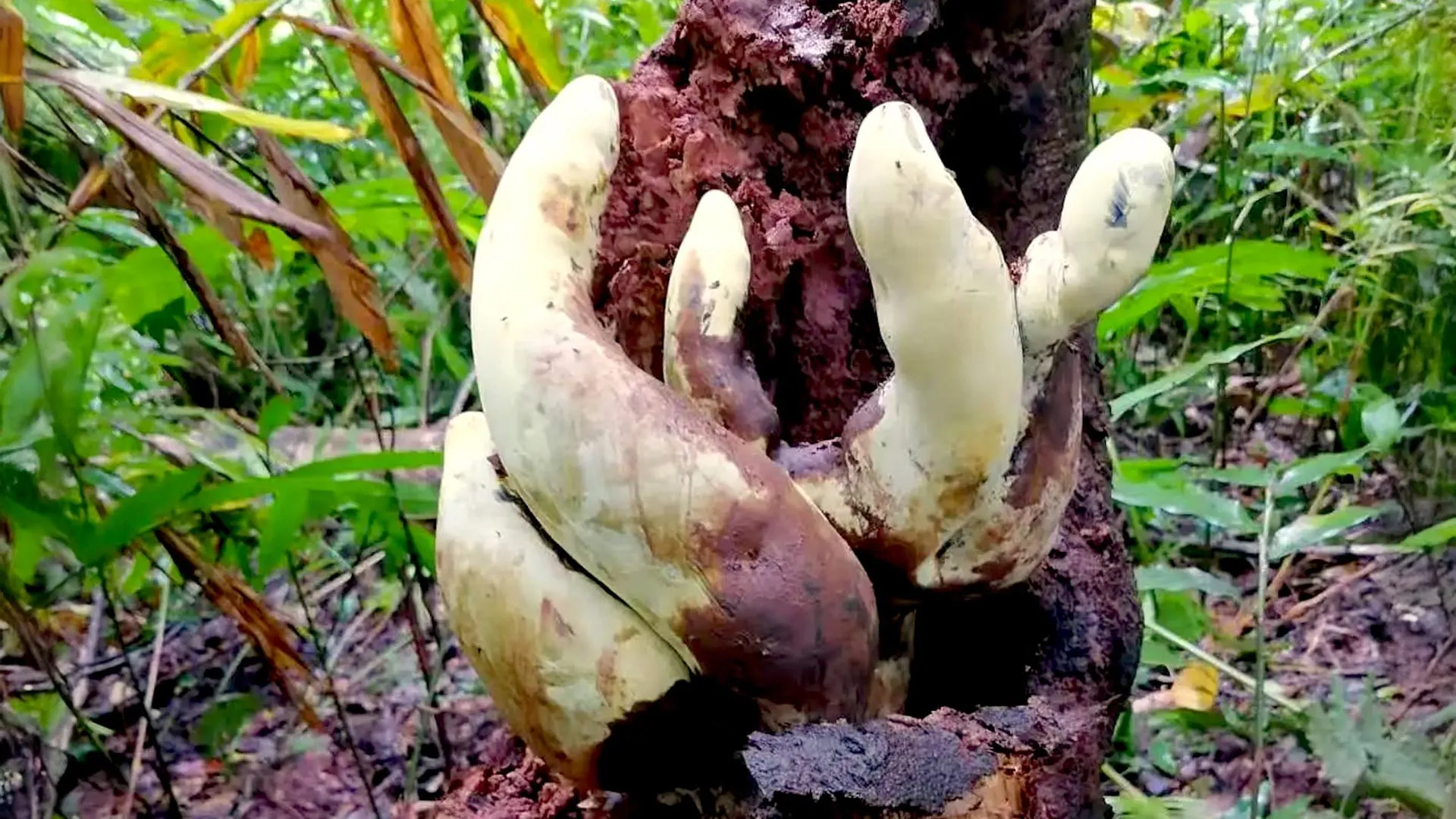
Researchers working in Yunnan Province, China, identified an extraordinary fungal species during forest surveys in temperate coniferous and tropical rainforest environments. The team encountered unusually large whitish reproductive structures, or stromata, emerging from the woody roots of Chinese cork oak trees. These structures proved to belong to a previously unknown fungal species that the scientists designated Dianjunus rex, informally nicknamed “D-rex.”
The fungus represents a significant discovery within the ascomycete group, the largest major grouping of fungi with over 64,000 recognized species. Its reproductive structures can reach heights of 50 centimeters and weigh as much as 2.2 kilograms, making them the largest known fruiting bodies among ascomycete fungi. The species proved sufficiently distinct to warrant establishment of an entirely new fungal family, Dianjunaceae, within the order Xylariales. Its closest known relative is Graphostroma platystoma, a wood-decomposing fungus found throughout the Northern Hemisphere.
Genetic analysis using molecular clock techniques revealed that the Dianjunaceae family originated approximately 65 million years ago, roughly one million years after the Cretaceous-Paleogene mass extinction that eliminated non-avian dinosaurs. Researchers propose that dramatic environmental changes following this extinction event may have created favorable ecological conditions for the ancestors of this fungal lineage, as forests experienced sudden availability of large quantities of dead plant material suitable for wood-decomposing species.
The fungus’s exceptional size remains scientifically intriguing, as the tallest previously known ascomycete fruiting bodies measured between 20 and 30 centimeters. Scientists hypothesize that the elevated reproductive structures may provide advantages for spore dispersal through dense forest vegetation via air currents, though such growth requires substantial energy investment. The discovery underscores the extent of undocumented fungal diversity within East Asian forest ecosystems, where challenging terrain, seasonal fruiting patterns, and historical research focus on economically valuable species have limited scientific documentation.
Article Attribution | Read More at Article Source
Article summary produced by Claude AI