

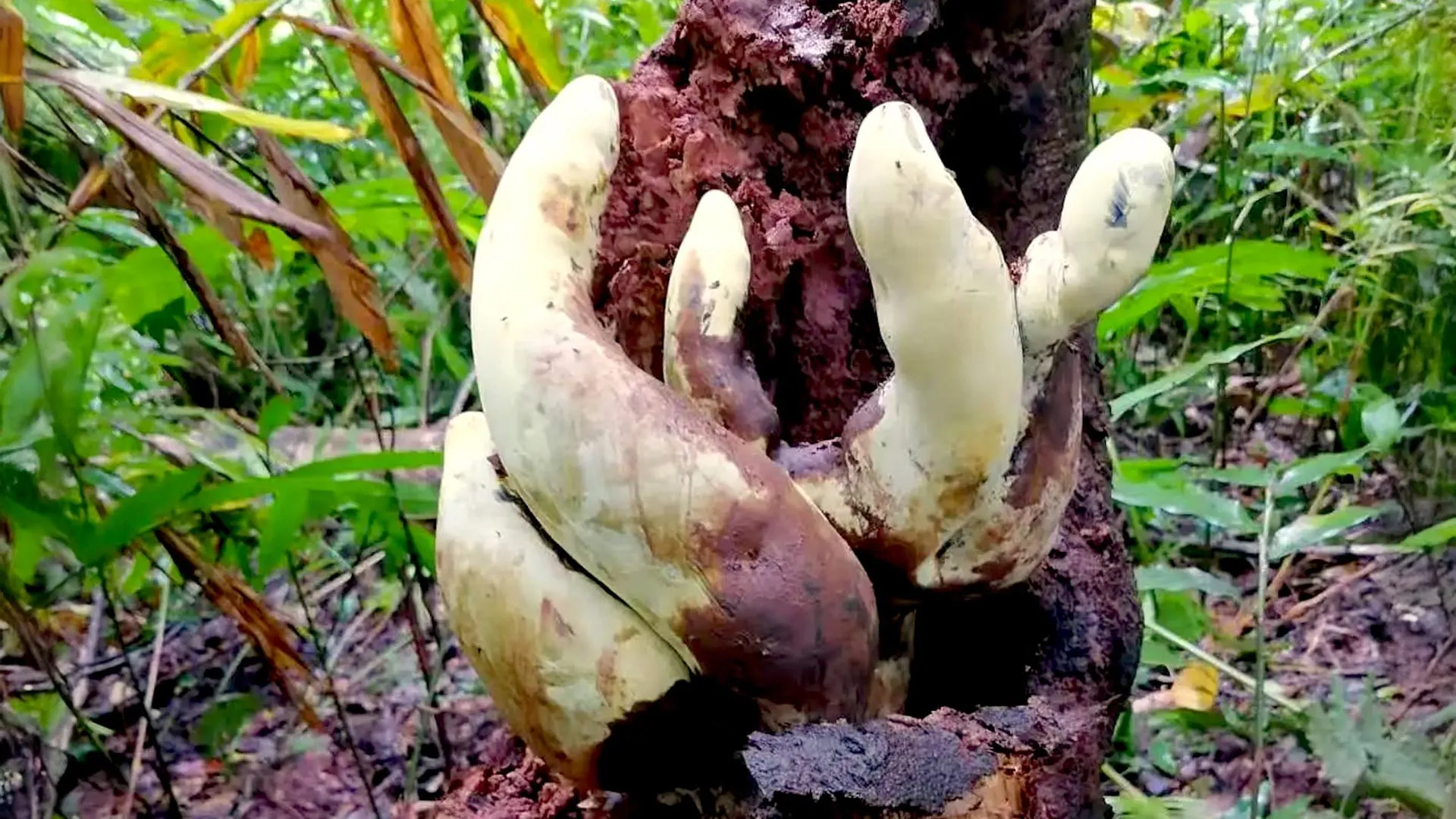
Researchers from the Kunming Institute of Botany in China identified a previously unknown fungus species while surveying forest environments in Yunnan Province. The team encountered unusually large whitish reproductive structures emerging from the roots of Chinese cork oak trees in temperate coniferous and tropical rainforest habitats. Laboratory analysis, including genome sequencing and physical examination, revealed the discovery represented not merely a new species but an entirely new genus and family within the fungal order Xylariales.
The fungus was designated Dianjunus rex, with the nickname “D-rex” referencing both its exceptional size and the ancient Dian kingdom. Its reproductive structures, called stromata, can reach 50 centimeters in height and weigh approximately 2.2 kilograms, making them substantially larger than the previously documented maximum height of 20 to 30 centimeters for related ascomycete fungi. The discovery required establishing a new fungal family, Dianjunaceae, and represents a significant addition to the roughly 64,000 recognized ascomycete species.
Genetic analysis using molecular clock techniques provided insights into the fungus’s evolutionary history. Researchers compared the specimen’s DNA with genomic data from hundreds of other fungi to estimate when the Dianjunaceae family originated. Results indicated the lineage emerged approximately 65 million years ago, roughly one million years following the Cretaceous-Paleogene mass extinction event. Scientists hypothesize that environmental upheaval from the extinction may have created ecological opportunities for wood-decomposing fungi, potentially contributing to the evolution of this unusual lineage.
The exceptional size of this fungus’s fruiting bodies likely evolved as an adaptation for spore dispersal in dense forest environments. By extending well above ground vegetation and debris, the reproductive structures may achieve more effective wind dispersal of spores. However, such growth requires substantial energy investment, suggesting this strategy would only become advantageous where ecological benefits substantially exceeded resource costs.
The discovery underscores the extent of undocumented fungal diversity within China’s subtropical forests. Researchers note that the region’s habitat diversity, climatic stability, and complex biological interactions create conditions favorable for fungal speciation. Continued exploration of these ecosystems, particularly in remote areas with challenging terrain, may reveal additional previously unknown species and evolutionary histories.
Article Attribution | Read More at Article Source
Article summary produced by Claude AI