

While a day is commonly understood to last precisely 24 hours, Earth’s rotation speed is not entirely constant. Scientists have detected variations measured in milliseconds, with certain days becoming marginally shorter or longer due to ongoing changes within the planet’s interior.
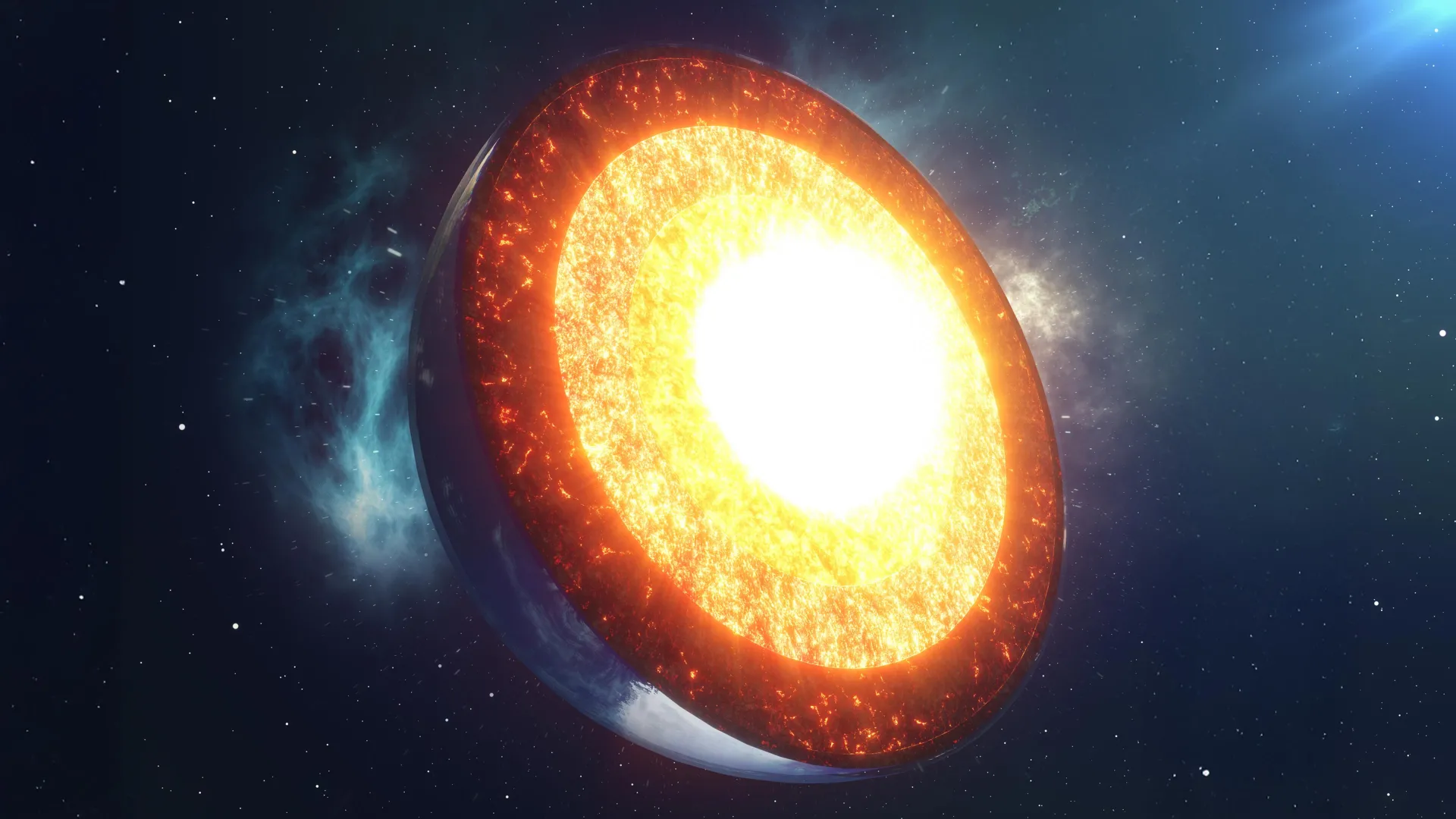
For approximately three decades, researchers have observed that Earth’s liquid core does not rotate uniformly. The planet’s magnetic field data indicates the liquid core experiences cyclical variations, accelerating gradually over several decades before decelerating in subsequent periods. Simultaneously, the mantle—the approximately 3,000 kilometer thick rocky layer encompassing the crust—responds inversely to these shifts. When the core accelerates, the mantle decelerates slightly, and vice versa. This reciprocal pattern occurs because Earth’s total angular momentum remains constant throughout these exchanges.
Physicists previously lacked a clear explanation for the mechanism underlying this momentum transfer between core and mantle. A recent study published Sept. 23 in Nature by University of Alberta researchers Huifeng Zhang and Mathieu Dumberry proposes a solution. Their research demonstrates that variations in the rotational velocity of Earth’s inner core—the solid region at the planet’s center—generate a phenomenon termed “gravitational torque.” Since the inner core lacks perfect spherical symmetry, fluctuations in its motion interact gravitationally with irregular mass distributions throughout the mantle, thereby modulating the mantle’s rotational speed and producing measurable changes in day length.
At the core-mantle boundary, an additional force operates in opposition to these gravitational effects. This boundary torque mechanism generates friction and electromagnetic resistance that counteract gravitational influence, effectively limiting the magnitude of day-length variations. The researchers attribute the observed fluctuations in day length to periodic shifts in equilibrium between gravitational torque and core-mantle boundary torque.
Beyond resolving this longstanding scientific puzzle, the findings reveal that Earth’s innermost layer behaves far more dynamically than its solid composition would suggest. Zhang and Dumberry’s research indicates the inner core undergoes “viscous deformation” on a timescale of approximately 10 years, implying Earth’s deepest interior undergoes substantial shape changes and responds to internal forces with greater fluidity than previously understood.
Article Attribution | Read More at Article Source
Article summary produced by Claude AI