

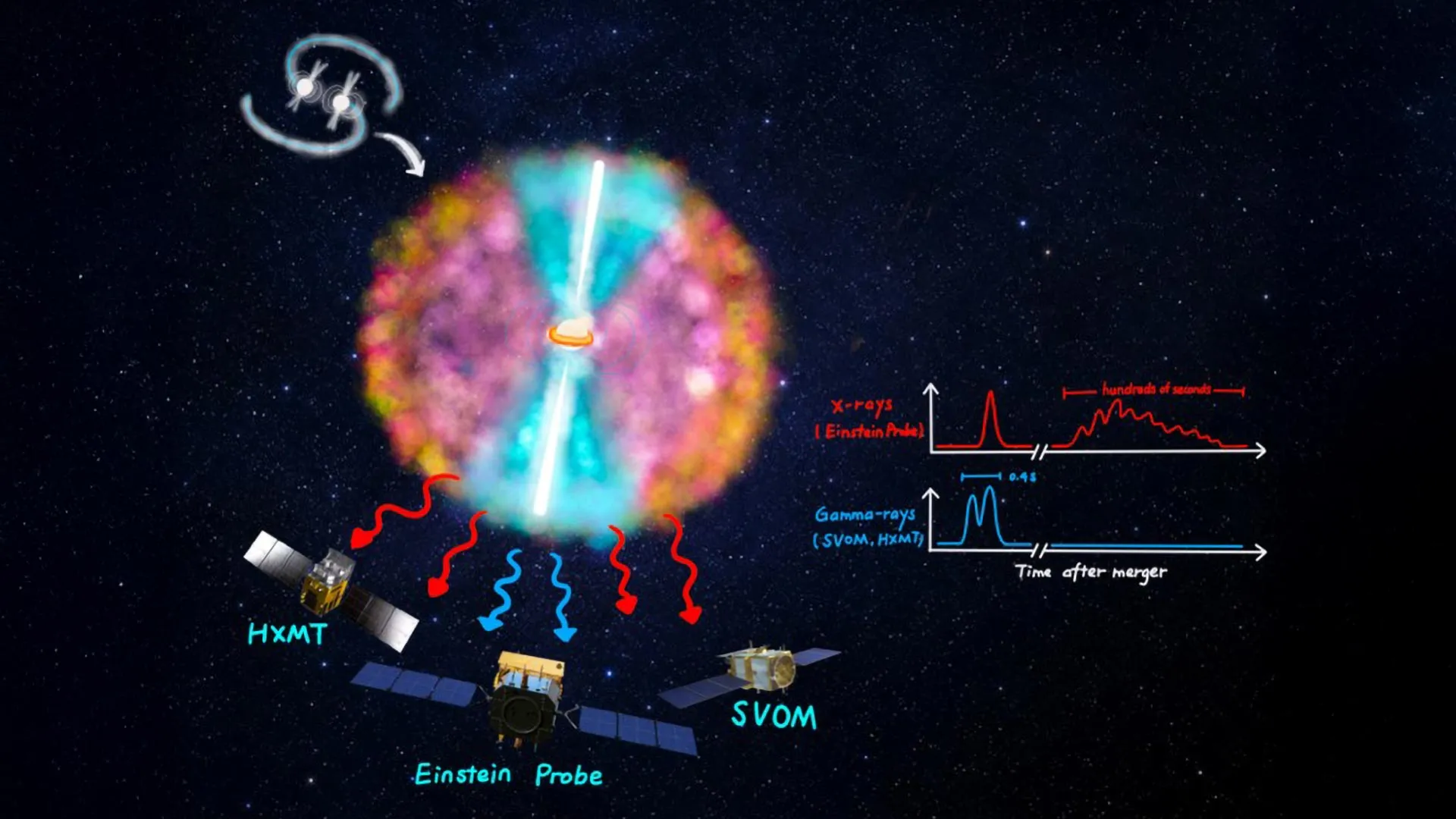
Astronomers using the Einstein Probe space observatory have identified an unusual burst event designated EP250704a/GRB 250704B that occurred on July 4, 2025. The initial observation appeared to be a standard short gamma-ray burst, characterized by a brief bright flash lasting less than half a second. However, follow-up analysis revealed that the source continued emitting soft X-rays for approximately ten minutes after the initial flash had ceased.
Short gamma-ray bursts are thought to result from the collision and merger of compact objects such as neutron stars. These events rank among the most energetic explosions observed in the universe and produce gravitational waves. Traditionally, astronomers have detected these bursts primarily through their gamma-ray emissions, as the earliest soft X-ray phase has been difficult to observe with conventional instruments. Most existing X-ray telescopes require gamma-ray alerts to identify and locate a burst before reorienting their instruments. The Einstein Probe’s continuous wide-field soft X-ray monitoring capabilities enabled scientists to detect this previously unobserved stage.
The extended X-ray activity carried significant energy but occurred at wavelengths that conventional gamma-ray instruments would have failed to register. Researchers organized a comprehensive international observational campaign using X-ray, optical, and radio wavelengths to characterize the event. Analysis indicated that the prolonged X-ray emission originated from the merger remnant rather than the outward-propagating blast wave. Spectroscopic observations helped researchers identify the burst’s host galaxy and measure its distance while ruling out an associated supernova.
Investigators propose that the merger likely produced a rapidly rotating, highly magnetized neutron star known as a magnetar, which powered the extended X-ray emission and maintained continued energy injection into the system. This explanation accounts for the sustained activity following the brief initial gamma-ray flash. Researchers suggest that similar extended soft X-ray activity may accompany other short gamma-ray bursts but may have remained undetected by earlier missions incapable of capturing prompt emissions below gamma-ray energies.
The findings hold significance for gravitational-wave astronomy and may help constrain models of neutron star properties. Since joint electromagnetic and gravitational-wave detections from merging neutron stars began in 2017, scientists have sought additional electromagnetic signals revealing the physical processes during and immediately following these extreme events. The newly discovered soft X-ray component represents a potential new probe for identifying electromagnetic counterparts to gravitational-wave sources, expanding the toolkit for multi-messenger astronomy.
Article Attribution | Read More at Article Source
Article summary produced by Claude AI