

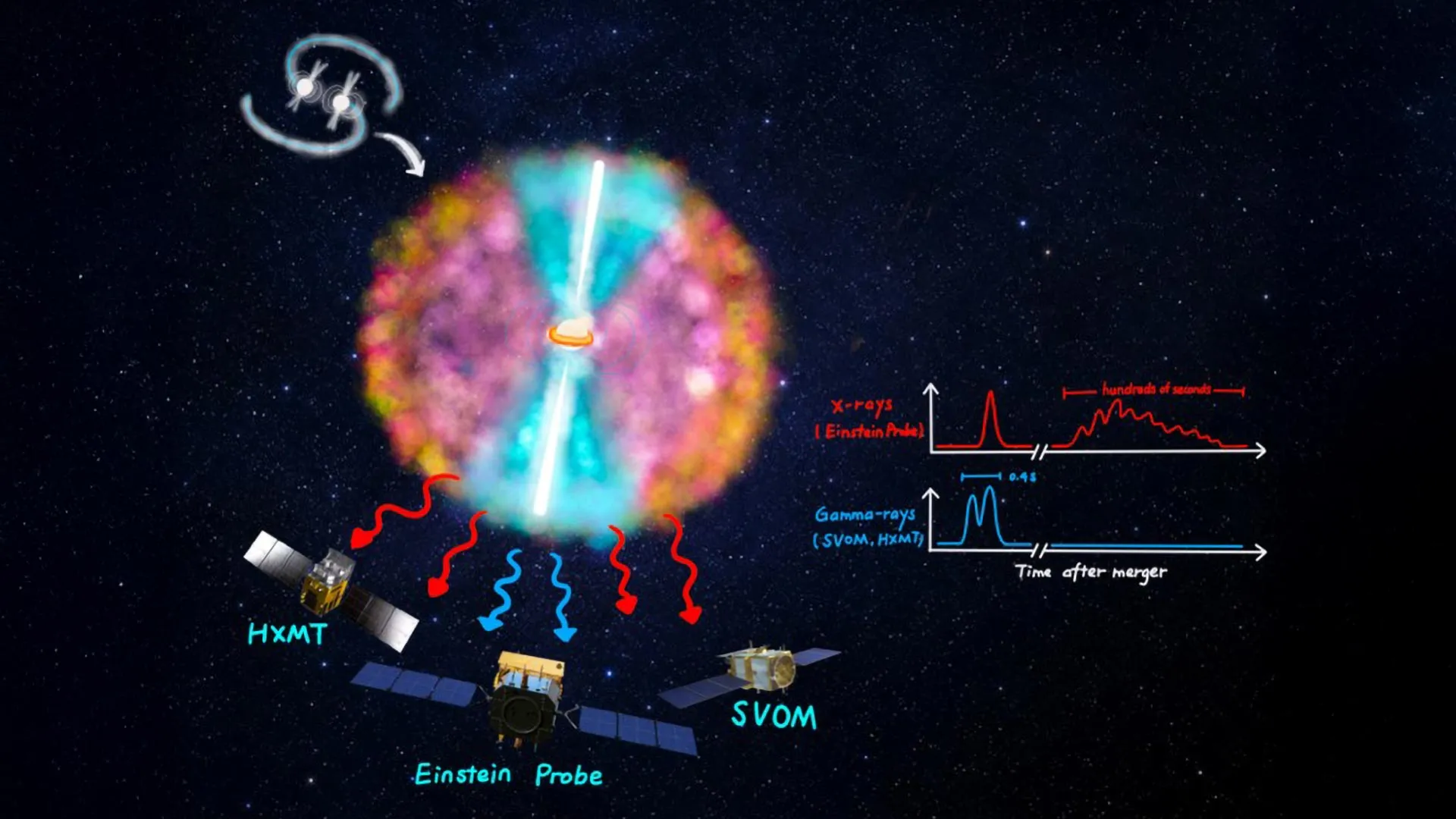
Astronomers using the Einstein Probe space telescope have identified a previously unobserved phase of neutron star collision events through detection of extended soft X-ray emissions. Short gamma-ray bursts, caused by merging compact objects such as neutron stars, have historically been studied primarily through their initial gamma-ray flashes, which last less than a second. However, conventional narrow-field X-ray instruments typically require gamma-ray alerts to locate these bursts before directing their observations.
The discovery came on July 4, 2025, when Einstein Probe detected an event designated EP250704a/GRB 250704B. While the burst initially appeared typical, with a gamma-ray flash lasting under half a second detected simultaneously by multiple instruments, the subsequent X-ray observations proved remarkable. The source continued emitting soft X-rays in distinct episodes for approximately ten minutes, far outlasting the initial explosion. This extended emission was energetic but occurred at wavelengths that would have eluded detection by conventional gamma-ray instruments, explaining why earlier missions had missed this activity.
To characterize the unusual signal, researchers coordinated an extensive international follow-up campaign using observations across X-ray, optical, and radio wavelengths. These multiwavelength observations identified the burst’s host galaxy, measured its distance through spectroscopic analysis, and ruled out an accompanying supernova. The analysis indicated that the extended X-ray activity originated from the merger remnant rather than from the expanding blast wave of the initial explosion.
The findings suggest that the merger produced a rapidly rotating, highly magnetized neutron star known as a magnetar, which could explain the prolonged X-ray emission and continued energy injection long after the initial gamma-ray phase concluded. Researchers indicate that similar soft X-ray components may accompany other short GRBs but have gone undetected due to instrumental limitations of previous missions. This discovery establishes soft X-ray emission as a new electromagnetic counterpart to gravitational-wave sources from compact object mergers and demonstrates Einstein Probe’s capability to reveal transient phenomena previously hidden from observation.
Article Attribution | Read More at Article Source
Article summary produced by Claude AI