

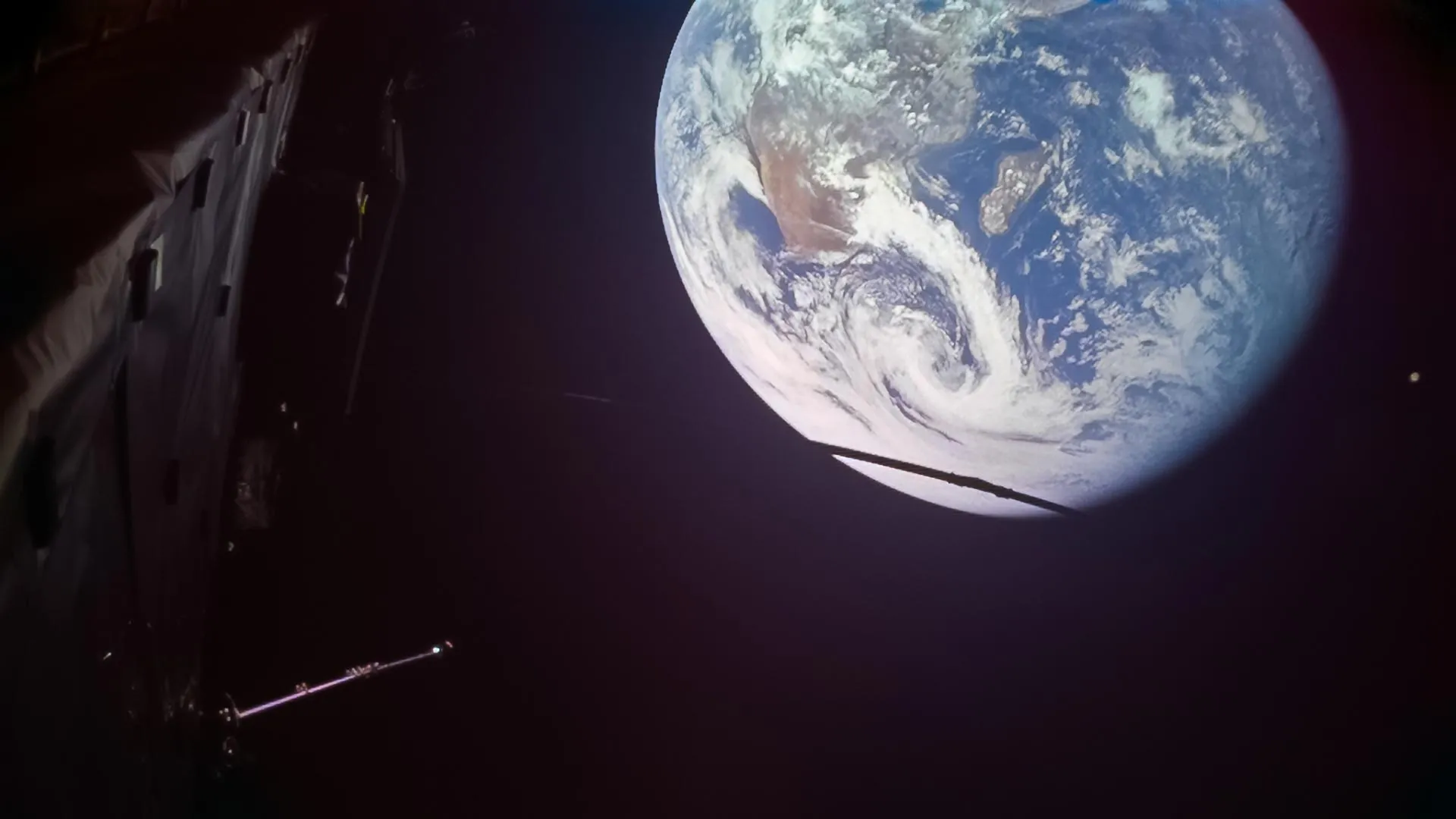
The European Space Agency’s Jupiter Icy Moons Explorer completed a planned gravitational assist near Earth earlier this week, marking a significant milestone in its journey to the outer solar system. The spacecraft made its closest approach at an altitude of 8640 kilometers above the Indian Ocean, where it captured images using onboard cameras. The maneuver successfully altered Juice’s trajectory by 20 degrees relative to its previous path and increased its velocity by 3.5 kilometers per second, all while requiring minimal fuel consumption.
Mission controllers demonstrated precise navigation capabilities throughout the encounter, requiring only one minor course correction out of six contingency opportunities that had been planned. The efficiency of the approach preserved propellant reserves that will prove essential during the spacecraft’s later scientific operations. Controllers initiated intensive monitoring of Juice in mid-August and will maintain heightened tracking activities through early October.
Beyond its primary purpose as a trajectory modifier, the Earth flyby served as a valuable testing ground for Juice’s 10 scientific instruments. Teams coordinated extensively to calibrate and validate the instruments under well-understood environmental conditions before the spacecraft reaches its ultimate destination. This represented the third such opportunity during the mission, following a lunar-Earth gravity assist in 2024 and comet observations in 2025. Scientists prioritized calibration activities based on their relevance to future observations of Jupiter’s moons.
During the encounter, Juice also collected data while traversing Earth’s magnetotail, the extended magnetic field region stretching away from the sun. Measurements from Juice combined with simultaneous observations from the European-Chinese Smile mission may provide scientists with unique insights into connections between deep magnetotail activity and polar region phenomena. The spacecraft is scheduled to return for a final Earth flyby in January 2029 before reaching Jupiter in 2031, where it will conduct 35 planned flybys of the moons Ganymede, Callisto, and Europa.
Article Attribution | Read More at Article Source
Article summary produced by Claude AI