

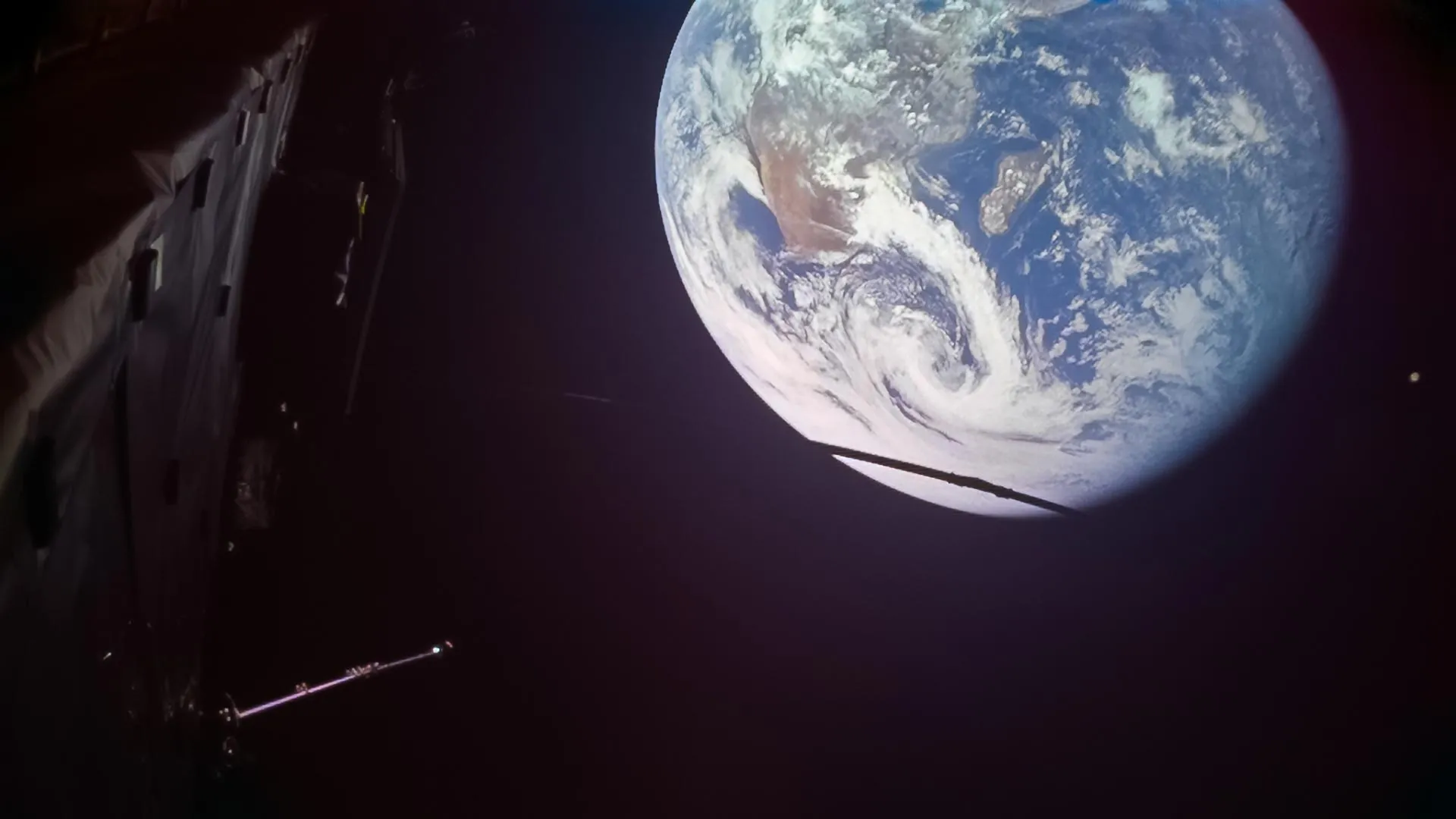
The European Space Agency’s Jupiter Icy Moons Explorer conducted a close approach to Earth on September 28, executing a precisely planned gravity assist maneuver. The spacecraft passed approximately 8,640 kilometers above the Indian Ocean at its closest point, allowing the mission to alter Juice’s trajectory by 20 degrees relative to its previous path and increase its velocity by 3.5 kilometers per second. Mission controllers demonstrated exceptional navigation accuracy by requiring only one minor course correction out of six pre-planned opportunities to position the spacecraft optimally for the gravitational interaction.
Beyond trajectory modification, the Earth encounter served as a critical testing ground for Juice’s scientific capabilities. The spacecraft’s 10 onboard instruments were activated to collect calibration data and validate their performance using Earth as a known reference target. This represented the third such opportunity during the mission’s journey, following earlier instrument testing during a lunar-Earth gravity assist in 2024 and observations of Comet 3I/ATLAS in 2025. Coordinating the timing and operation of various instruments required extensive collaboration among ESA’s technical teams and external science groups responsible for the instruments.
The gravity assist preserved propellant reserves that will prove essential for Juice’s primary mission objectives at Jupiter. The spacecraft is designed to conduct 35 flybys of Jupiter’s large moons—Ganymede, Callisto, and Europa—requiring precise maneuvering and fuel reserves for scientific operations. By successfully minimizing fuel consumption during the Earth encounter through careful planning and navigation, the mission maximized resources available for the ambitious observational campaign planned for the Jovian system.
Juice will return to Earth for a third and final gravity assist in January 2029 before continuing to Jupiter, where it is scheduled to arrive in 2031. The spacecraft also collected magnetic field and particle measurements while passing through Earth’s magnetotail, providing data that scientists plan to coordinate with simultaneous observations from the European-Chinese Smile mission. Detailed images and spectra from Juice’s instruments are expected to be released in coming weeks after data transmission and preliminary analysis by instrument teams.
Article Attribution | Read More at Article Source
Article summary produced by Claude AI