

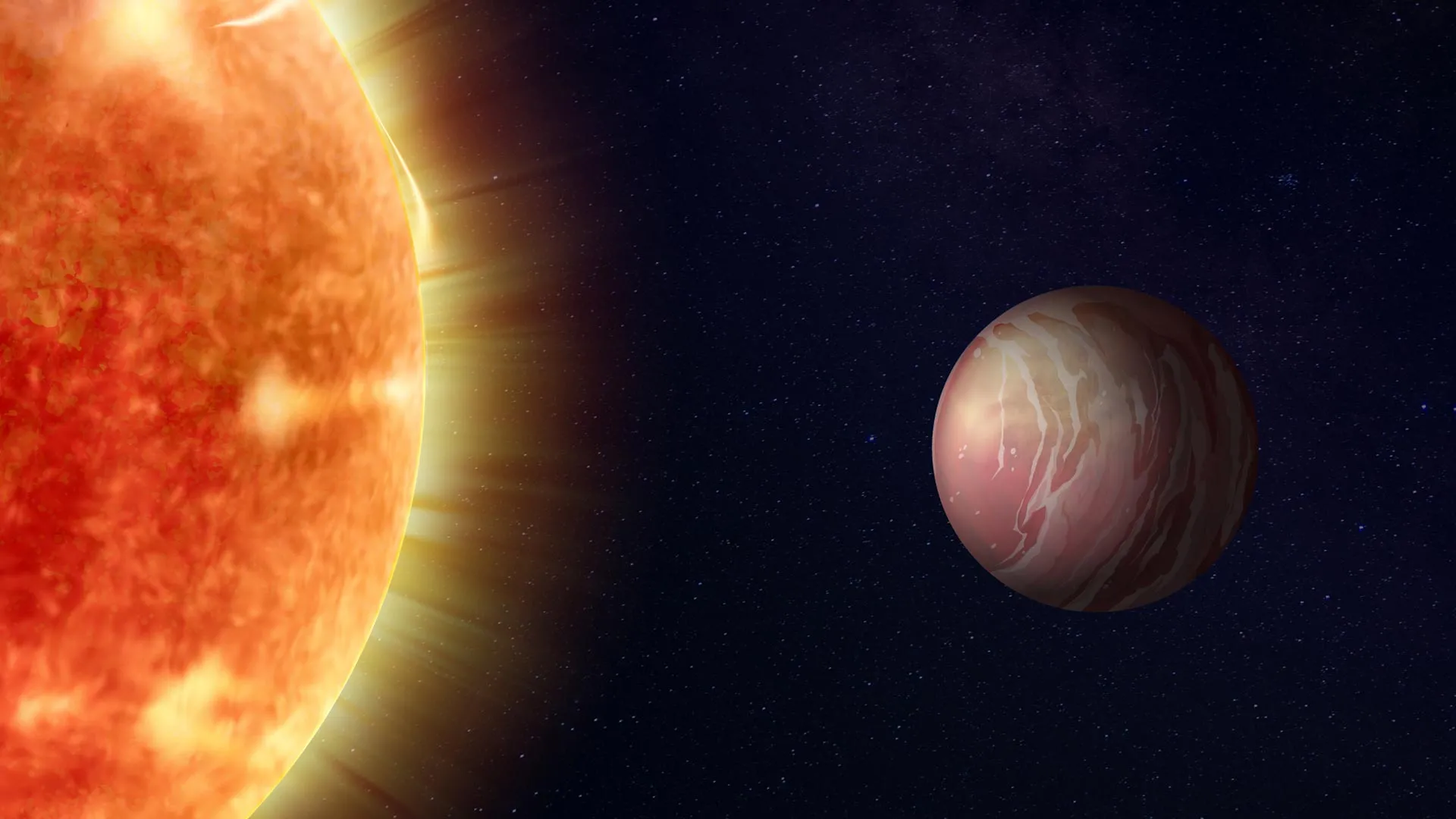
An international research team has identified evidence that a rocky exoplanet covered in molten lava maintains a substantial atmosphere despite conditions once thought too harsh for one to survive. The planet, designated TOI-561 b and positioned approximately 280 light-years from Earth, was observed continuously over 37 hours by scientists using the James Webb Space Telescope, capturing nearly four complete orbits around its host star. The findings were published in The Astronomical Journal by researchers including Dr. Anjali Piette from the University of Birmingham.
Data from the observations indicate that TOI-561 b reflects approximately 75% of the starlight that reaches it, a reflectivity level comparable to Venus. Earlier temperature measurements had puzzled researchers, as the dayside of the planet was considerably cooler than predicted for a dark rocky world orbiting so close to its star. Nightside observations revealed insufficient heat to account for the missing energy, suggesting that substantial portions of incoming radiation were either being redirected toward the dark hemisphere or bounced back into space before reaching the surface.
Research simulations point to a layer of silicate mineral clouds as the likely source of this reflectivity. These clouds, potentially composed of silicon dioxide and magnesium silicate, may form above the dayside and function as a reflective barrier. The atmosphere itself also appears to distribute heat from the illuminated side toward the perpetually dark hemisphere, further moderating surface temperatures on the sunlit portion of the world.
Scientists remain uncertain about the precise atmospheric composition of TOI-561 b. Possibilities include a thick carbon dioxide layer similar to Venus’s atmosphere but at far higher temperatures, or an atmosphere dominated by sulfur dioxide gas, which is released through volcanic activity on Jupiter’s moon Io. One compelling hypothesis proposes that the planet’s global ocean of molten rock acts as a continuous source of atmospheric gases, potentially explaining how the world has retained an atmosphere despite billions of years of intense stellar radiation.
Researchers plan additional observations at longer wavelengths using JWST to determine the atmosphere’s chemical makeup and clarify whether TOI-561 b more closely resembles an extremely hot Venus or an intensified version of the volcanic moon Io. These future studies may help resolve the fundamental mystery of how a planet subjected to such extreme conditions has managed to maintain and sustain its atmosphere over such extended timescales.
Article Attribution | Read More at Article Source
Article summary produced by Claude AI