

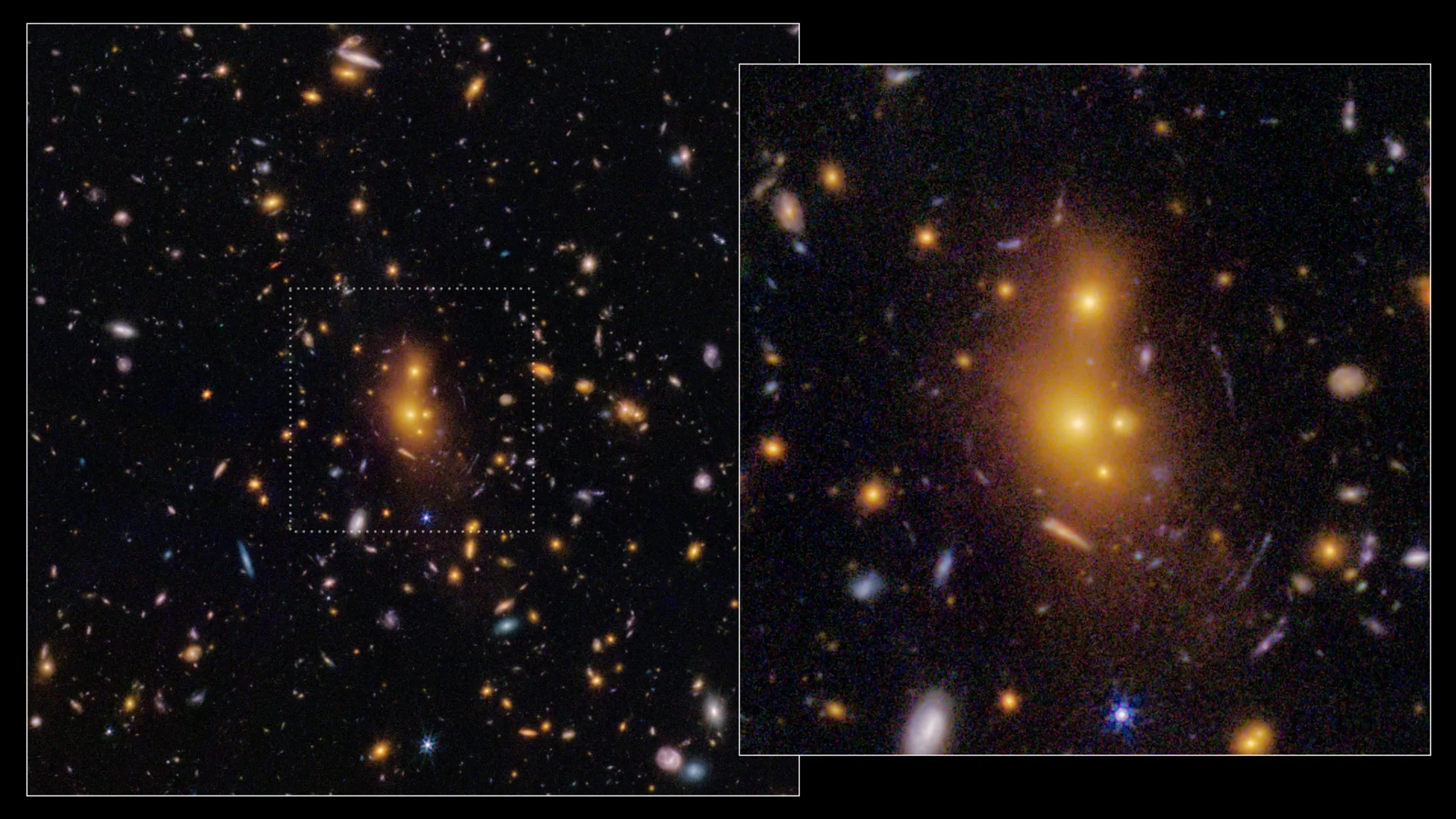
Observations from NASA’s James Webb Space Telescope have revealed a galaxy cluster called XLSSC 122 that is challenging astronomical understanding of structure formation in the early universe. Located approximately 10.4 billion light-years from Earth, the cluster existed during an era when the universe was undergoing its most intense period of star formation, a timeframe known as cosmic noon. Despite its ancient origins, the cluster exhibits an unexpectedly mature structure and mass concentration inconsistent with standard cosmological predictions about how massive structures should develop gradually over time.
The research, conducted by scientists at IPAC and presented on June 17, 2026, at the American Astronomical Society meeting, demonstrates that XLSSC 122 holds a distinction as the most distant galaxy cluster known to exhibit strong gravitational lensing. This phenomenon occurs when the cluster’s powerful gravity bends and distorts light from even more distant galaxies positioned behind it. Lead researcher Kyle Finner noted that the gravitational lensing provides an exceptionally precise tool for measuring how mass is distributed throughout the cluster and testing cosmological theories.
The cluster was originally identified in 2014 through X-ray observations, with subsequent Hubble Space Telescope measurements confirming its distance and unexpectedly developed appearance. However, the distinctive curved light arcs indicating strong gravitational lensing were not definitively detected until JWST observations. Scientists determined that dark matter, an invisible substance undetectable through direct observation but whose gravitational effects are well-established, accounts for most of the gravitational distortion. This dark matter composition provides researchers with an important method to understand cosmic structure development since the Big Bang.
Additional analysis using weak gravitational lensing, combined with X-ray and radio observations, revealed that XLSSC 122 is still undergoing a merger process, with galaxies continuing to combine as the larger structure develops. The three coordinated research papers provide comprehensive insight into this unusual cluster’s properties and offer new perspectives on galaxy cluster formation during the universe’s early epochs, potentially suggesting that some cosmic structures formed more rapidly than current models predict.
Article Attribution | Read More at Article Source
Article summary produced by Claude AI