

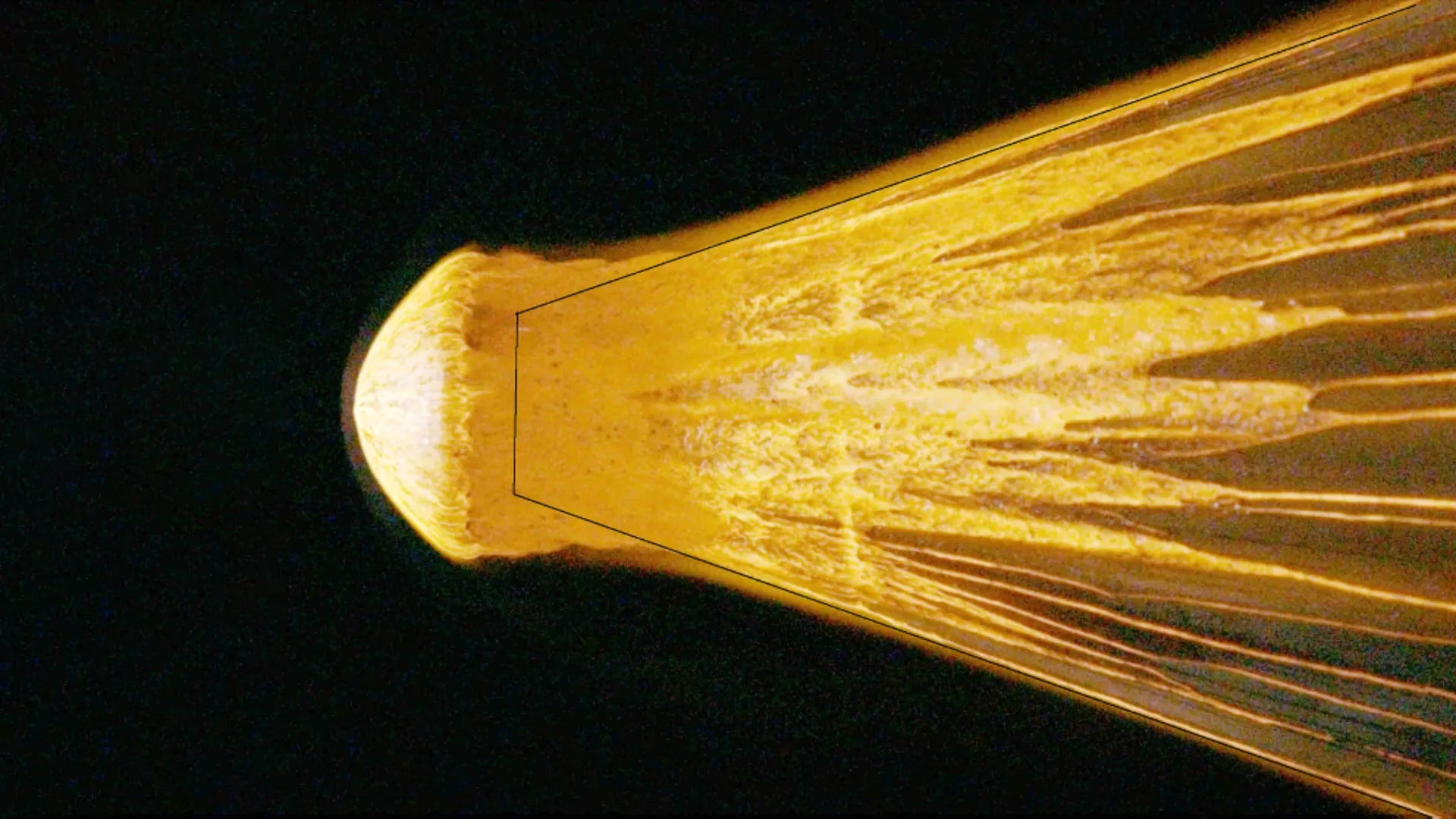
Researchers studying atmospheric entry of meteorites have developed a comprehensive model describing seven distinct phases that space rocks undergo as they descend through Earth’s atmosphere, according to findings published in Meteoritics & Planetary Science. The study, led by Dr. Peter Jenniskens of the SETI Institute and NASA Ames Research Center, examined video recordings and photographs of 75 documented meteorite falls to better understand the physical processes governing their transformation.
The research challenges previous assumptions about how meteorites lose mass during atmospheric entry. Scientists previously believed that extreme heat and radiation caused solid rocks to evaporate, but the new analysis reveals that melting and fragmentation are the dominant mechanisms. The journey begins in Phase 1 when incoming rocks generate shock waves in the upper atmosphere, producing the visible streaks known as meteors. As rocks descend into denser air during Phase 2, brightness intensifies, sometimes with repeating fluctuations that reveal rotation rates between 0.5 and 5 seconds for the fastest-spinning objects. By Phase 3, the meteor becomes a fireball, and melting emerges as the primary mass-removal process, with molten material stripped away by intense airflow.
The research identifies a critical transition at Phase 5, approximately 60 kilometers altitude, where increasing air pressure causes rocks to fragment. A surprising discovery was that rocks begin breaking apart at pressures far lower than expected—roughly one-fifth the strength of recovered meteorites. Researchers attribute this early fragmentation to atmospheric heating and pre-existing cracks from collisions in space. The shape of the surviving rock influences fragment distribution, with intact rear sections creating pressure voids that draw smaller pieces downwind.
Phase 6 occurs when the rear portion finally fractures, producing bright flares and scattering fragments at higher relative speeds. These final flashes typically appear red due to the meteor’s reduced velocity. By Phase 7, surviving pieces experience continued melting and deceleration until light production ceases, leaving a fusion crust on their surfaces before landing. The findings provide insights into asteroid behavior and how different materials respond to atmospheric entry conditions.
Article Attribution | Read More at Article Source
Article summary produced by Claude AI