

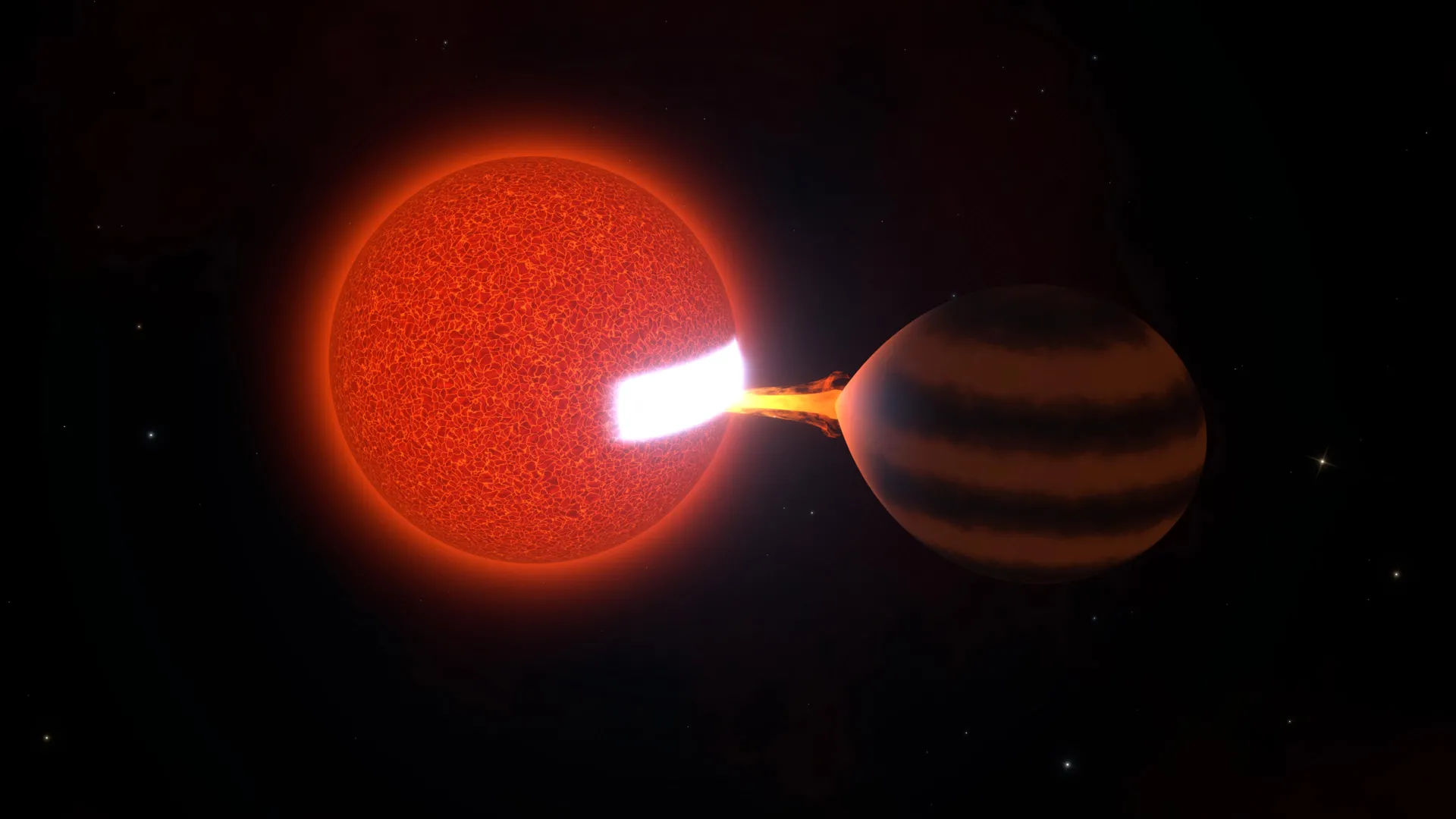
An international research team led by MIT scientists has identified an unusual stellar system designated ZTF J0440+2325 located approximately 300 light-years from Earth. The system contains a low-mass star that is steadily drawing material from a brown dwarf companion—an object more massive than a typical planet but unable to sustain the hydrogen fusion that powers ordinary stars. Unlike the dramatic events typically observed in astronomy where stars rapidly consume planetary companions or the stable orbits found in most planetary systems, this represents a middle ground where material transfer occurs so gradually that the process could continue for hundreds of thousands of years or potentially even billions of years.
The discovery emerged from observations made by the Zwicky Transient Facility, an astronomical survey that monitors changes in celestial objects’ brightness. Several years ago, researchers examining ZTF data noticed an unusual repeating pattern in brightness changes that resembled triangular waveforms rather than the typical smooth curves associated with stellar explosions or other cosmic events. Initially, scientists considered whether the signal might originate from a black widow binary system—a configuration where a neutron star strips material from a smaller companion. However, the observed motion did not match the pronounced dynamics typically associated with such systems.
Through further investigation using multiple telescopes, researchers determined that the system contained two relatively low-mass objects orbiting each other at an extremely close distance. The central star possesses approximately 85 times the mass of Jupiter, while the brown dwarf companion weighs roughly 25 Jupiter masses. The brown dwarf completes one full orbit around its host star in just 87 minutes. The research team, which included scientists from MIT, Caltech, the University of Hawaii, institutions in Spain, and the Harvard-Smithsonian Center for Astrophysics, published their findings October 5 in Nature Astronomy, documenting the first observed example of a low-mass star steadily feeding on another low-mass object in this manner.
According to MIT physicist Kevin Burdge, this discovery provides an alternative scenario to the violent endings typically associated with stellar interactions. Rather than a star rapidly consuming a companion—as Earth will experience when the Sun eventually becomes a red giant—this system demonstrates that a star can gradually feed on its companion across an extraordinarily extended timescale, fundamentally altering understanding of possible long-term stellar relationships.
Article Attribution | Read More at Article Source
Article summary produced by Claude AI