

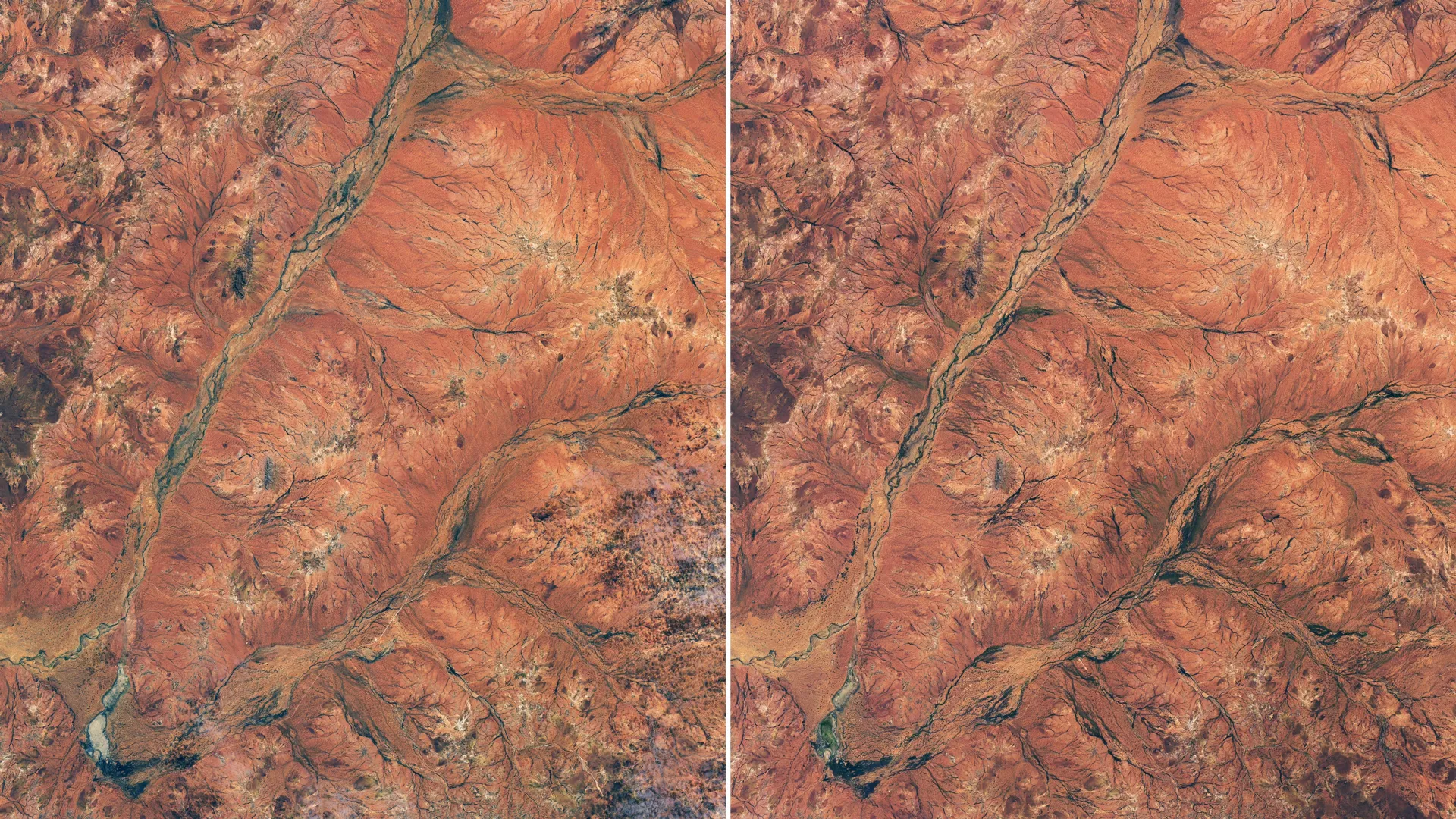
Satellite imagery from NASA’s Landsat 8 satellite documented a striking change in vegetation across a remote region of Western Australia’s outback between late August 2025 and late August 2026. The Murchison region, located approximately 600 kilometers north of Perth, experienced a remarkable wildflower explosion following months of unusually heavy rainfall. According to Australia’s Bureau of Meteorology, above-average rainfall in June and significantly wetter-than-normal conditions in August created ideal circumstances for dormant seeds to germinate across the landscape.
The transformed terrain typically consists of hardy plants adapted to arid conditions, including grasses, saltbush, and mulga trees, which thrive in areas with limited precipitation. The cold fronts that brought moisture to the region in late winter 2026 awakened wildflower seeds that had remained inactive in the dry soil, producing an extraordinary variety of colorful blooms. Local experts characterize this wildflower season as potentially the most impressive the area has experienced in nearly two decades. The botanical display extended into the grounds of the Commonwealth Scientific and Industrial Research Organisation’s Murchison Radio-astronomy Observatory, where several threatened plant species were among the flowering vegetation.
The observatory, officially known as Inyarrimanha Ilgari Bundara, operates as a radio astronomy research facility dedicated to detecting celestial radio signals and studying the universe. Its remote location within a designated radio quiet zone proves essential for sensitive astronomical observations, as the isolation helps minimize electromagnetic interference from human technology. While the wildflower spectacle unfolded at ground level, the facility’s antenna arrays continued their regular work scanning the distant cosmos. Australia’s radio astronomy infrastructure has supported numerous NASA missions historically, including contributions to the Mariner 2 mission in 1962, the Apollo 11 Moon landing in 1969, and more recently the Artemis II mission in April 2026.
Article Attribution | Read More at Article Source
Article summary produced by Claude AI