

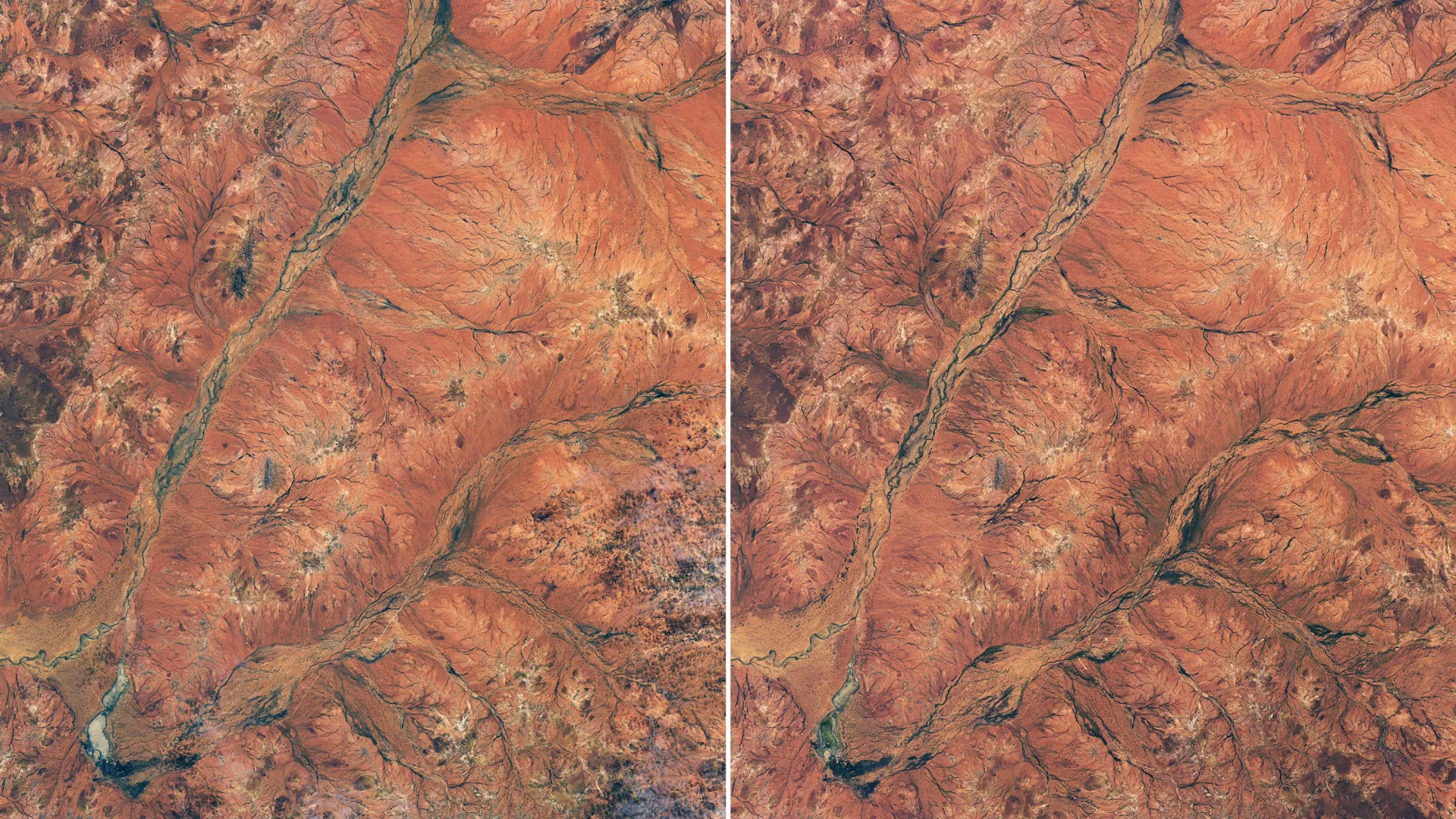
A striking seasonal display has emerged across Western Australia’s arid landscape, with satellite imagery documenting the transformation of the normally dry Murchison region northeast of Perth. The comparison of NASA Landsat 8 satellite images taken in late August 2025 and late August 2026 reveals extensive increases in vegetation coverage. Scientists attribute this exceptional flowering event to a series of cold fronts that brought above-average rainfall during June and well above-normal precipitation in August, creating conditions that allowed dormant seeds to germinate across the landscape.
The region, approximately 600 kilometers north of Perth, is typically characterized by hardy vegetation adapted to arid conditions, including grasses, saltbush, and mulga trees. While wildflowers periodically emerge in the area, their abundance fluctuates significantly based on rainfall patterns. The display extended across the grounds of a research facility operated by Australia’s national science agency, and notably included several species classified as threatened, adding ecological significance to the seasonal event.
The colorful transformation occurred at the Inyarrimanha Ilgari Bundara, a CSIRO radio astronomy observatory dedicated to studying celestial phenomena through radio telescope arrays. The facility’s remote location within a designated radio quiet zone is essential for its scientific work, as isolated settings reduce electromagnetic interference that could compromise sensitive astronomical observations. The unusual wildflower bloom provided a striking contrast to the observatory’s primary mission of detecting distant radio signals from space.
Australia’s radio astronomy infrastructure has contributed substantially to NASA’s space exploration efforts across several decades. The Murriyang telescope in New South Wales assisted with early planetary missions and provided critical support during the Apollo 11 Moon landing. The nation also manages the Canberra Deep Space Communication Complex, a component of NASA’s international Deep Space Network that maintains contact with spacecraft throughout the solar system. These facilities continued supporting NASA operations, including the Artemis II mission in April, while the surrounding landscape temporarily displayed its own remarkable natural phenomenon.
Article Attribution | Read More at Article Source
Article summary produced by Claude AI