

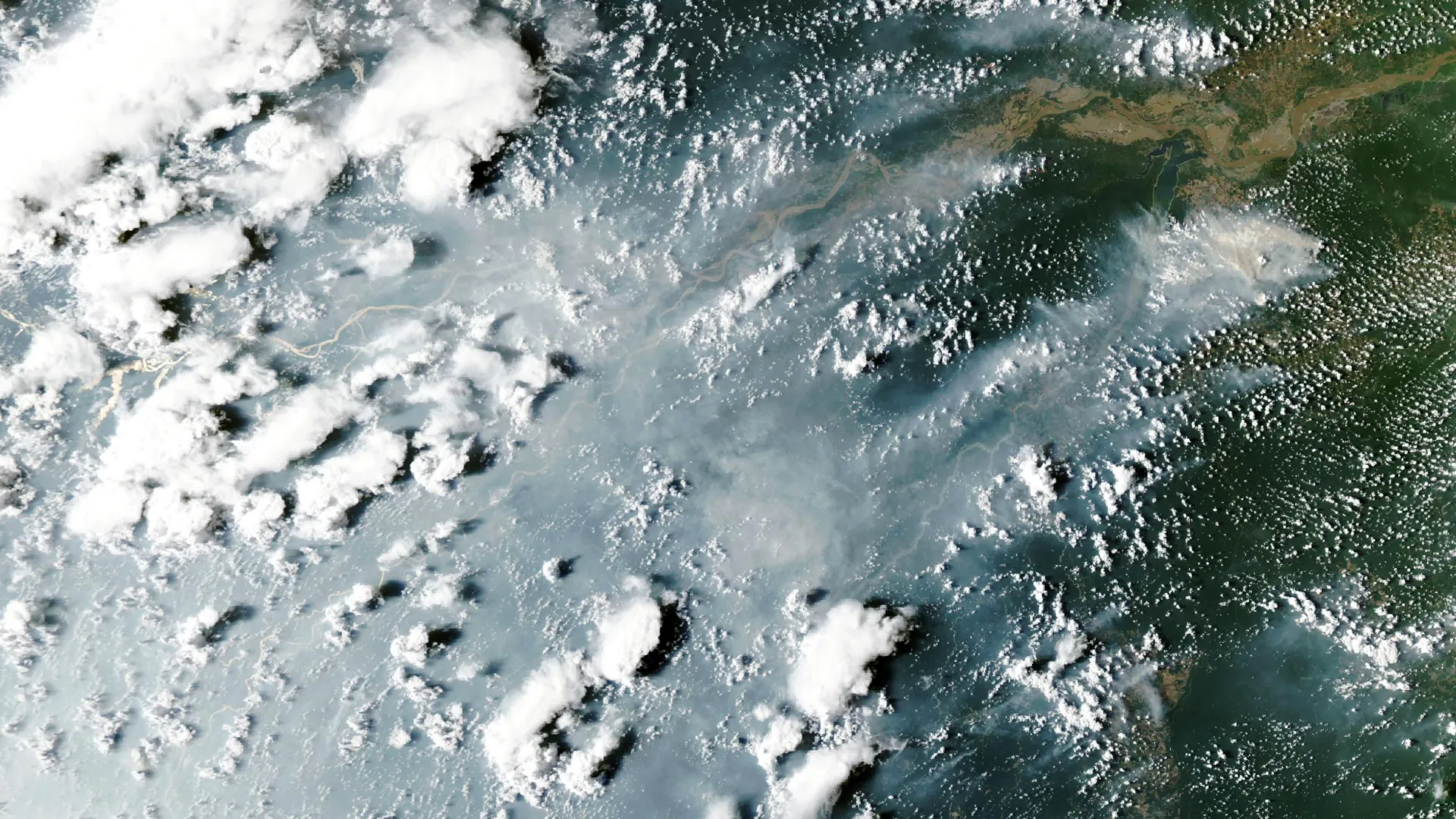
A significant increase in wildfire activity has been documented across the Amazon rainforest, with satellite monitoring systems detecting rising fire and smoke emissions beginning in September. The detected fires span central and eastern portions of the rainforest, extending from areas surrounding major Brazilian cities Manaus and Santarém toward the Amazon River’s mouth. On October 12, NASA’s Aqua satellite captured imagery showing extensive smoke plumes rising from multiple fires along both sides of the river. Smoke concentrations in Manaus reached hazardous levels, with fine particulate matter exceeding 135 micrograms per cubic meter, prompting school closures and cancellation of public events across the city of over 2 million residents.
Scientists attribute the current fire cascade to rainfall disruptions associated with El Niño conditions affecting tropical regions. According to NASA researchers, the pattern typically begins with drought-triggered peat fires in Indonesia, followed by intensification of fire activity in the central and eastern Amazon as dry conditions spread. This progression was documented in previous El Niño events during 2015-2016 and 2023. Douglas Morton, an Earth system scientist at NASA’s Goddard Space Flight Center, noted that Indonesia experienced significant fire activity beginning in August, and the Amazon now represents the second stage of this broader tropical fire cascade.
Forecasts indicate the fire danger may expand geographically and persist longer than the immediate crisis. Scientists anticipate fire activity spreading northward into November and December across Brazilian states of Roraima and Amapá, along with portions of northern Pará, Venezuela, Guyana, and Suriname. Conditions are then expected to shift southward, with peak fire danger potentially reaching southern Amazon regions of Brazil and Paraguay by August and September 2027. Particular concern exists regarding forests that burned during previous El Niño events, as repeated burning in tropical rainforests can intensify damage to ecosystems not adapted to frequent fires.
Nearly all fires currently active in the Brazilian Amazon originated from human activity rather than natural causes such as lightning. Brazil’s meteorological data indicates extreme drought conditions, with Manaus experiencing rainfall 95 percent below normal in August and 60 percent below normal in September. These conditions have transformed controlled fires used for land management into uncontrolled wildfires spreading into the rainforest’s dry understory vegetation. Scientists warn that communities have an opportunity to reduce fire danger in regions not yet affected by implementing strict burning restrictions before drought conditions intensify further.
Article Attribution | Read More at Article Source
Article summary produced by Claude AI