

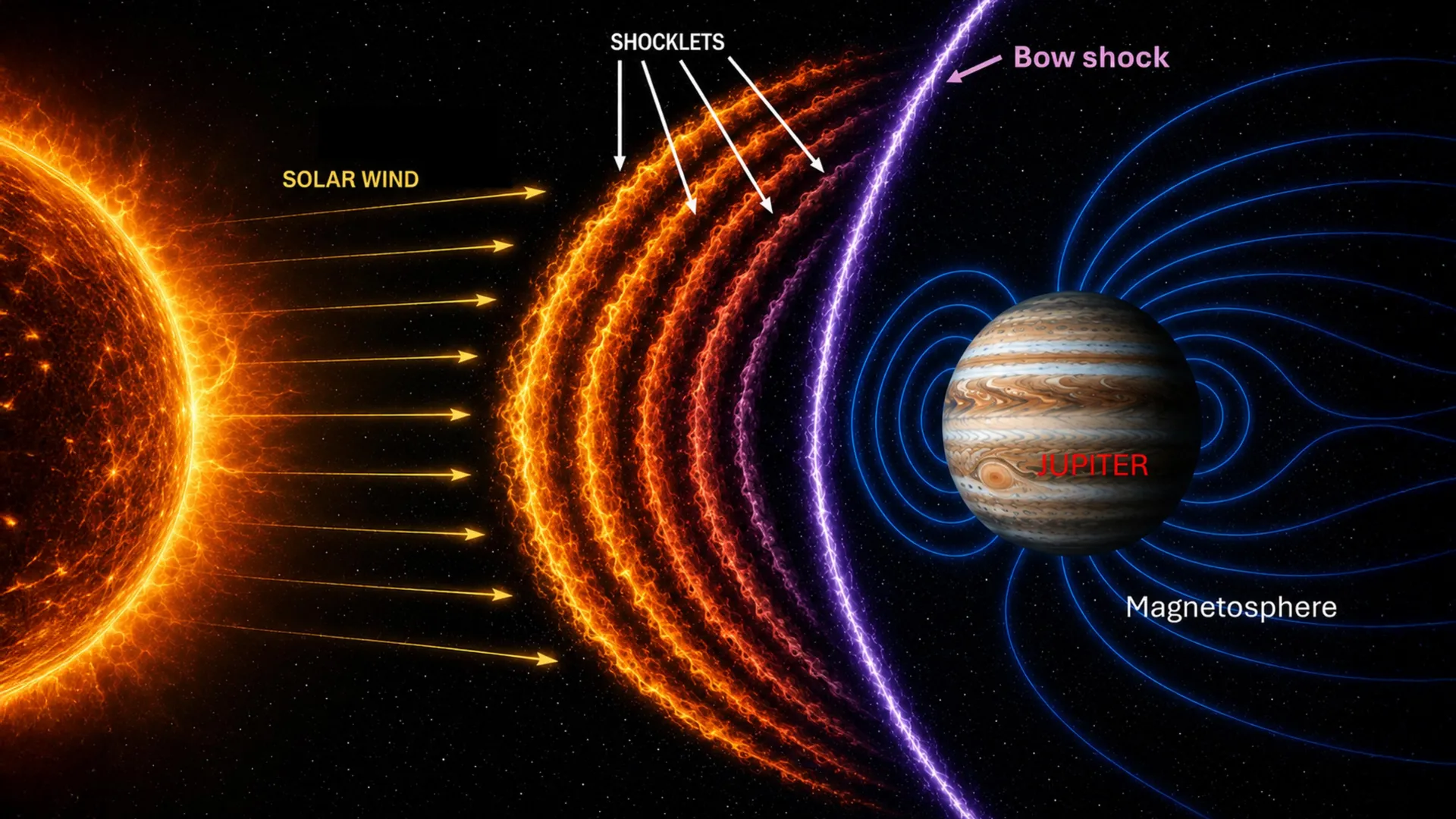
NASA researchers using data from the Juno spacecraft have identified significant differences in how Jupiter and Earth protect themselves from the solar wind, a continuous stream of high-energy charged particles emitted by the Sun. The study, led by scientists at the University of Iowa, provides detailed observations of Jupiter’s bow shock—an invisible boundary where solar particles encounter the planet’s magnetic environment. The findings demonstrate that Jupiter relies on a substantially more intricate defense mechanism than previously understood.
According to the research, Jupiter’s bow shock operates using plasma waves across multiple frequencies, creating a richer harmonic structure compared to Earth’s system. This approach allows Jupiter to interact with and transfer energy to a greater number of incoming particles, effectively heating and slowing them down. By contrast, Earth’s bow shock primarily concentrates plasma waves around a single frequency, which is sufficient for the conditions present near our planet. Jayasri Joseph, a postdoctoral researcher at Iowa and the study’s corresponding author, noted that the presence of multiple frequencies enables Jupiter to heat more particles in the solar wind and reduce their velocity more effectively.
The researchers also discovered that Jupiter maintains an additional layer of protection through smaller shock structures called shocklets, which slow the solar wind before it reaches the primary bow shock. Earth’s system does not employ this extra mechanism, suggesting that Jupiter requires more sophisticated energy management due to the greater intensity of solar wind impacts on the giant planet. Bill Kurth, a research scientist involved in the study, explained that Earth does not need these additional steps because the solar wind impact is considerably less powerful.
The significance of these findings extends beyond Jupiter itself. The mechanisms identified in Jupiter’s bow shock could help scientists better understand shock waves throughout the universe, particularly those associated with supernova remnants and other extreme astrophysical events. The detailed plasma wave measurements were made possible by observations collected in December 2024 using Juno’s Waves instrument, which was designed and built at the University of Iowa. The study was published online on July 31 in Nature Communications.
Article Attribution | Read More at Article Source
Article summary produced by Claude AI