

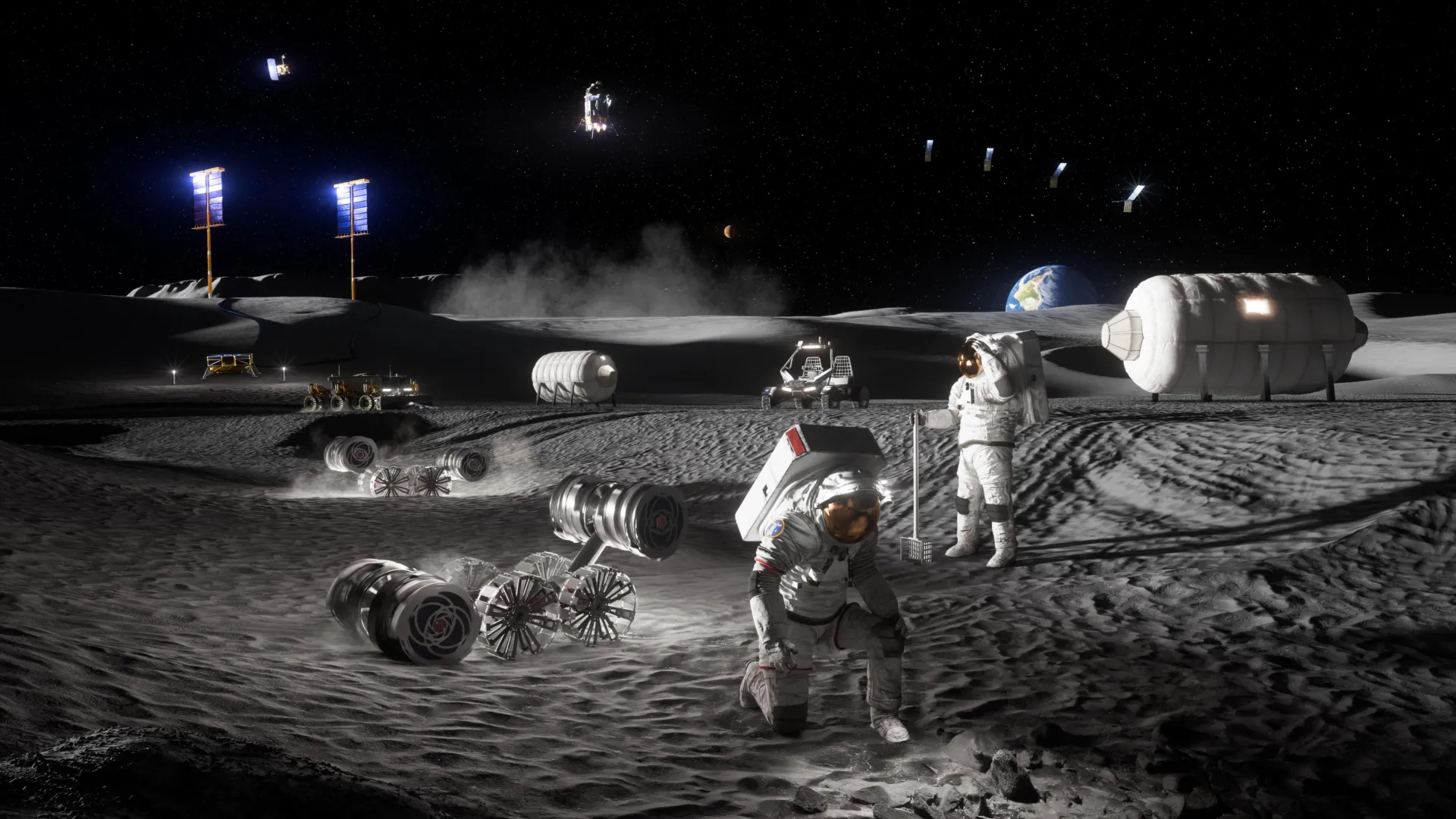
NASA has chosen three research investigations to support the establishment of a permanent Moon base through its PRISM program and CLPS initiative. The missions will address critical questions about sustaining human life on the lunar surface by examining natural shelters, identifying usable resources, and characterizing environmental threats.
The Lunar Environment Monitoring Station — South Pole will deploy an autonomous facility to track conditions and hazards over extended periods. The station will detect micrometeoroids, measure volatile substances in the Moon’s thin outer layer, and use a short-period seismometer to detect vibrations and moonquakes. This data will help engineers design safer infrastructure for permanent lunar habitats. The investigation is led by Dr. Mehdi Benna of the University of Maryland, Baltimore County.
The second mission, called GIMLI, will investigate the Marius Hills Pit, which may connect to an extensive underground lava tube. Using geophysical measurements, researchers will determine whether large hollow passages exist beneath the lunar surface. Such formations could provide natural shelter from intense temperature fluctuations, harmful radiation, and frequent impacts from space debris. Dr. Nathaniel Putzig of the Planetary Science Institute leads this investigation.
The DISCO payload will conduct the first direct measurements of water ice on the lunar surface from ground level, focusing on extremely cold regions called micro-cold traps. Understanding the location, quantity, and distribution of ice could enable astronauts to extract water locally and potentially convert it into oxygen and hydrogen. The investigation will also examine how landing procedures affect surface conditions and terrain stability. Dr. Ariel Deutsch of NASA’s Ames Research Center directs this mission.
Together, these three investigations will provide essential information to minimize risks to future astronauts while advancing long-term lunar exploration and preparation for Mars missions.
Article Attribution | Read More at Article Source
Article summary produced by Claude AI