

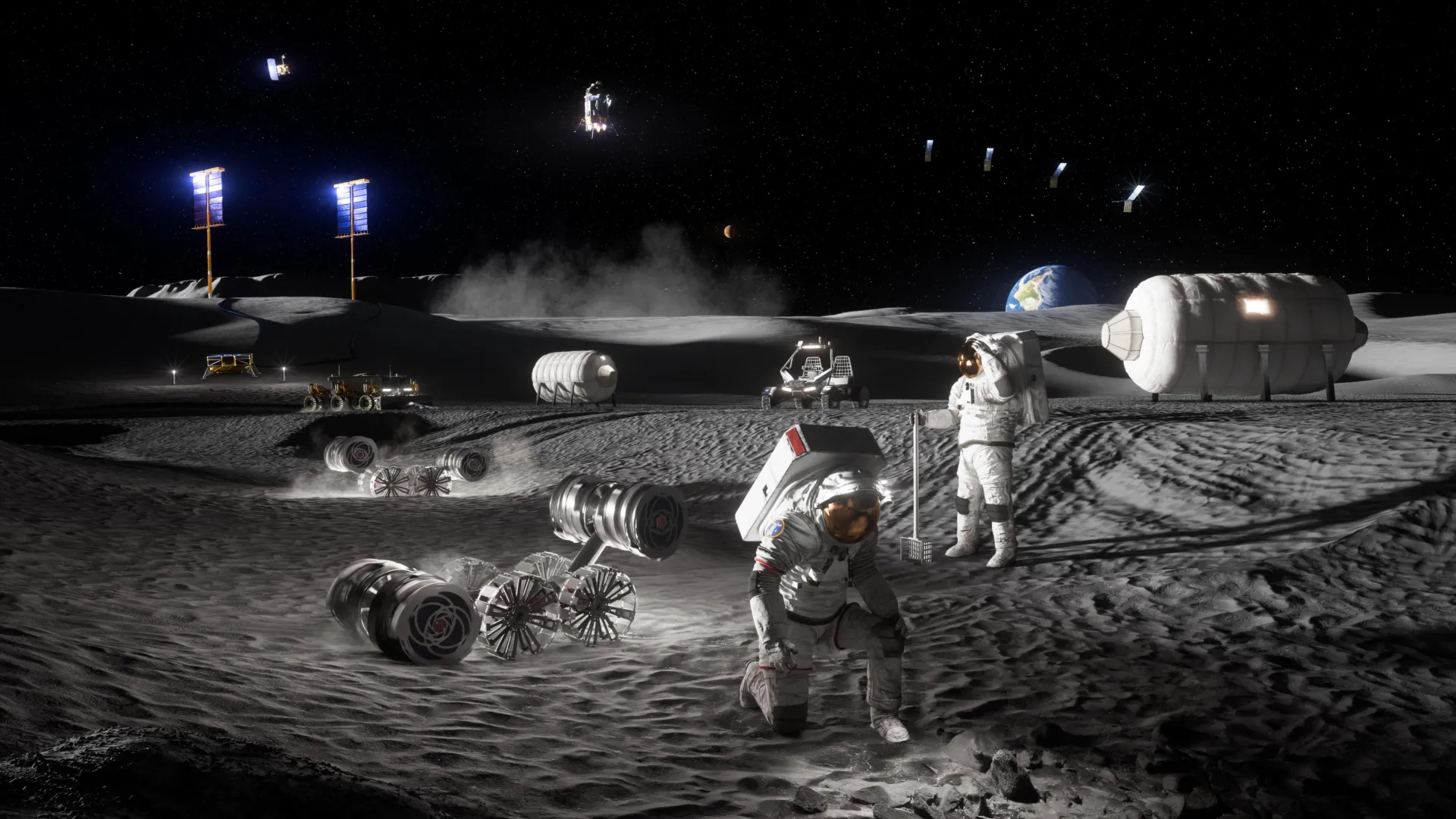
NASA has made progress toward establishing humanity’s initial Moon base by selecting three scientific investigations through its Payloads and Research Investigations on the Surface of the Moon (PRISM) program. These missions will be delivered via the Commercial Lunar Payload Services (CLPS) initiative and address distinct challenges related to long-term human habitation on the lunar surface. The investigations will search for natural shelters, identify resources astronauts could utilize, and assess dangerous conditions that future habitats and equipment must endure. According to Nicky Fox, associate administrator of NASA’s Science Mission Directorate, the effort aims to provide astronauts with critical information and safety measures while minimizing risks during lunar operations.
The first investigation, the Lunar Environment Monitoring Station at the South Pole (LEMS-SP), will establish an autonomous facility to track environmental conditions over extended periods. The station will detect micrometeoroids, small space debris that strike the lunar surface without atmospheric protection, and measure volatiles in the Moon’s extremely thin outer layer. A short-period seismometer will detect vibrations and moonquakes, providing engineers with data needed to design safer infrastructure for a permanent base. This research is led by Dr. Mehdi Benna of the University of Maryland, Baltimore County.
The second investigation, known as the Geophysical Instruments for Marius Lunar pit Investigation (GIMLI), will examine the Marius Hills Pit to determine whether it connects to extensive underground lava tubes. These formations, created when the outer surface of flowing lava hardens while molten rock continues beneath, could provide natural shelter from intense temperature fluctuations, harmful radiation, and frequent micrometeorite impacts. Dr. Nathaniel Putzig of the Planetary Science Institute leads this investigation, with findings potentially influencing where NASA places future habitats.
The third mission, the Depth Imager with Spectral and Color Optics (DISCO), will make direct measurements of ice preserved in micro-cold traps on the lunar surface. Water ice could provide a practical resource for astronauts, reducing the expense of transporting water from Earth and potentially enabling local production of oxygen and hydrogen. DISCO will also investigate physical properties of the lunar surface to improve understanding of landing operations and equipment movement. Dr. Ariel Deutsch of NASA’s Ames Research Center in California’s Silicon Valley leads this investigation. Combined, these three efforts establish foundational knowledge for supporting sustained human presence beyond Earth.
Article Attribution | Read More at Article Source
Article summary produced by Claude AI