

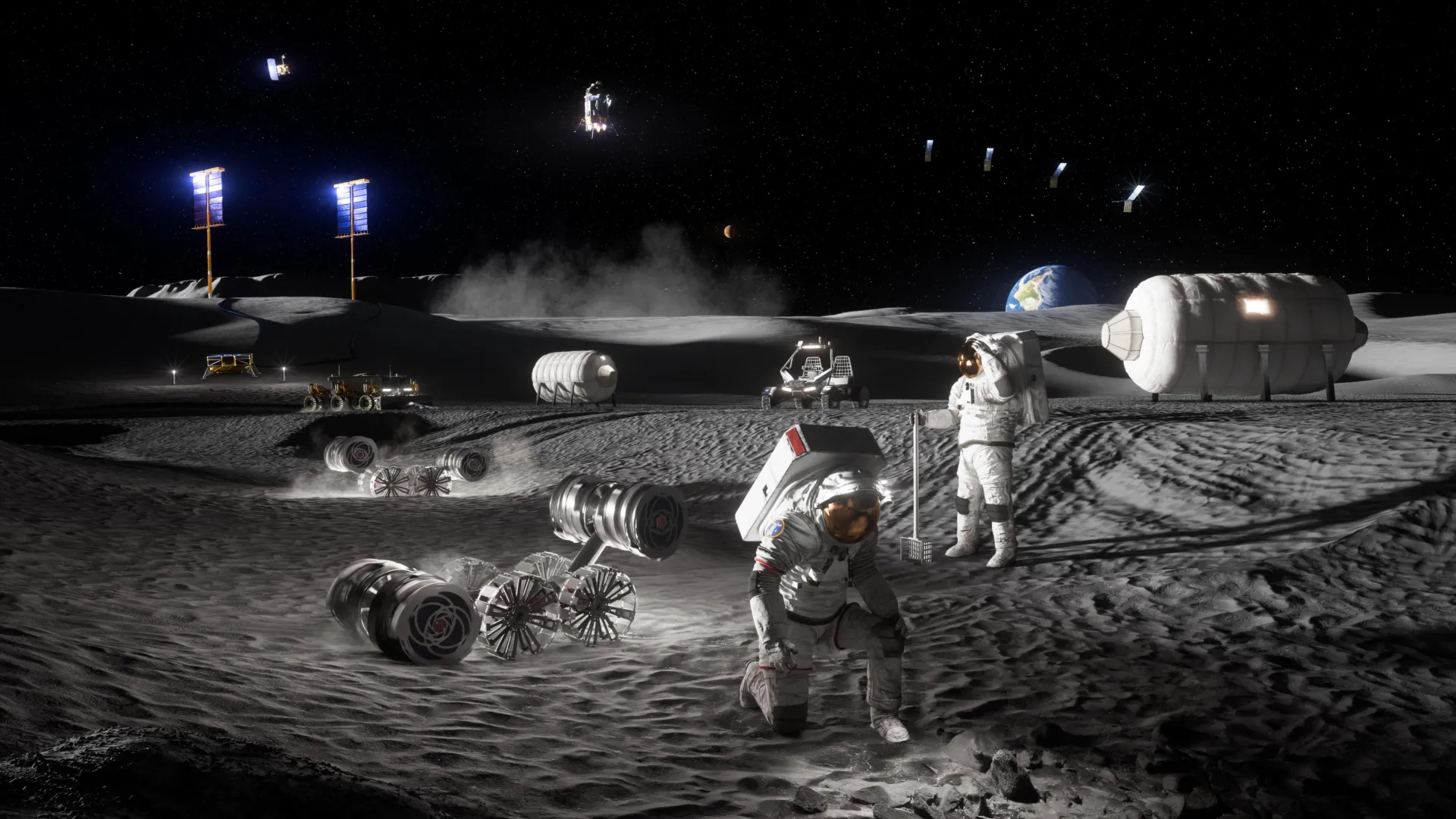
NASA has chosen three scientific investigations to address critical challenges for establishing a permanent human presence on the Moon. The missions will be delivered through the agency’s Commercial Lunar Payload Services initiative and will focus on identifying underground shelters, locating water ice resources, and assessing environmental risks. These efforts support NASA’s broader Artemis and Moon Base programs as the agency prepares for long-term lunar exploration and eventual human missions to Mars.
The first investigation, the Lunar Environment Monitoring Station for the South Pole, will establish an autonomous facility to track environmental conditions and potential hazards over an extended timeframe. The station will detect micrometeoroids—small space debris that pose a threat to equipment and habitats since the Moon lacks a protective atmosphere. It will also measure volatile substances in the Moon’s thin outer layer of gases and monitor seismic activity through a short-period seismometer to detect moonquakes. These measurements will help engineers design safer infrastructure for the lunar base.
The second investigation, known as GIMLI, will examine the Marius Hills Pit to determine whether it connects to large underground lava tubes. Scientists believe these natural formations could provide astronauts with stable temperatures and natural radiation shielding from the harsh lunar environment. Understanding the presence and size of underground passages could influence where NASA locates future habitats and how they are constructed, potentially reducing the need for extensive surface-based protective structures.
The third investigation, DISCO, will make direct measurements of water ice in extremely cold regions on the Moon’s surface. Identifying accessible ice deposits could allow astronauts to obtain water locally and potentially process it into oxygen and hydrogen. The investigation will also examine how landing spacecraft affect the lunar terrain and assess surface stability for safe movement of personnel and equipment. Together, these three missions will provide NASA with essential information to minimize risks to astronauts while maximizing the feasibility of establishing humanity’s first lunar outpost.
Article Attribution | Read More at Article Source
Article summary produced by Claude AI