

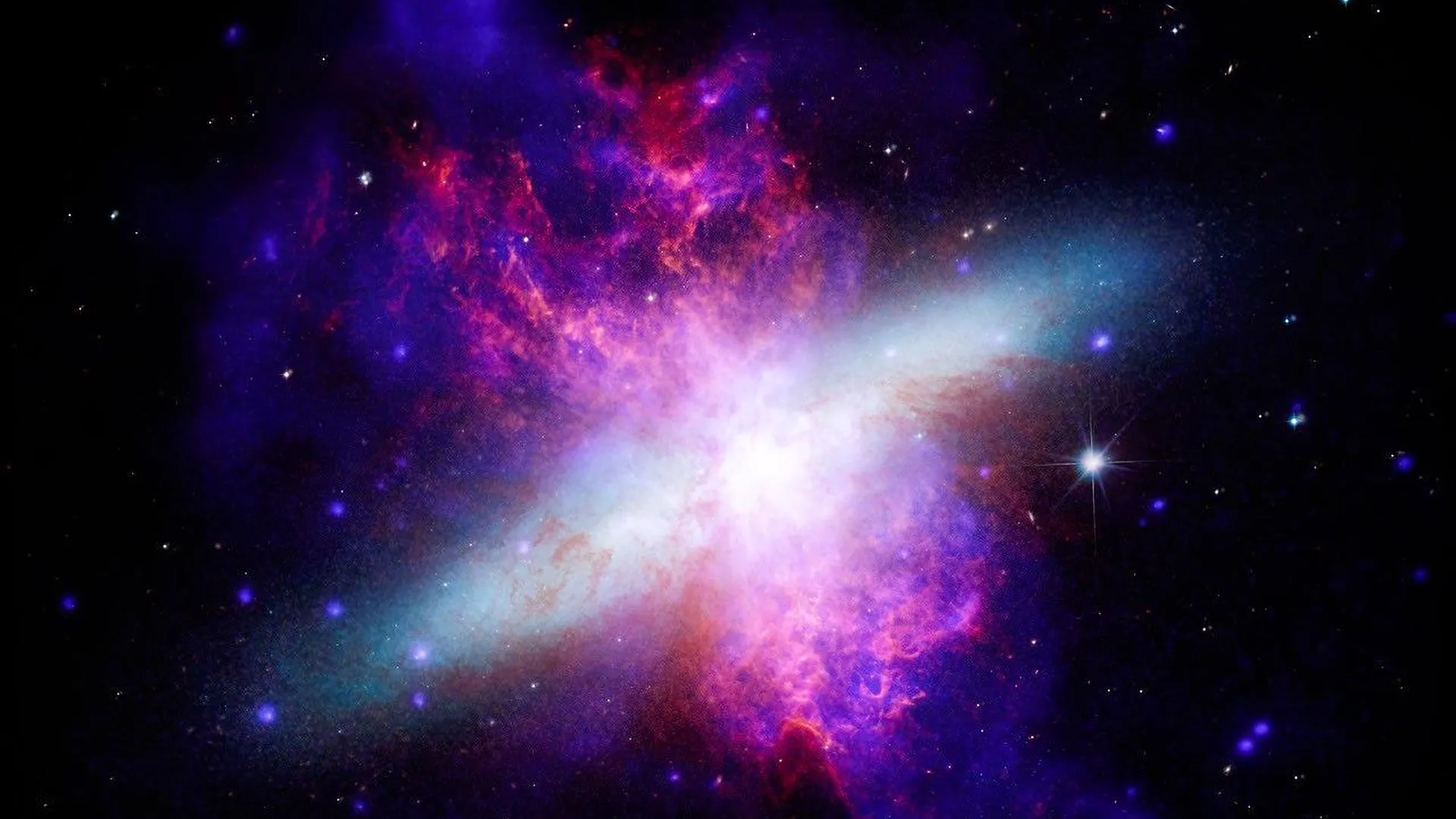
NASA has unveiled a collection of 16 images showcasing galaxies across the universe, combining observations from several of the world’s most advanced space-based and ground-based observatories. The images integrate data from NASA’s Chandra X-ray Observatory, James Webb Space Telescope, Hubble Space Telescope, IXPE, the Neil Gehrels Swift Observatory, NuSTAR, and other facilities. X-ray observations prove particularly valuable for detecting extreme cosmic phenomena that remain invisible at other wavelengths, including superheated gas clouds, material ejected from supermassive black holes, and stellar explosion remnants.
The gallery highlights the structural diversity found throughout the universe. Spiral galaxies like Messier 33 and NGC 3938 display sweeping arms filled with energetic stellar pairs and explosive phenomena. Barred spiral galaxies such as NGC 1672 and NGC 1385 contain elongated central structures that funnel material toward their cores, triggering intense star formation. Additional observations reveal how gravitational interactions between galaxies can disturb gas clouds and stimulate new star birth, as demonstrated in NGC 4725. Dramatic side-view observations of the Whale Galaxy and the Cigar Galaxy show powerful outflows of superheated gas extending thousands of light-years into space.
Supermassive black holes represent another major feature in the collection. When actively consuming material, these central galactic engines become exceptionally energetic, launching high-speed particle jets and massive outbursts that shape their host galaxies. Centaurus A displays a striking example, with jets extending tens of thousands of light-years outward. The Sombrero Galaxy reveals a supermassive black hole surrounded by an extensive halo of heated gas and stellar remnants. In Messier 106, jets from the central black hole interact with surrounding gas to create unusual spiral structures.
The images also document galactic collisions and mergers, providing important context for understanding the Milky Way’s distant future. Arp 143 shows the aftermath of a direct collision that produced an expanding ring and triggered widespread star formation. NGC 3256 and II Zw 096 exemplify the violent interactions common in the early universe. Scientists anticipate that the Milky Way will eventually merge with the Andromeda galaxy billions of years from now, making observations of other galactic mergers valuable for predicting how such an encounter could proceed. Additional unusual systems in the collection include NGC 1569, which exhibits the intense star formation typical of young galaxies, NGC 660 with its rare polar ring structure, and Messier 90, which is losing its gas as it moves through the Virgo Cluster.
Article Attribution | Read More at Article Source
Article summary produced by Claude AI