

When NASA’s OSIRIS-REx spacecraft arrived at asteroid Bennu in 2018, it encountered an unexpected landscape dominated by large boulders rather than the smoother terrain earlier observations had suggested. The discovery created a scientific puzzle because previous measurements from NASA’s Spitzer Space Telescope indicated that Bennu’s surface had low thermal inertia, a property more consistent with fine materials like sand that warm and cool quickly. Large solid rocks typically retain heat much longer, raising questions about how a boulder-covered asteroid could cool so rapidly.
After samples from Bennu were returned to Earth, researchers led by Andrew Ryan of the University of Arizona’s Lunar and Planetary Laboratory began examining rock fragments in detail. Using laboratory techniques and lock-in thermography conducted by researchers at Nagoya University in Japan, the team discovered that the rocks were highly porous. However, porosity alone could not account for the observed heat loss. The critical finding was that the rock particles contained extensive networks of internal cracks that fundamentally altered how heat moved through the material.
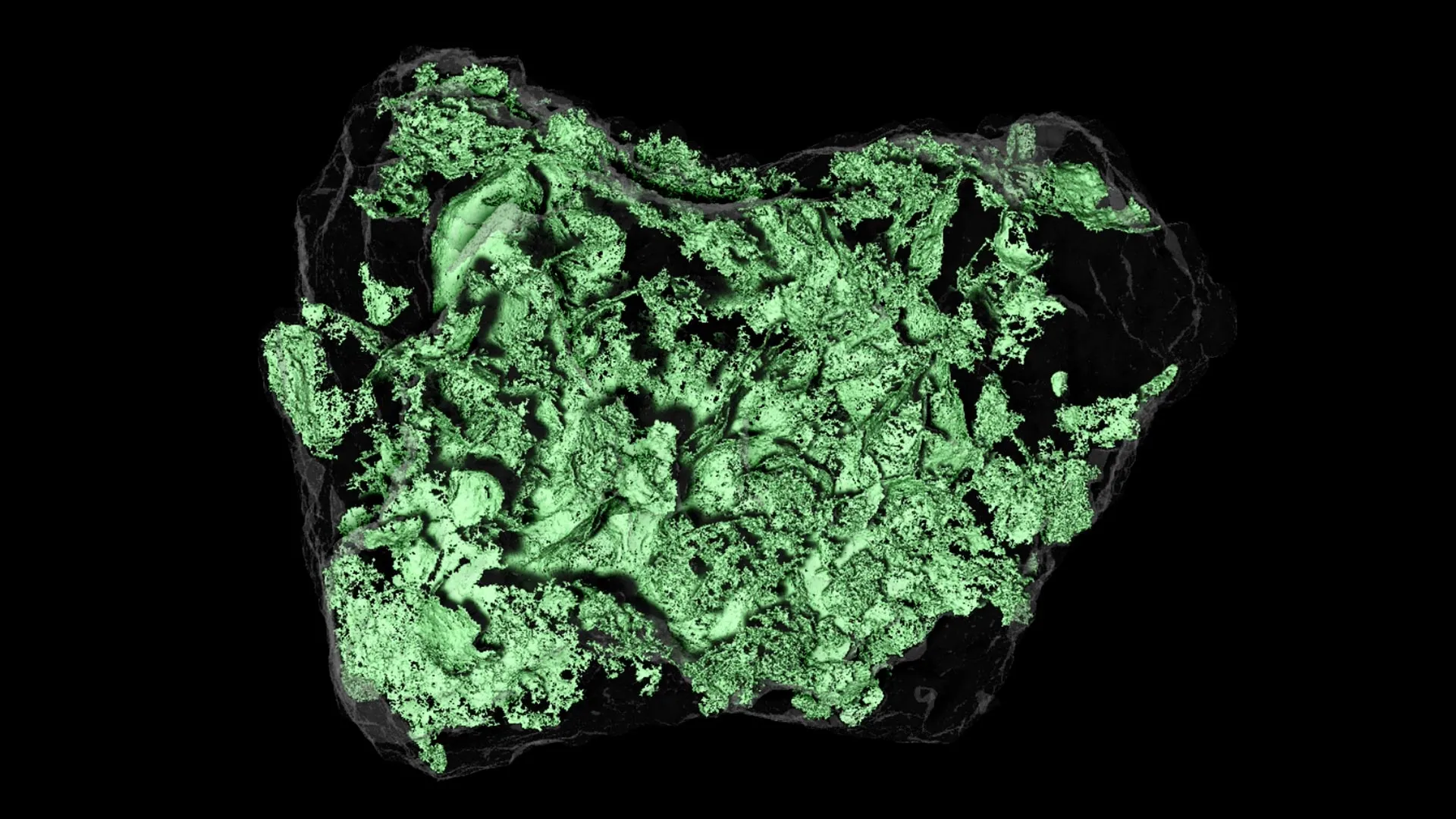
Scientists at NASA’s Johnson Space Center in Houston used X-ray computed tomography, or XCT scanning, to create detailed three-dimensional images of the asteroid samples’ internal structures while maintaining pristine conditions using protective nitrogen-filled glove boxes. This technique allowed researchers to visualize features invisible from the surface without damaging the original material. The scans were then incorporated into computer simulations that tracked how heat travels through asteroid rocks.
By scaling the calculations from individual particles to the much larger boulders found on Bennu’s surface, Ryan’s team successfully reproduced the low thermal inertia that spacecraft instruments had measured. The results revealed that the widespread internal fractures were equally important as porosity in explaining the rocks’ thermal behavior. The discovery has broader implications for asteroid science, providing astronomers with a crucial link between remote heat measurements and the actual internal structure of asteroid material, improving how scientists interpret observations from future missions.
Article Attribution | Read More at Article Source
Article summary produced by Claude AI