

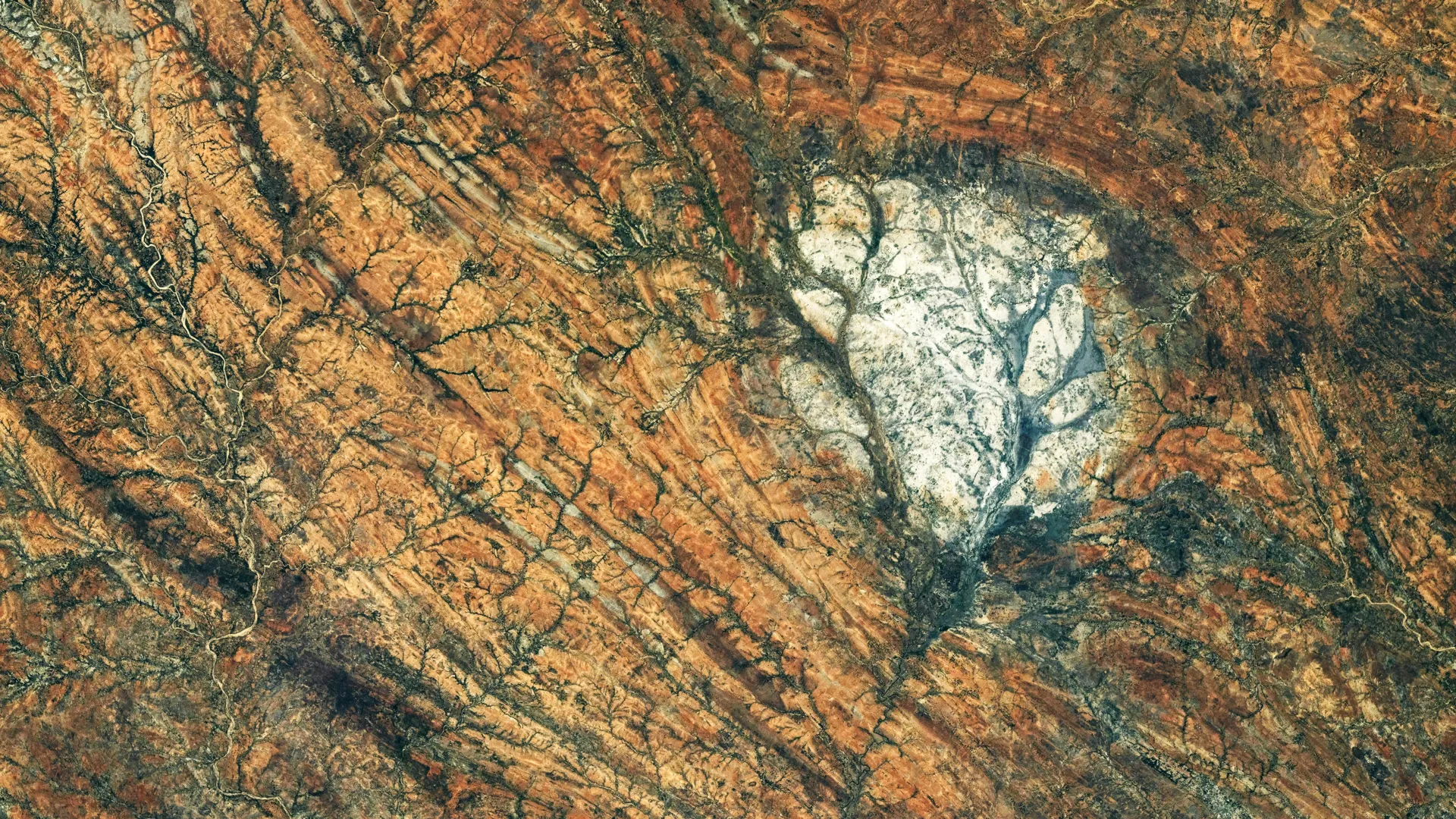
An astronaut aboard the International Space Station photographed the Saririaky anorthosite massif in southern Madagascar on August 28, 2026. The formation consists of anorthosite, an igneous rock that comprises much of the Moon’s bright, reflective highlands and is easily visible to observers on Earth. While commonly associated with the lunar surface, anorthosite deposits also occur in several terrestrial locations, including eastern Canada, Scandinavia, southern India, and Madagascar. The Saririaky massif, which covers approximately 100 square kilometers, stands out distinctly from the surrounding landscape when viewed from space.
Geological research indicates the Saririaky formation originated during the late Precambrian period, dating back at least 600 million years. Anorthosite is classified as an intrusive igneous rock, forming when molten material cools and solidifies beneath Earth’s surface, allowing minerals to develop relatively large crystals. The formation sits within a ductile shear zone, where rocks have undergone intense deformation from powerful geological forces acting deep within Earth’s crust. Studies have identified long, parallel geological features extending north to south in the region, recording the powerful deformation that affected surrounding rocks.
Scientists attribute much of this transformation to ancient continental collisions that occurred during the formation of Gondwana, a supercontinent that eventually encompassed portions of present-day Africa, India, Madagascar, Australia, and Antarctica. Immense pressure and heat from these collisions reshaped large sections of Earth’s crust. Some researchers suggest a second anorthosite massif located approximately 60 kilometers north of Saririaky was once connected to it, with tectonic forces subsequently stretching and separating the original rock body through a process known as boudinage.
The scientific significance of anorthosite extends beyond understanding Earth’s geological history. The Moon’s anorthosite-rich highlands, which exceed 4 billion years in age, formed early in lunar development when the young Moon was covered by an enormous magma ocean. As this molten material gradually cooled, certain minerals crystallized and accumulated near the surface, forming the Moon’s early outer crust. Apollo astronauts returned lunar anorthosite samples to Earth for research, though the limited quantity makes terrestrial formations valuable for comparison. The Saririaky massif provides another striking example of geological similarities between Earth and the Moon, with its distinctive appearance revealing how hundreds of millions of years of tectonic activity can transform ancient rock into a landscape visible from orbit.
Article Attribution | Read More at Article Source
Article summary produced by Claude AI