

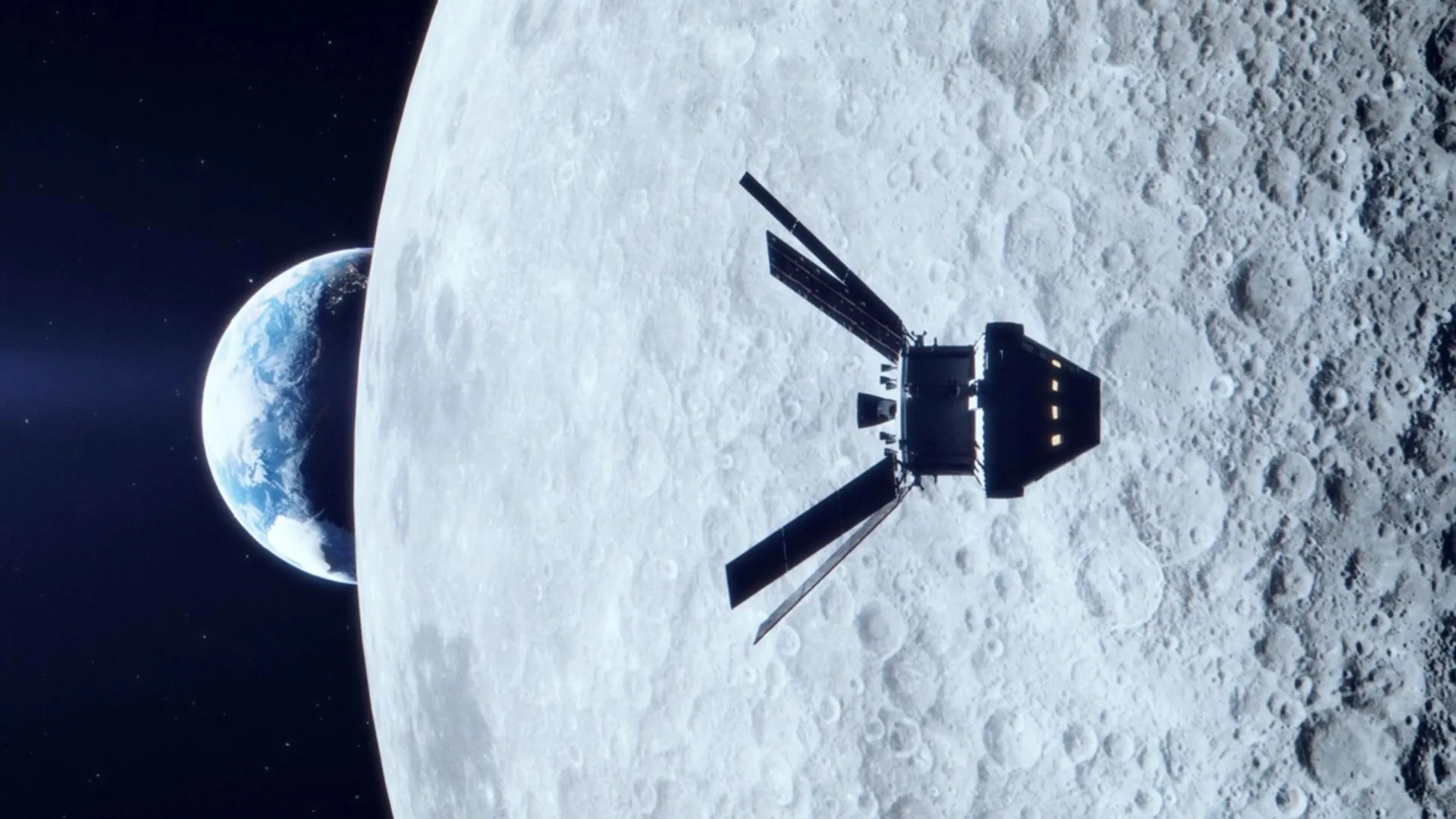
NASA’s Artemis I mission has provided new measurements of cosmic radiation exposure in the lunar environment using experimental detectors placed aboard the Orion spacecraft. During the uncrewed mission in late November and early December 2022, researchers deployed more than 10,000 tiny crystals embedded in two human-shaped mannequins to record radiation levels throughout the journey. Scientists from the Institute of Nuclear Physics of the Polish Academy of Sciences in Cracow developed fluorescent lithium fluoride detectors that function as passive radiation sensors, capturing microscopic changes in crystal structure caused by charged particles passing through them.
The lithium fluoride detectors work by recording atomic defects created when radiation particles strike the crystals. When illuminated with blue light, these altered regions emit red fluorescence, allowing researchers to examine particle tracks under a microscope. A key advantage of this technology is that it eliminates the chemical etching process required by traditional passive detectors, enabling direct observation of radiation tracks using standard fluorescence microscopy. However, analyzing the complex data proved challenging, as cosmic radiation arrives from all directions in unpredictable combinations of different particles and energy levels. Researchers developed sophisticated calibration techniques and specialized software to remove background interference and accurately interpret the measurements.
The findings revealed important differences between radiation exposure near the Moon and in low Earth orbit. In the lunar environment, the Van Allen radiation belts—which trap low-energy protons around Earth—do not extend far enough to affect astronauts. Consequently, lunar radiation consists primarily of high-energy galactic particles that travel through the entire human body, producing more uniform radiation dose distribution compared with the uneven patterns observed in earlier space station experiments. Notably, while astronauts near the Moon experience higher radiation levels than those in low Earth orbit, the increase may be less dramatic than previously anticipated, as the substantial contribution from trapped low-energy protons that dominates radiation exposure in Earth orbit disappears in the lunar vicinity. The research was published in the journal Radiation Measurements.
Article Attribution | Read More at Article Source
Article summary produced by Claude AI