

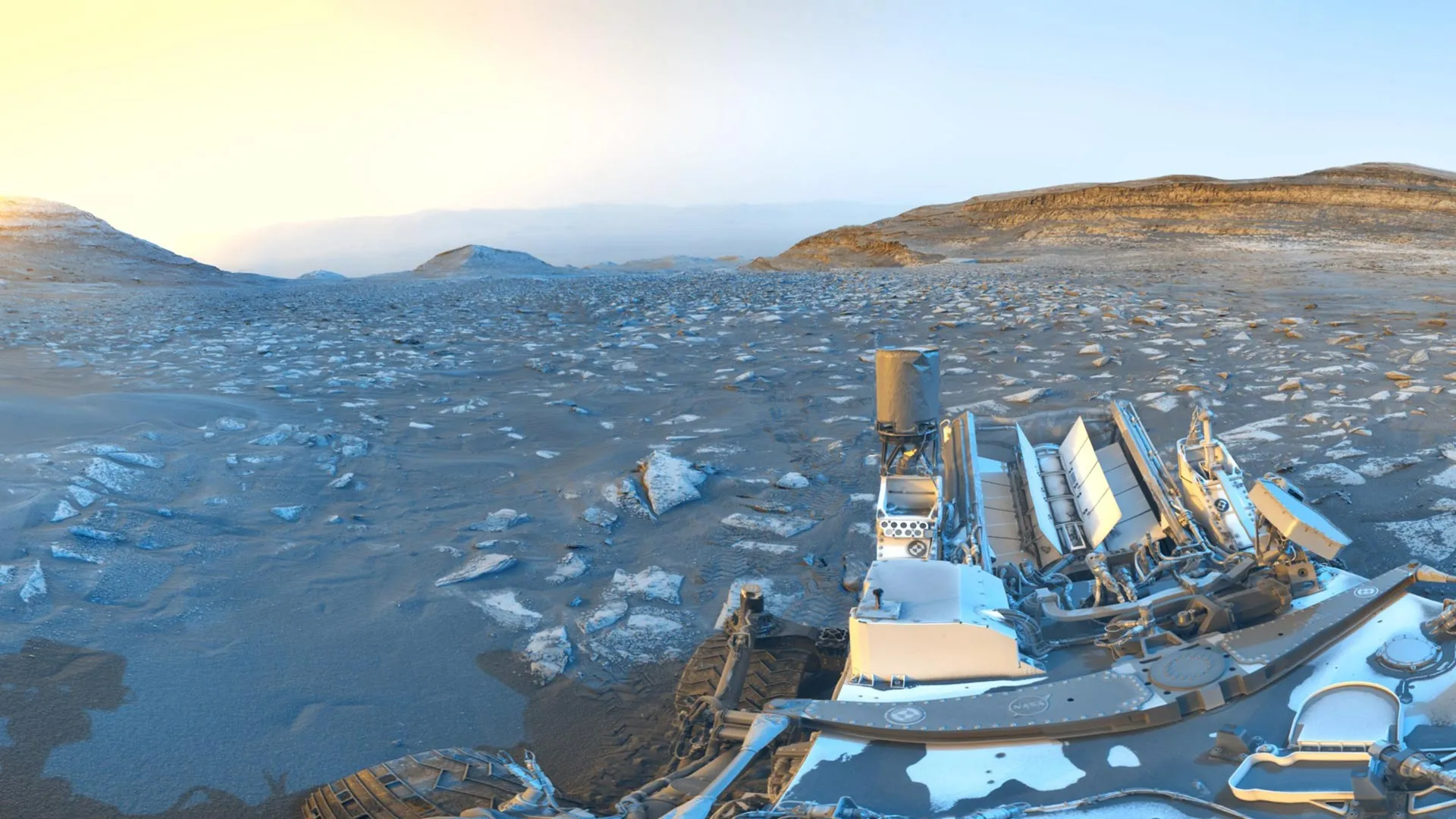
NASA’s Curiosity rover has achieved a significant operational milestone after 5,000 Martian days of exploration on the Red Planet. The rover documented this accomplishment by capturing panoramic images of its surrounding landscape while stationed at a location designated Chocolatal, a sandy ridge formation.
The rover’s navigation cameras, which typically operate in black and white, recorded two separate panoramas at different times during the Martian day. The first image was captured on Aug. 30, 2026, at 9:56 a.m. local Mars time, coinciding with the mission’s 5,000th sol. A follow-up panorama was obtained approximately three sols later on Sep. 2, 2026, at 5:39 p.m. local Mars time during the 5,003rd Martian day of the mission.
Upon arrival on Earth, mission teams combined the two captured scenes into a unified image and applied artistic color interpretation to differentiate the time periods. The morning view was rendered in blue tones while the afternoon scene was rendered in yellow, creating a composite “postcard” view. This approach follows established practices from previous Curiosity imaging campaigns, with similar techniques employed as recently as November 2021.
The resulting image provides visibility of several rover components in the foreground, including the cylindrical UHF antenna responsible for data transmission to Mars-orbiting spacecraft and the finned Multi Mission Radioisotope Thermoelectric Generator, which supplies nuclear power to the rover. Rover tracks are also visible stretching across the Martian terrain. The panorama captures the landscape of Gale Crater from Curiosity’s current position in the lower foothills of Mount Sharp, a 3-mile-high mountain within the crater, looking downhill toward the crater floor with the distant crater rim barely visible along the horizon.
Curiosity was developed by NASA’s Jet Propulsion Laboratory under Caltech management. The mission operates as part of NASA’s Science Mission Directorate’s Mars Exploration Program.
Article Attribution | Read More at Article Source
Article summary produced by Claude AI