

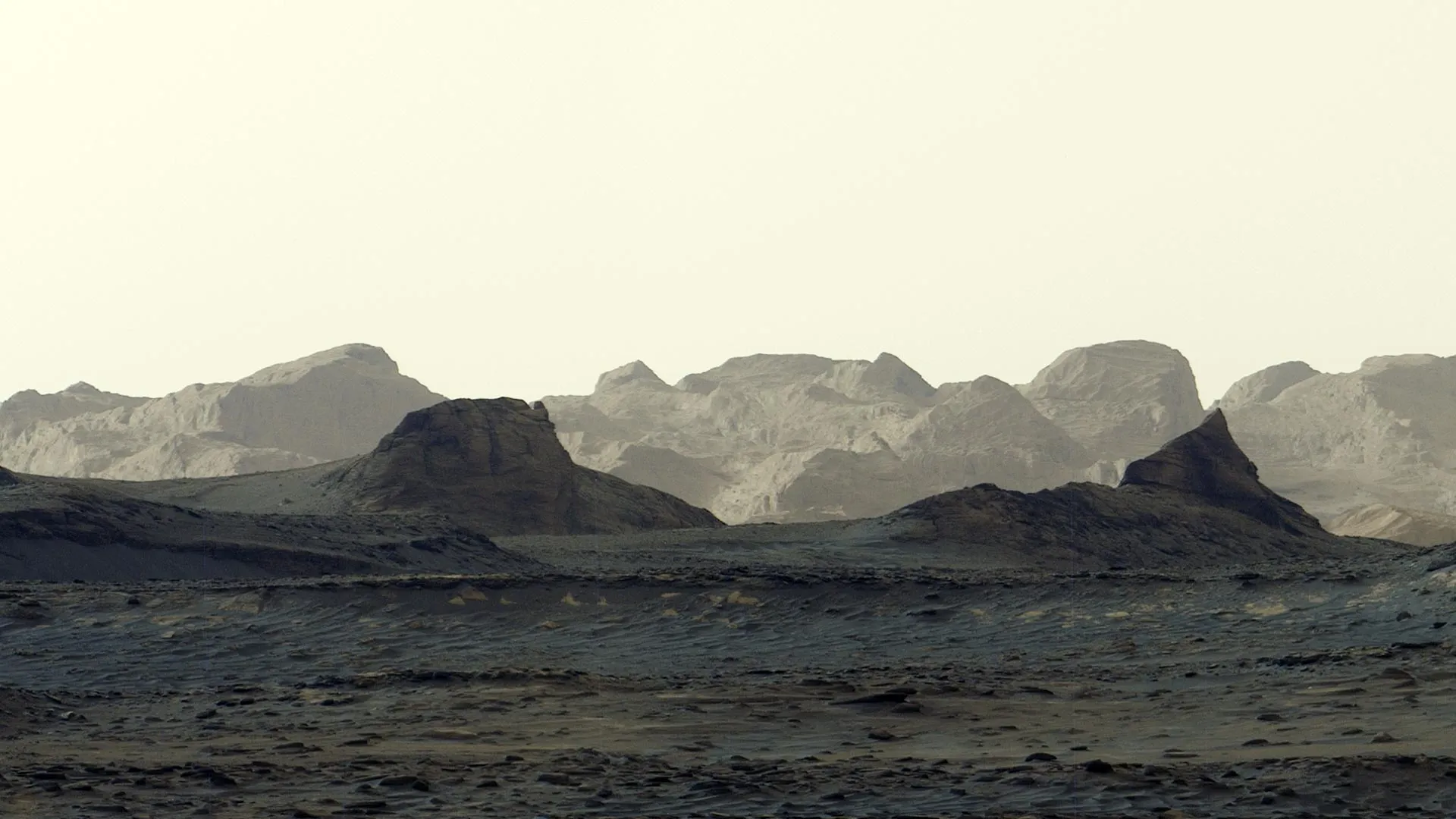
NASA’s Curiosity rover has transmitted a new panoramic image of Mars depicting a series of distinctive wind-carved cliff formations called yardangs. The panorama was captured using the rover’s Mastcam on August 11 during the mission’s 4,982nd Martian sol, with six separate photographs combined to create the sweeping view. The images were processed without white balancing, preserving the distinctive blue tones and lighting conditions of the Martian morning as the sun illuminated the distant formations.
The yardangs stretch approximately 10 miles across the northwestern section of Mount Sharp, a 3-mile-tall mountain that Curiosity has been ascending since 2014. The rover recently achieved a significant elevation gain of 0.6 miles, surpassing the climbing record of any other rover on Mars. As the rover continues its approach to these unusual formations, researchers anticipate obtaining increasingly detailed observations of the cliff structures.
Mount Sharp’s layered sedimentary rock formations preserve geological records spanning billions of years of Martian history. Scientists have used these layers to reconstruct periods when lakes and streams flowed through the region. As Mars’ environment changed over time, these water bodies disappeared, leaving behind mineral deposits. According to current understanding, wind erosion subsequently carved the distinctive yardang formations from the existing rock layers.
However, the particular yardang layer displays unusual characteristics that have prompted scientific inquiry. The formation differs in color from surrounding terrain, exhibits tilted rock layers in unexpected directions, and appears to sit distinctly atop the surrounding landscape. Ashwin Vasavada, Curiosity project scientist at NASA’s Jet Propulsion Laboratory, noted the anomalies and suggested one hypothesis involves ash deposits from ancient volcanic activity.
Curiosity is currently in its second year of an extended mission that began with examination of boxwork ridge formations. Mission planners expect the rover to reach the yardang formations sometime in 2027, at which point the robotic arm can conduct direct measurements and analysis to determine the formation processes and provide additional insights into Mars’ ancient environmental transformations.
Article Attribution | Read More at Article Source
Article summary produced by Claude AI