

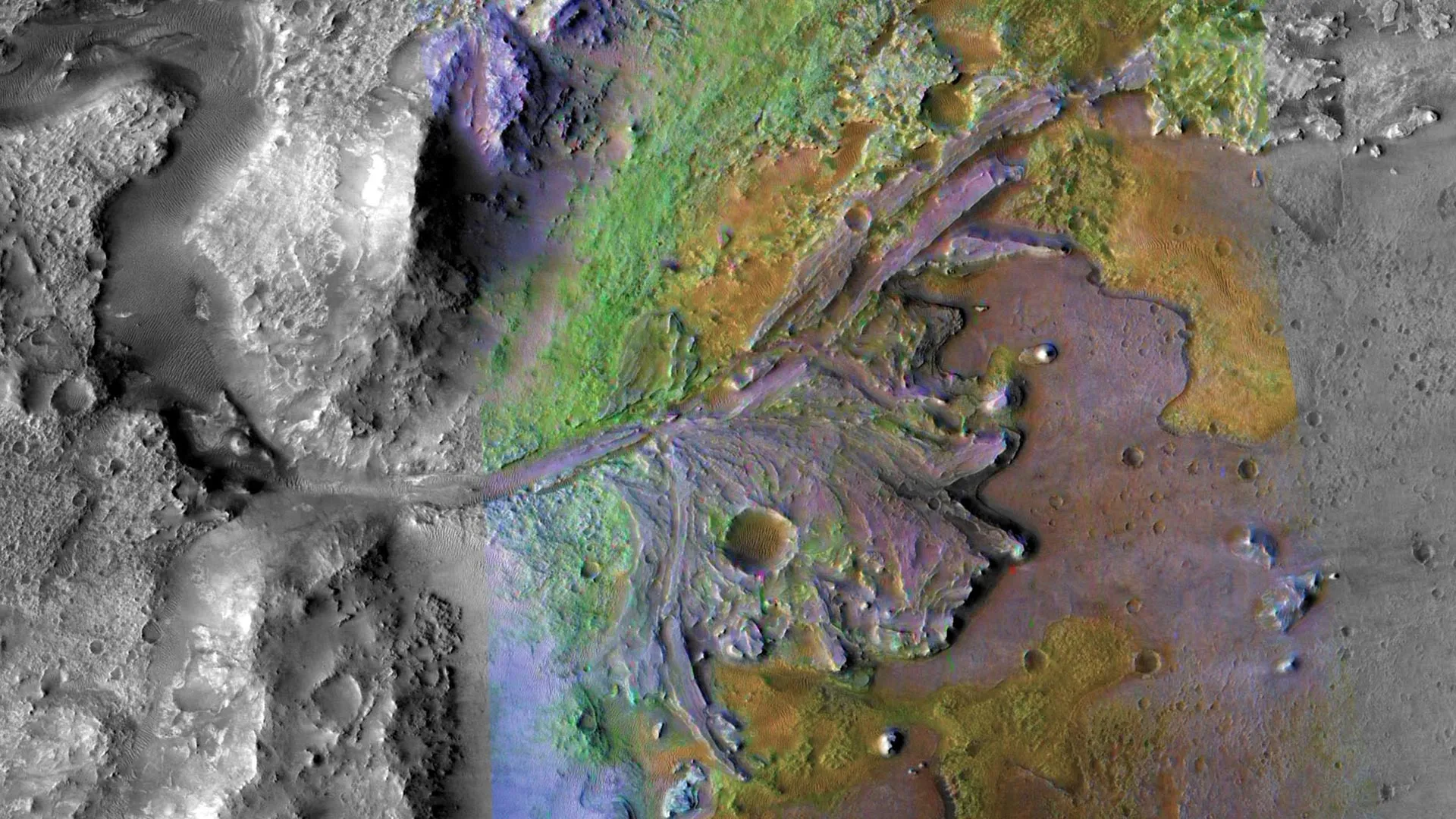
A new study analyzing data from NASA’s Perseverance rover indicates that the Margin Unit in Jezero Crater has a more intricate water history than scientists initially predicted based on orbital observations. The research, published in Communications Earth & Environment, suggests the area experienced multiple distinct episodes of water interaction spanning different periods of Mars’ geological history.
When Perseverance arrived at the crater’s inner rim in September 2023, researchers anticipated encountering sedimentary rocks typical of an ancient lakeshore. Instead, the rover found igneous rocks that revealed unexpected complexity. Using SuperCam, an instrument mounted on the rover’s mast that can analyze mineral composition through laser spectroscopy, scientists studied over 185 bedrock targets across the region and identified evidence of at least three separate water interaction episodes, each leaving distinct chemical and physical signatures.
At higher elevations within the Margin Unit, Perseverance encountered olivine-rich crystalline rock that showed minimal water alteration, suggesting it originally formed deep underground from slowly cooling magma. The situation changed dramatically at lower elevations near the ancient lakebed, where olivine appeared heavily fractured and altered, with silica filling spaces between mineral grains.
Researchers identified three distinct periods of water activity. The first involved groundwater rich in carbon dioxide that reacted with olivine to create carbonate deposits in rock fractures. A second episode may have corresponded with the ancient lake that once occupied Jezero Crater, producing additional silica as a byproduct of olivine alteration. A third and later phase involved heated groundwater circulating underground, evidenced by mineral veins containing calcium sulfate and fluorite discovered in the eastern Margin Unit.
The findings suggest Jezero Crater served as a convergence point for multiple water systems rather than being shaped by a single lake environment. According to Candice Bedford, the study’s lead author from Purdue University, the results may help reshape scientific understanding of water history throughout Jezero Crater and across Mars more broadly, potentially improving reconstructions of early Mars’ climate and habitability conditions.
Article Attribution | Read More at Article Source
Article summary produced by Claude AI