

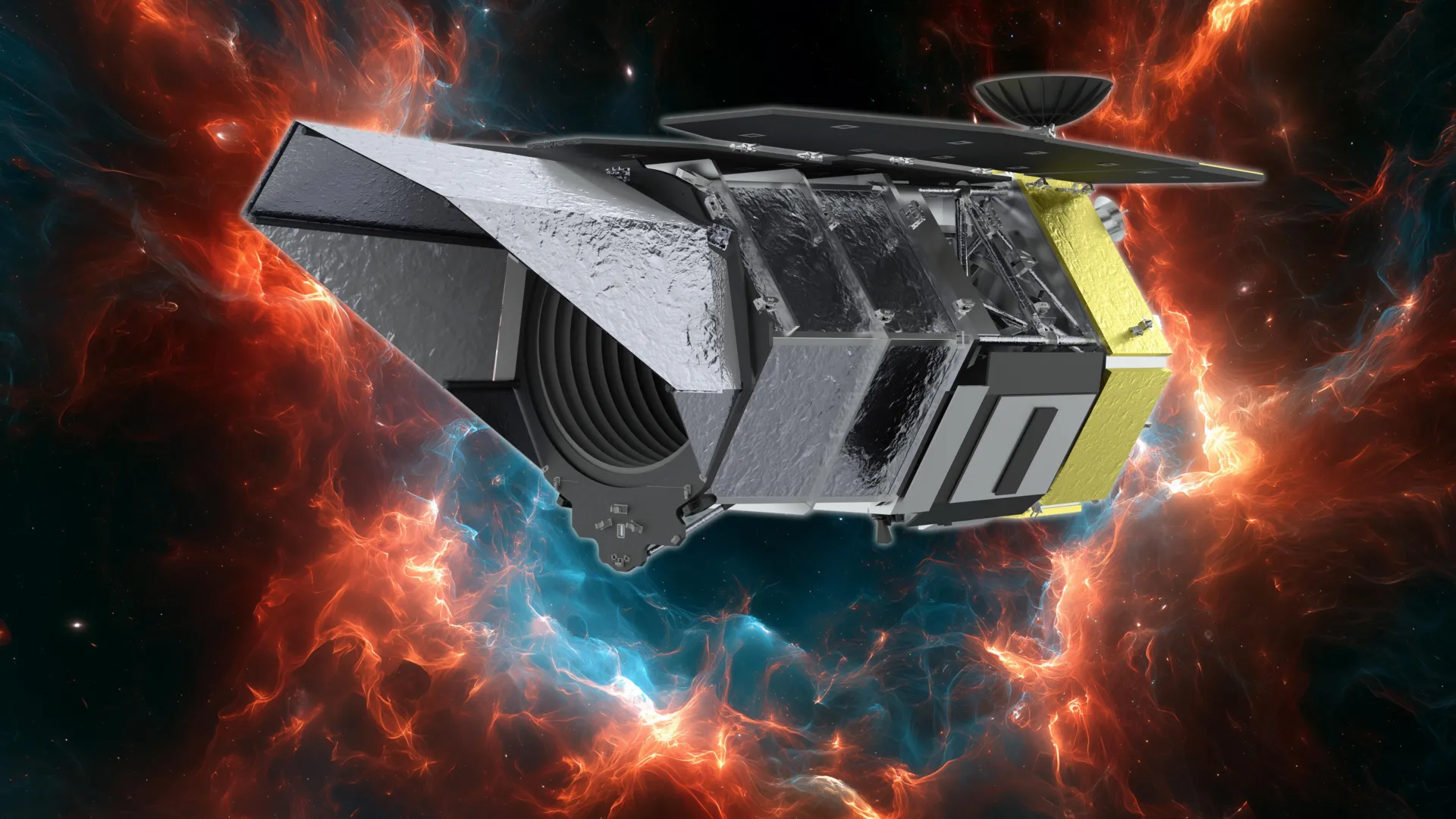
NASA’s Nancy Grace Roman Space Telescope has successfully completed a series of critical tests validating its fine-guidance system and coronagraph instrument capabilities. Between September 15 and 21, engineers conducted assessments of the guidance system, which maintains the observatory’s pointing accuracy during observations. The fine-guidance system works by monitoring reference stars with known positions and continuously providing corrections to the spacecraft’s attitude control system to counteract any drift that might occur during imaging operations.
The stability achieved during testing proved exceptional, maintaining pointing accuracy to better than 1/100,000 of a degree for extended periods—approximately 30 minutes for the Wide Field Instrument and up to eight hours for the Coronagraph Instrument. Engineers compared this level of precision to maintaining laser focus on a U.S. dime from roughly 150 miles away, with expectations to improve further as tuning continues. Roman employs a novel guidance approach by tracking detailed wavelength patterns called spectra rather than relying on a separate dedicated guide instrument like other space telescopes.
On September 22 and 27, the team integrated the fine-guidance system with Roman’s Coronagraph Instrument, designed to suppress starlight and enable detection of faint exoplanets and circumstellar dust. The coronagraph achieved its first observations of cosmic light, observing a faint star in the Large Magellanic Cloud and subsequently detecting multiple stars in a different region of that galaxy. Initial observations contained additional noise because detectors were intentionally kept warmer to prevent contamination, but a second test with cooled detectors confirmed the instrument could detect multiple stars as expected.
These successful tests represent significant milestones in Roman’s commissioning process, confirming that light properly traverses the optical system and that the telescope maintains the precise pointing necessary for future observations. The results provide confidence that Roman can successfully fulfill its mission objectives studying exoplanets and other celestial phenomena once more demanding observations begin.
Article Attribution | Read More at Article Source
Article summary produced by Claude AI