

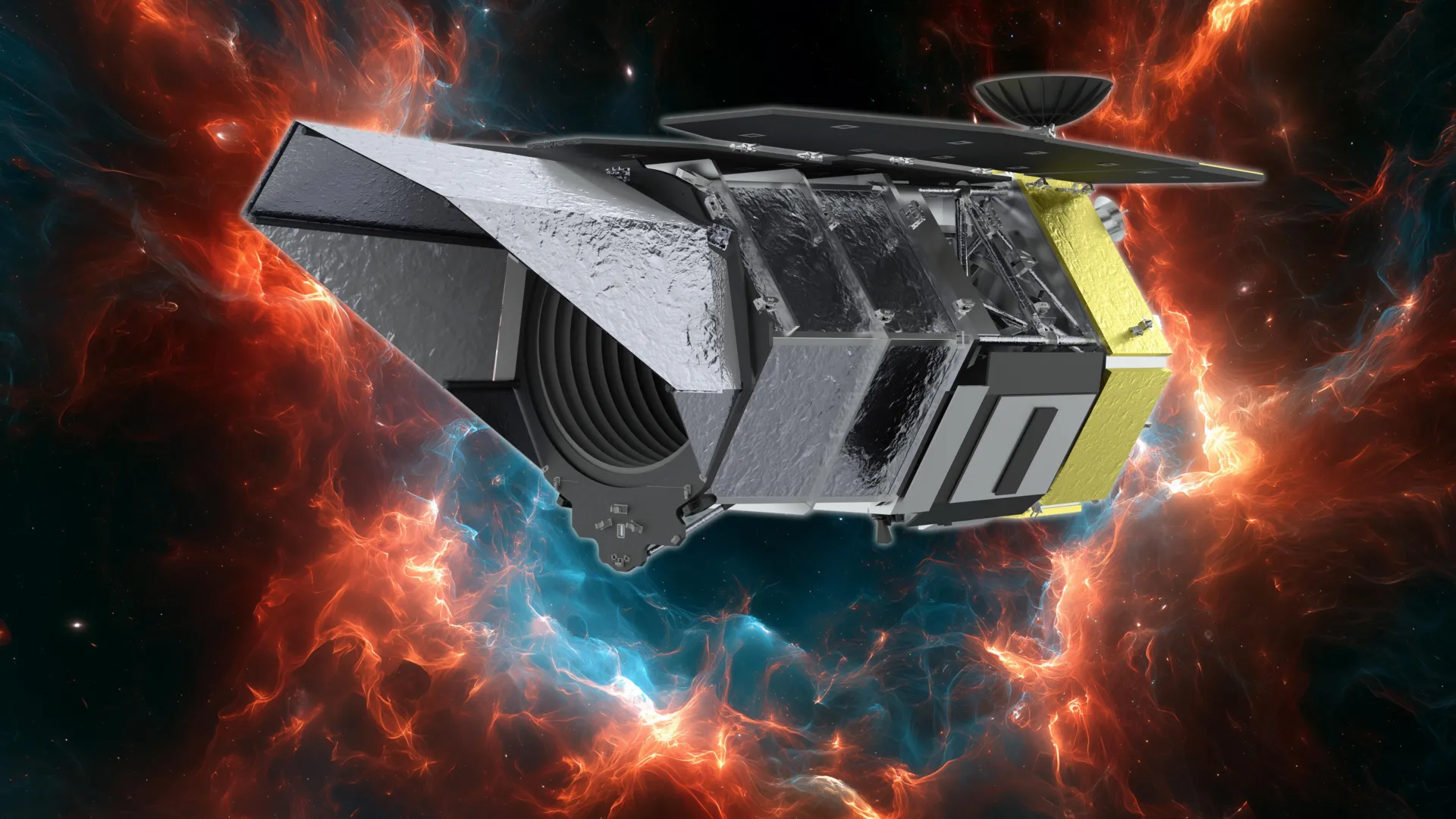
NASA’s Nancy Grace Roman Space Telescope has demonstrated its ability to maintain precise pointing stability during observations, completing a series of important validation tests. Between September 15 and 21, engineers conducted tests of the telescope’s fine-guidance system, which is responsible for keeping the observatory locked onto its targets with exceptional accuracy. The fine-guidance system works in conjunction with the attitude control system to track guide stars and make real-time corrections to counter any drift during exposures.
The Roman telescope achieved pointing stability better than 1/100,000 of a degree for extended periods, comparable to keeping a laser focused on a U.S. dime from approximately 150 miles away. For Wide Field Instrument observations, the telescope maintained this level of stability for half-hour durations, while Coronagraph Instrument observations sustained it for up to eight hours. Engineers anticipate further performance improvements as they continue refining the guidance system, potentially extending the theoretical laser-on-dime comparison to about 230 miles.
Roman will employ an innovative guidance approach that has not previously been used in this manner. Rather than relying on a separate guider instrument like other space telescopes, Roman will use spectral information—detailed wavelength patterns contained in light data—to maintain precise positioning. This approach leverages the telescope’s existing scientific instruments, allowing the same capabilities used for observations to support guidance functions.
On September 22 and 27, the team successfully tested the fine-guidance system alongside the Coronagraph Instrument, which received cosmic light for the first time. The coronagraph is designed to suppress starlight and enable the study of fainter exoplanets and dusty disks around nearby stars. During testing, the coronagraph observed stars in the Large Magellanic Cloud, with initial observations confirming the instrument could produce focused images and detect multiple stars once detectors were cooled to optimal operating temperatures. These successful tests represent progress in the instrument’s commissioning process as NASA prepares Roman for more advanced observations.
Article Attribution | Read More at Article Source
Article summary produced by Claude AI