

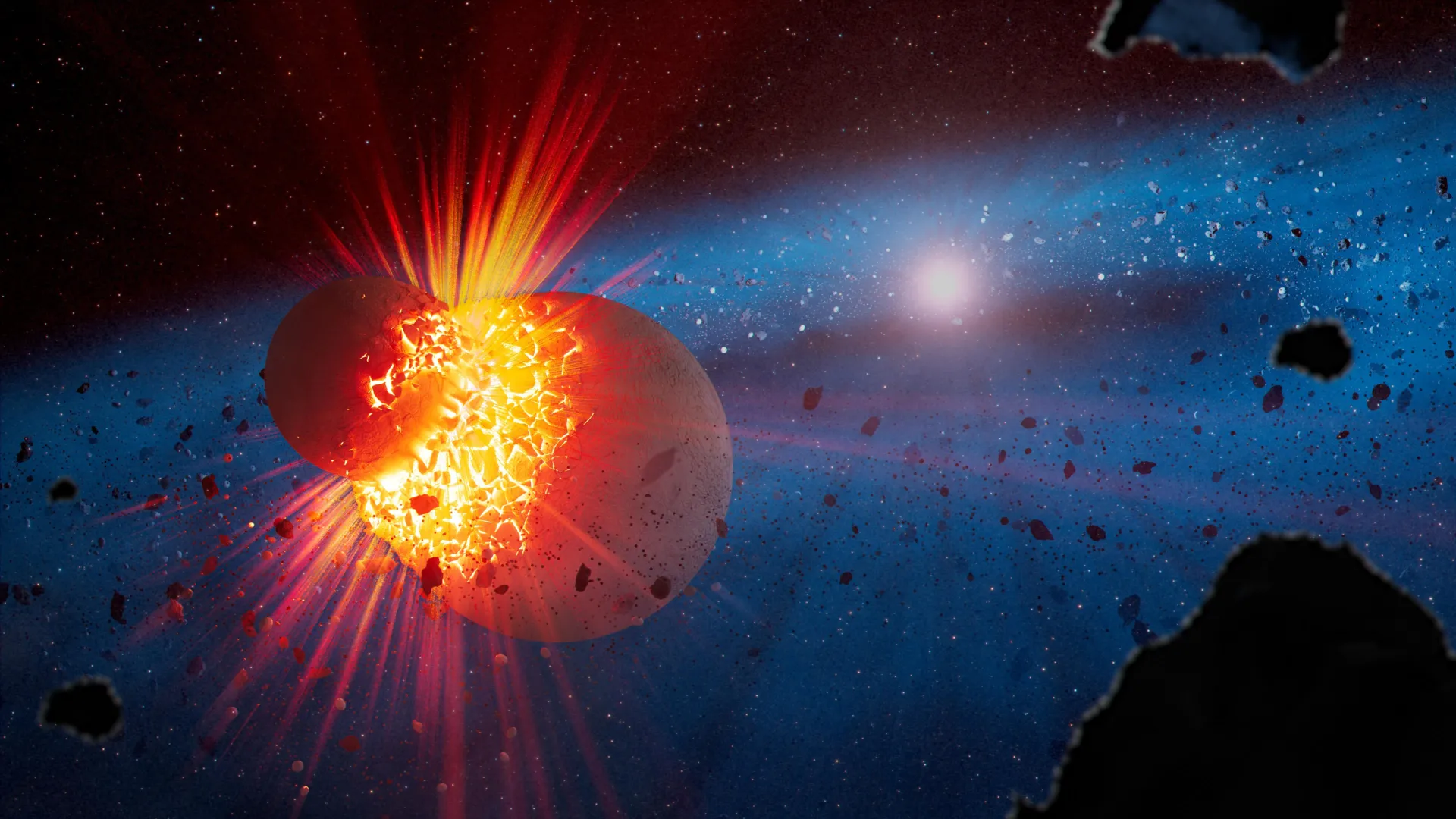
Astronomers using NASA’s James Webb Space Telescope have identified rare systems showing evidence of massive planetary collisions, offering insights into how rocky planets form and evolve. The research, led by Kate Su of the Space Science Institute and published in The Astrophysical Journal, focused on extreme debris disks—unusual systems containing exceptionally large amounts of warm dust close to their stars, located in regions similar to where rocky planets orbit in our solar system.
The team examined 21 extreme debris disks, with 12 newly observed by Webb and four representing follow-up studies of systems previously examined by NASA’s retired Spitzer Space Telescope. The researchers identified three defining characteristics of these systems: smaller dust grains compared to typical debris disks, unusually high concentrations of warm dust, and irregular brightness fluctuations over time. Analysis of mineral compositions revealed two broad categories—silica-rich and silica-poor disks—each providing clues about the collisions that produced them.
Approximately one-third of the sample consists of silica-rich disks, which scientists believe resulted from extremely energetic collisions between Mars-sized bodies powerful enough to vaporize substantial amounts of rocky material. The remaining two-thirds are silica-poor systems appearing to result from lower-energy collisions, including grazing impacts between Moon-sized objects. A significant age difference distinguishes the two groups, with silica-rich disks identified only around stars younger than 300 million years, while silica-poor disks appear around stars of varying ages and display stronger brightness variations.
The findings may help reconstruct Earth’s early history and its formation through a similar giant impact. The timeline observed in silica-rich debris disks matches estimates for terrestrial planet formation in the first few hundred million years after solar system formation, consistent with current models of how Earth and the Moon emerged. Scientists are also investigating whether the Sun may have experienced a silica-poor debris disk phase, which could align with theoretical models of our solar system’s early dynamical evolution.
Article Attribution | Read More at Article Source
Article summary produced by Claude AI