

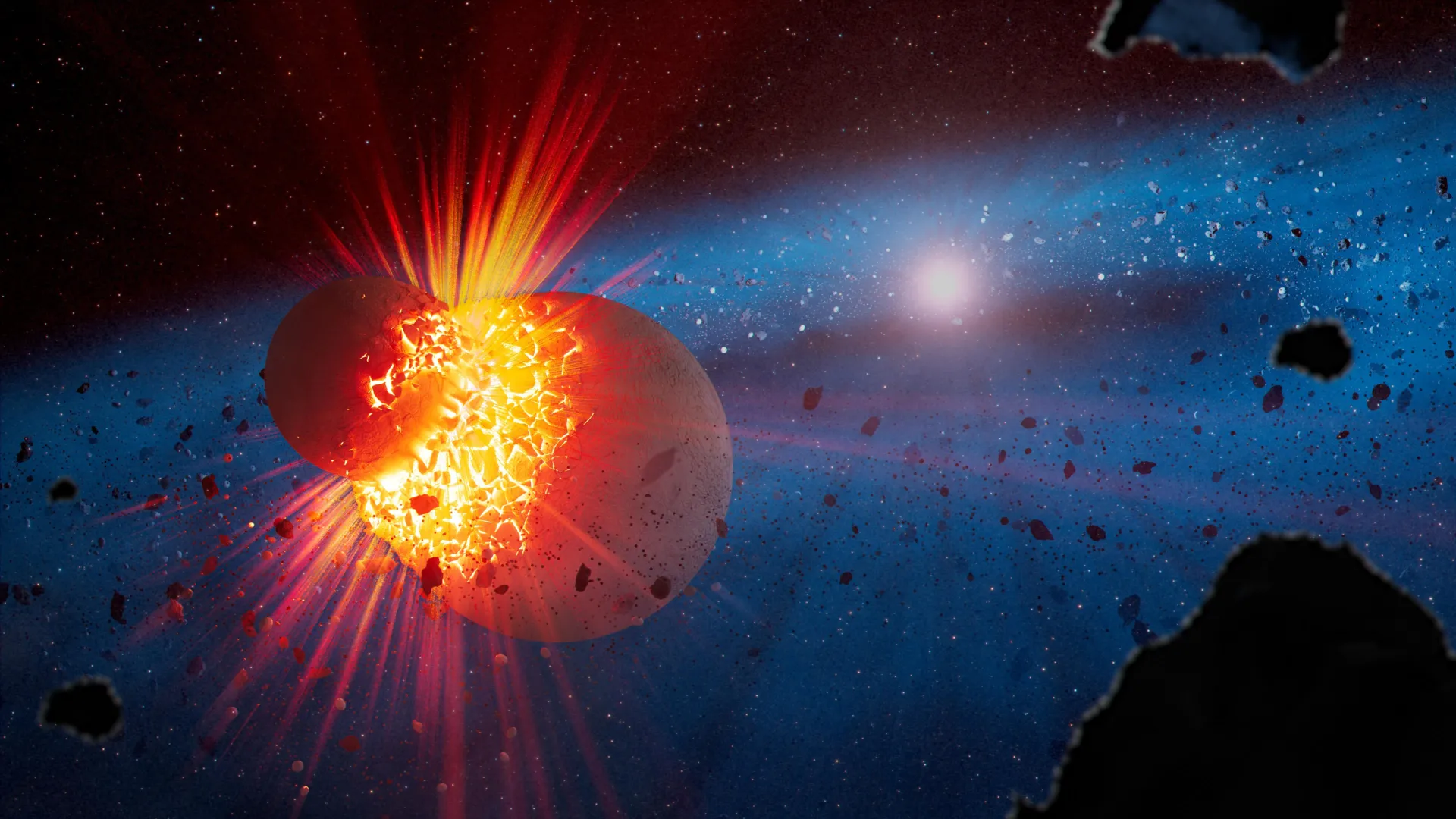
Astronomers using NASA’s James Webb Space Telescope have identified evidence of violent collisions between planetary bodies in distant young star systems. These findings, published earlier this month in The Astrophysical Journal, help researchers understand planetary formation processes similar to the impact theorized to have created Earth’s Moon billions of years ago.
The research focused on extreme debris disks—rare systems containing unusually large amounts of warm dust near young stars. Scientists had previously identified this category using NASA’s retired Spitzer Space Telescope, but observations indicated these systems are uncommon, appearing around only about 1% of young stars. A team led by Kate Su of the Space Science Institute compiled a sample of 21 extreme debris disks for detailed analysis, combining archival Spitzer data with new Webb observations.
The Webb observations revealed three defining characteristics of extreme debris disks: smaller-than-typical dust grains, high concentrations of warm dust, and irregular changes in brightness over time. Analysis of mineral composition divided the systems into two categories—silica-rich and silica-poor disks. Silica-rich disks, identified only around stars younger than 300 million years, are believed to result from extremely energetic collisions between Mars-sized bodies. The silica-poor disks appear to stem from lower-energy collisions involving Moon-sized objects and were found around stars of varying ages, showing greater brightness variability.
These findings have implications for understanding Earth’s early history. The timeline and energy levels of the silica-rich disk systems align with theoretical models for terrestrial planet formation within a solar system’s first few hundred million years, matching estimates for when Earth and its Moon formed. The research also suggests our solar system may have experienced similar extreme debris disk phases during its development, potentially providing clues about the giant planets’ orbital evolution and the events shaping our cosmic neighborhood.
Article Attribution | Read More at Article Source
Article summary produced by Claude AI