

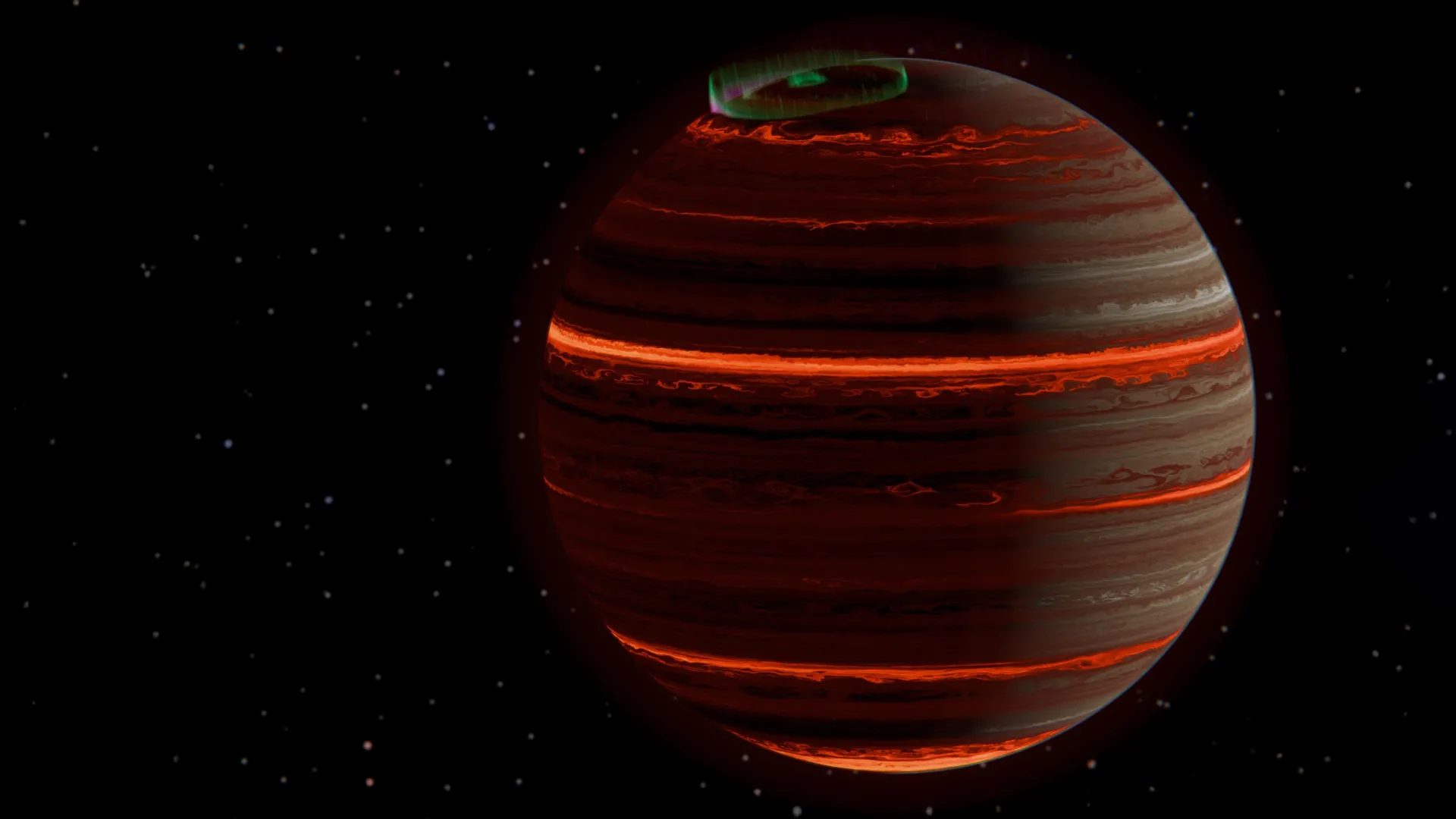
Scientists from Trinity College Dublin have identified a systematic approach to understanding atmospheric conditions on distant celestial objects by analyzing data from NASA’s James Webb Space Telescope. The research focused on SIMP 0136, a brown dwarf located approximately 20 light-years from Earth, using mathematical analysis to decode complex weather patterns previously considered unpredictable.
The team employed a technique called Principal Component Analysis to examine variations in the brown dwarf’s brightness as it rotated, revealing hidden patterns in its atmosphere. Rather than starting with predetermined assumptions about atmospheric behavior, the researchers let observational data guide their analysis. The method proved effective at distinguishing genuine atmospheric changes from measurement noise, enabled by Webb’s highly sensitive instruments that can detect minute fluctuations in the object’s brightness across different wavelengths.
The analysis yielded surprising results, showing that despite appearing chaotic, the brown dwarf’s atmosphere is largely controlled by two key factors related to temperature fluctuations and vertical cloud arrangement. Researchers identified three distinct recurring weather states that rotate into and out of view, creating shifting atmospheric patterns with regions of varying heat and cloud density. These patterns demonstrated remarkable consistency over multiple observations, suggesting underlying structural organization rather than random chaos.
Brown dwarfs occupy a unique position between planets and stars, larger and hotter than typical gas giants but lacking sufficient mass to function as stars. SIMP 0136 features enormous cloud systems with rapid evolution, more comparable to extreme versions of Jupiter’s weather than Earth’s conditions. According to lead researcher Merle Schrader, the light observed by Webb in 2023 had left the brown dwarf during her birth year, illustrating the vast distances involved.
The findings hold significant implications for studying exoplanet atmospheres. Since brown dwarfs can be directly observed unlike most planets orbiting distant stars, they provide valuable laboratories for testing atmospheric processes under extreme conditions. The new analytical technique could streamline future investigations by quickly identifying dominant atmospheric drivers, allowing astronomers to prioritize which features warrant detailed computer modeling and further study.
Article Attribution | Read More at Article Source
Article summary produced by Claude AI