

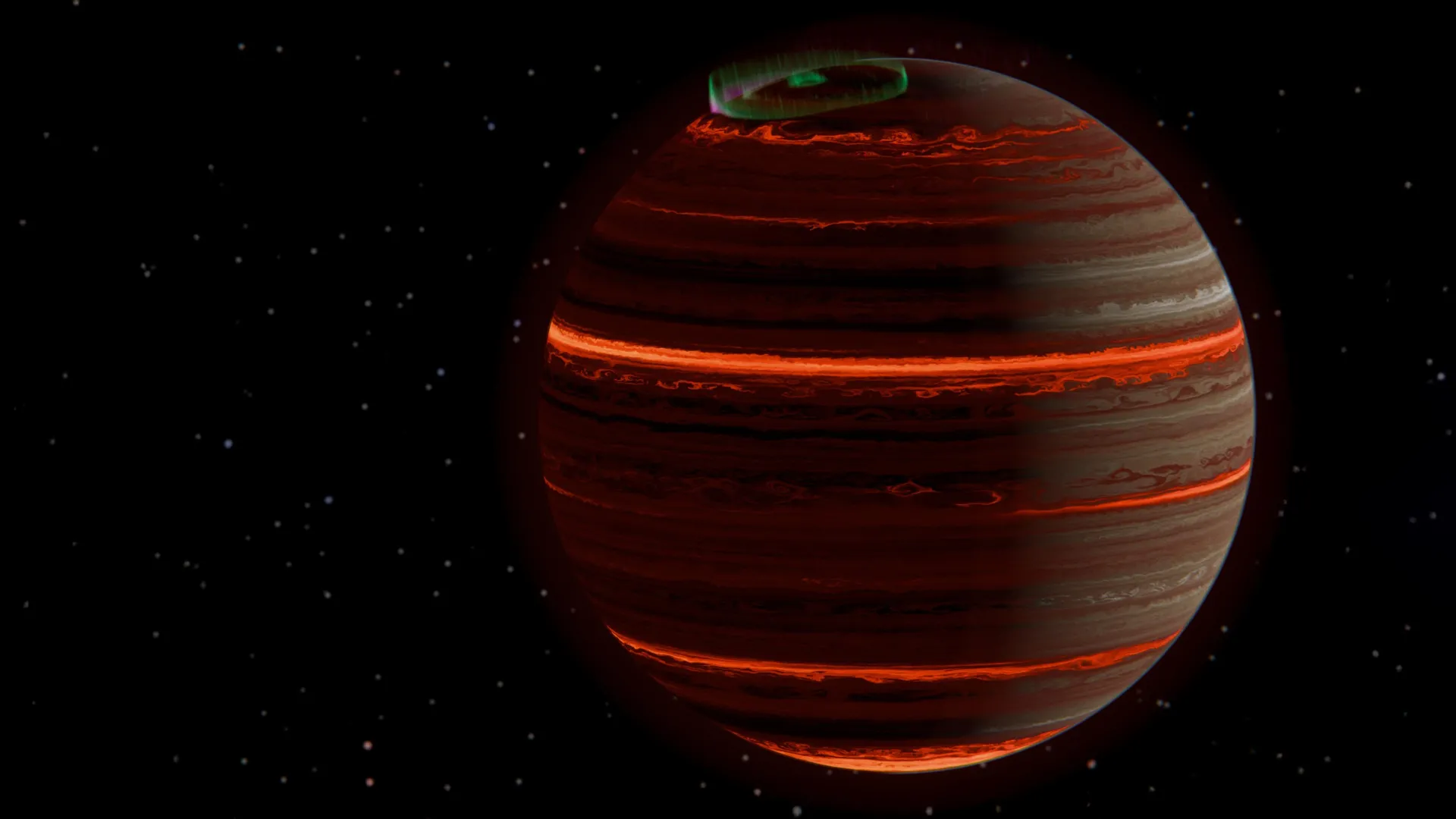
Scientists at Trinity College Dublin have employed NASA’s James Webb Space Telescope to study atmospheric conditions on SIMP 0136, a brown dwarf located approximately 20 light-years from Earth. The research team applied a mathematical technique called Principal Component Analysis to examine data collected by the space observatory, allowing them to identify dominant patterns in the object’s complex atmosphere without relying on pre-existing assumptions about how it should behave.
The analysis revealed an unexpected finding: despite appearing highly chaotic, SIMP 0136’s atmospheric variability could be explained by just two primary components related to temperature fluctuations and the vertical arrangement of cloud layers. The researchers identified three recurring weather states that shift in and out of view as the brown dwarf rotates, creating an atmospheric patchwork of regions with varying temperatures and cloud thicknesses. Rather than changing unpredictably, these patterns appear to follow a consistent underlying structure that persists over multiple rotations, even as the atmosphere’s detailed appearance continues to evolve.
Brown dwarfs occupy a unique position between planets and stars, larger and hotter than typical gas giants but lacking sufficient mass to function as stars. SIMP 0136’s massive cloud systems and extreme weather conditions create an environment far more dramatic than anything found on Jupiter or Earth. The research, published in Astronomy & Astrophysics, demonstrates that seemingly chaotic atmospheric systems can be governed by remarkably consistent processes.
The findings have broader implications for astronomy. The technique developed by the Trinity team could enhance how astronomers analyze future James Webb observations of brown dwarfs and exoplanets. Since brown dwarfs can often be directly observed, they provide valuable opportunities to study atmospheric processes that are difficult to investigate on most exoplanets orbiting distant stars, including cloud formation, heat distribution, and atmospheric circulation under extreme conditions.
Article Attribution | Read More at Article Source
Article summary produced by Claude AI