

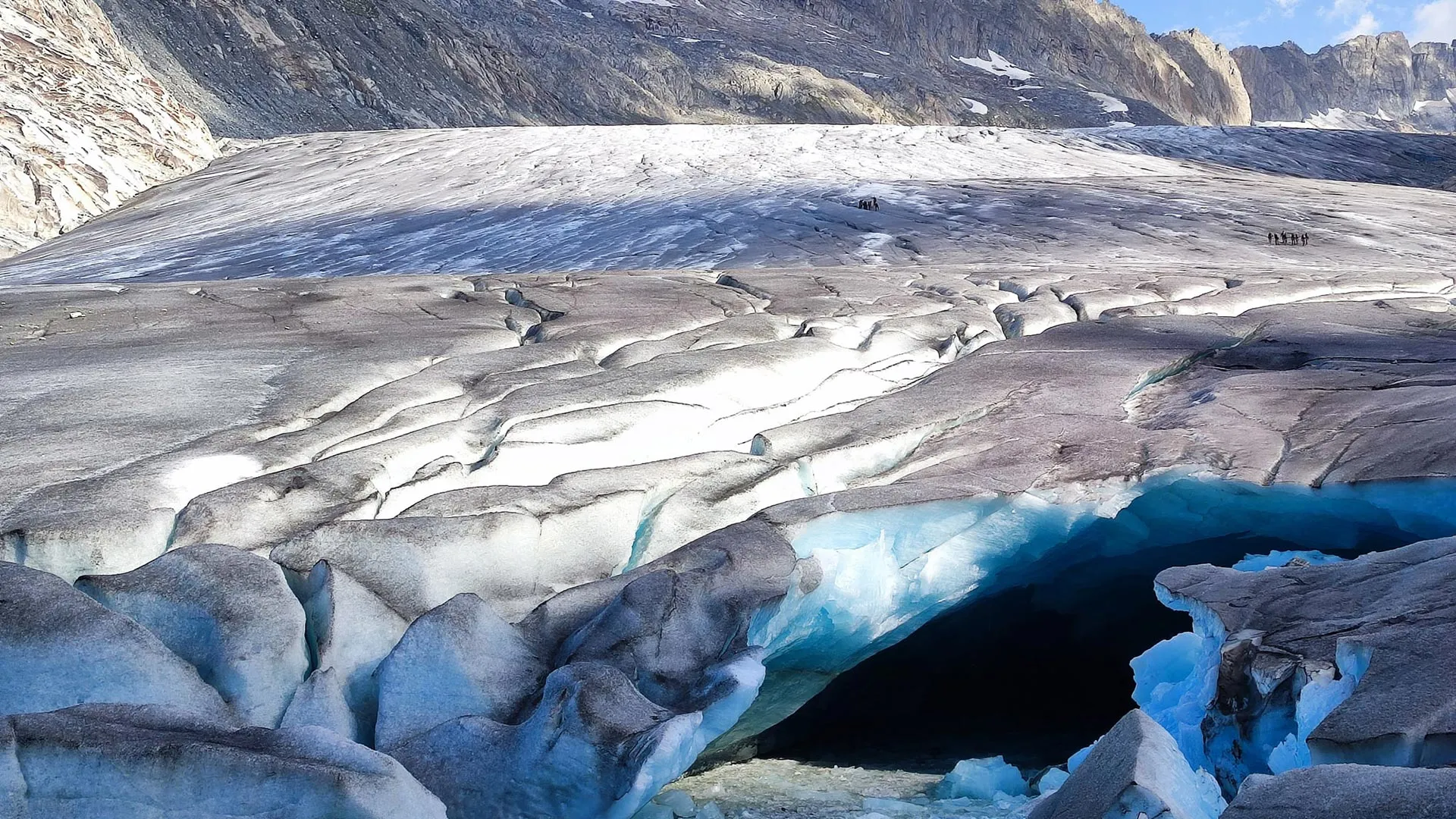
Switzerland experienced significant glacial loss this year, with glaciers shedding more than 5% of their total ice volume. This marked another severe year for the country’s alpine ice, though not quite equaling the record losses from 2022. The average thickness of glaciers decreased between 2.5 to 4 meters, with lower glacier sections losing substantially more in some instances.
Major Swiss glaciers including Rhône, Aletsch, and Clariden experienced their worst melting on record. Additionally, several smaller glaciers disappeared entirely during the year, among them Bella Tola and Griessfirn. When measured over a five-year period, the cumulative loss becomes more dramatic, with Switzerland having shed nearly 20% of its total glacier ice volume.
These observations come from annual monitoring conducted by the Swiss Academy of Sciences through its Glacier Monitoring Network, which operates through ETH Zurich and partner universities. The extensive melting resulted from a combination of factors: the winter of 2025 to 2026 ranked among Switzerland’s ten least snowy winters on record, leaving glaciers with reduced protective snow cover. Summer conditions between May and September 2026 proved particularly challenging, with persistent heat and dry weather accelerating melting at all elevations.
Temperature records were set during the measurement period, with the freezing level elevation exceeding 4,000 meters on 76 days—more than double the typical frequency—establishing a new Swiss benchmark. By the end of summer, snow had retreated to such high elevations that glacier ice became exposed at 3,500 meters.
While the extensive melting temporarily eased Switzerland’s water supply pressures, releasing approximately 2.2 trillion liters between July and September, this benefit carries limitations. As glaciers continue shrinking, the volume of meltwater they can supply will inevitably decline, reducing a resource that currently provides seasonal relief during warmer months.
Article Attribution | Read More at Article Source
Article summary produced by Claude AI