

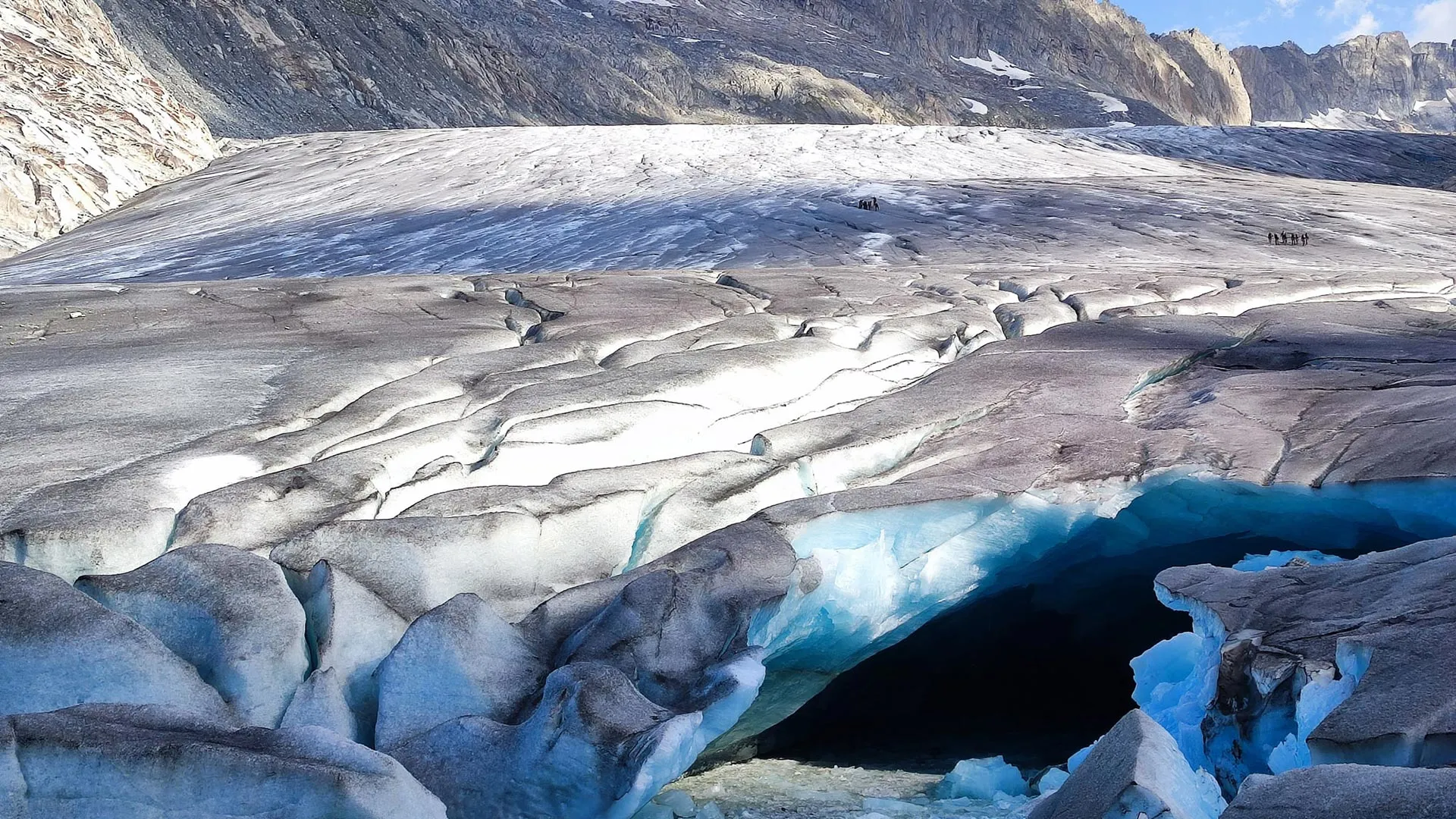
Switzerland’s glaciers experienced significant ice loss in 2026, shedding more than 5% of their total volume and marking another severe year of decline for the country’s mountain ice reserves. The average glacier thinned between 2.5 and 4 meters, though lower sections in certain areas lost as much as 10 meters. While this melting did not surpass the record losses recorded in 2022, the ongoing deterioration continues to reshape Switzerland’s alpine landscape.
Several prominent glaciers, including the Rhône, Aletsch, and Clariden, reached their highest melting rates on record during the year. The situation proved particularly acute for smaller glaciers, with some disappearing entirely. The Bella Tola glacier in Valais and the Griessfirn glacier in Glarus both vanished permanently in 2026. Over a five-year span, Switzerland has lost approximately 20% of its total glacier ice volume, reflecting the rapid transformation occurring across the country’s mountains.
These assessments come from the Swiss Academy of Sciences’ annual report, which relies on data collected through the Glacier Monitoring Network, or GLAMOS, based at ETH Zurich and the universities of Fribourg and Zurich. The research team attributes the extensive melting to a combination of factors, including remarkably low snowfall during the winter of 2025 to 2026—ranking among the ten least snowy winters in Swiss records—and sustained heat through the summer months. Between May and September, persistent high temperatures and dry conditions accelerated ice loss at all elevations.
Temperatures reached freezing levels above 4,000 meters on 76 days during summer 2026, more than double the typical frequency and a new Swiss record. By September, snow had retreated to elevations of 3,500 meters, exposing underlying glacier ice that would normally remain covered. The massive melting provided a temporary benefit, with approximately 2.2 trillion liters of water released between July and September—roughly four times Switzerland’s annual household drinking water consumption. However, as glacier volumes continue their irreversible decline, the supply of meltwater available to address future water shortages will correspondingly diminish.
Article Attribution | Read More at Article Source
Article summary produced by Claude AI