

Researchers at Yale University have completed a comprehensive analysis of how ancient animals transitioned from terrestrial to aquatic lifestyles, examining hundreds of fossil and modern specimens from institutions worldwide. The study, published in Current Biology, employed a combination of traditional paleontological methods, machine learning models, and statistical techniques to investigate one of vertebrate evolution’s most significant transitions. Lead author Caleb Gordon collected extensive data including over 11,000 measurements, photographs, and CT scans to reconstruct the evolutionary adaptations of secondarily aquatic species.
The research focused on resolving long-standing scientific debates about specific prehistoric animals’ lifestyles. Paleontologists have historically disagreed on whether certain extinct species were primarily aquatic, terrestrial, or amphibious, as the fossil record often provides incomplete or conflicting evidence. Gordon developed machine learning models trained on living animals to identify relationships between skeletal proportions and known lifestyles, enabling researchers to estimate how extinct species used aquatic environments and predict soft tissue adaptations that rarely survive fossilization.
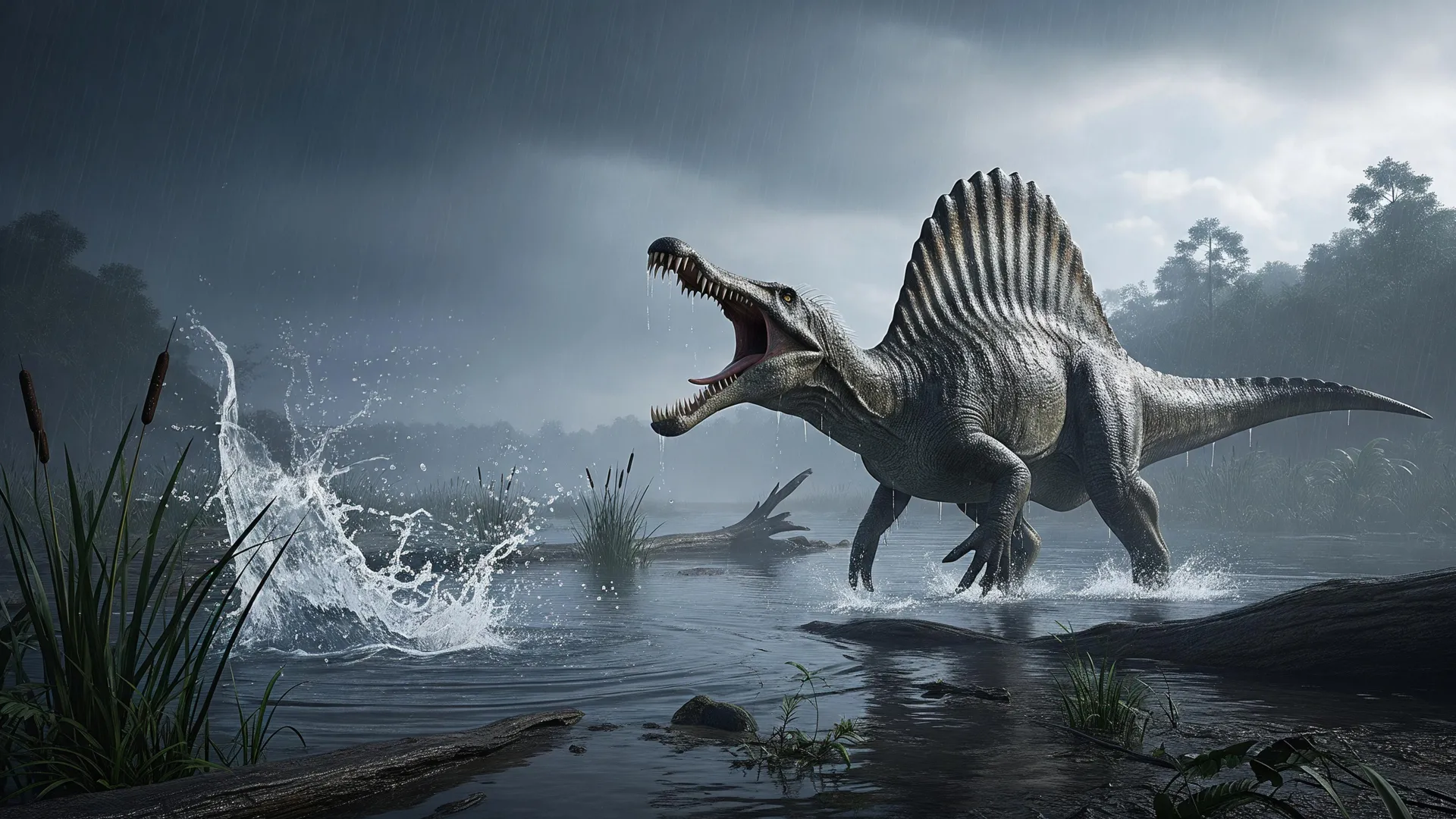
One significant finding concerns Spinosaurus, a giant dinosaur that inhabited what is now northern Africa approximately 113 million to 94 million years ago. The team’s analysis supports the interpretation that Spinosaurus spent the vast majority of its time submerged underwater, hunting prey like modern seals or penguins, rather than pursuing a heron-like shoreline existence as some researchers have suggested. This conclusion strengthens arguments that the enormous predator was substantially more aquatic than terrestrial.
The study reached different conclusions about mesosaurs, small marine reptiles from 290 million to 274 million years ago. Despite long-standing theories suggesting their live-bearing reproduction indicated fully aquatic existence, the analysis indicates their skeletal proportions reflected an amphibious lifestyle similar to modern alligators or platypuses. The researchers found that all Paleozoic marine reptiles appeared to maintain regular contact with land, with none achieving completely aquatic adaptation. Using forelimb proportions as indicators, the models predicted soft tissue flippers and aquatic habits with greater than 90% accuracy.
Article Attribution | Read More at Article Source
Article summary produced by Claude AI