

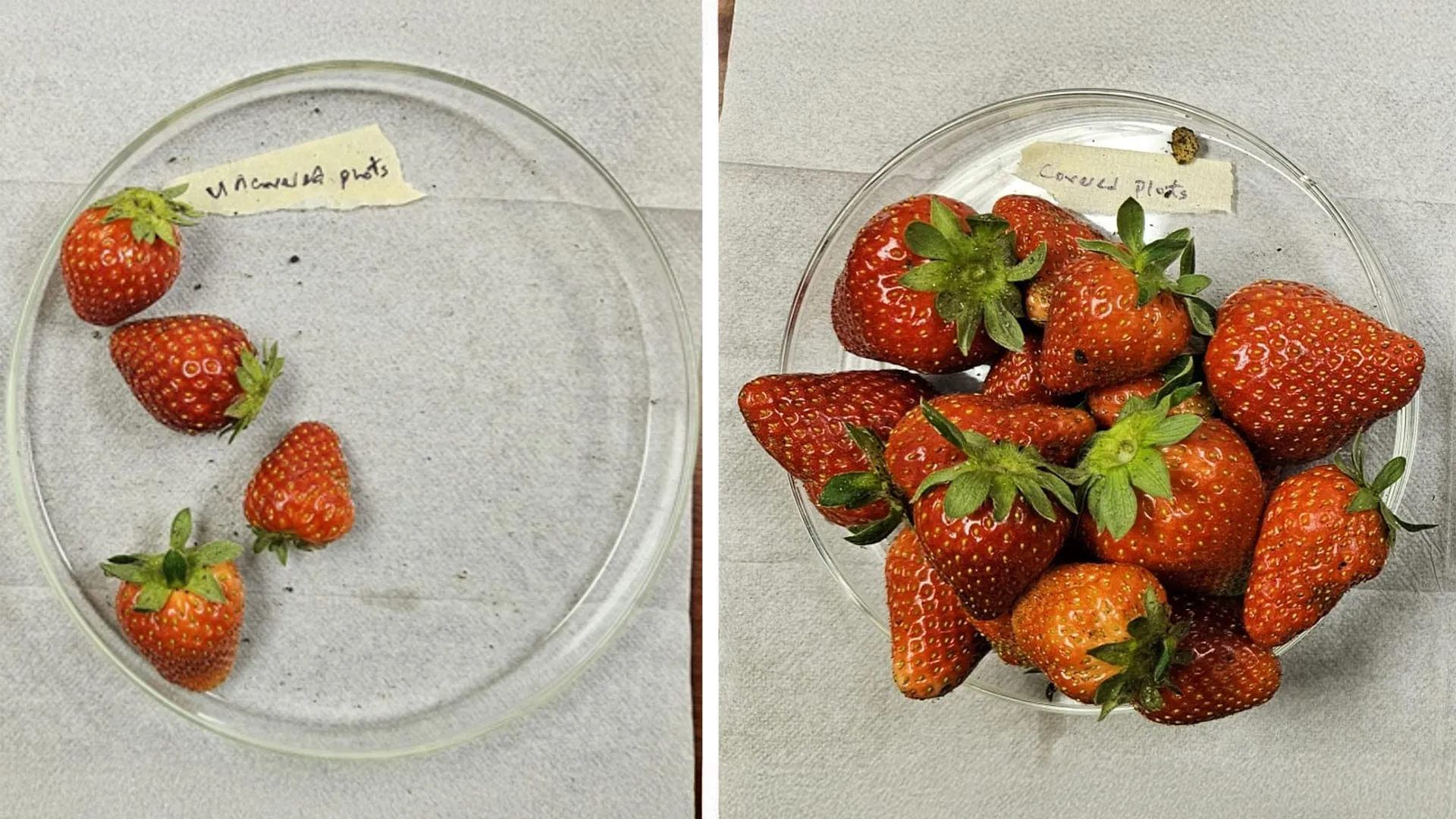
Researchers at North Carolina State University have developed a specialized fabric covering that dramatically enhanced strawberry production in controlled field testing. The textile, designated Plant Armor, is placed directly over strawberry plants and features a three-dimensional porous structure that permits the passage of sunlight, rainfall, and air while physically blocking insects from accessing the crops.
Trial results demonstrated substantial productivity gains, with covered plants producing yields reaching 3.56 times those of unprotected plants across three growing seasons. The fabric maintained adequate light transmission and did not negatively impact relative humidity levels around the plants. Beyond yield increases, researchers observed that the textile generated a consistent warming effect that enabled covered plants to progress through developmental stages more rapidly than their uncovered counterparts, allowing them to reach the fruiting phase earlier in the growing cycle.
The warming benefit functioned by providing plants with optimal accumulated heat units, or growing degree-days, necessary for advancing through various phenological stages. Graduate research assistant Gabriel Olawuyi noted that the physical barrier created by Plant Armor also presents opportunities for reducing conventional pesticide applications, since the fabric prevents insect feeding on protected plants. These characteristics suggest potential for decreased water consumption and lower chemical inputs in strawberry agriculture.
The technology originated unexpectedly from military textile research aimed at improving soldier comfort and reducing mosquito-bite transmission through protective uniforms. This crossover application demonstrates the value of interdisciplinary scientific collaboration, according to co-author R. Michael Roe. The research, published in the journal Agriculture, was supported by grants from the North Carolina Agricultural Foundation and the U.S. Department of Agriculture’s National Institute of Food and Agriculture. North Carolina State University holds the patent on the Plant Armor Gen 2 fabric and has licensed the technology for commercial development.
Article Attribution | Read More at Article Source
Article summary produced by Claude AI