

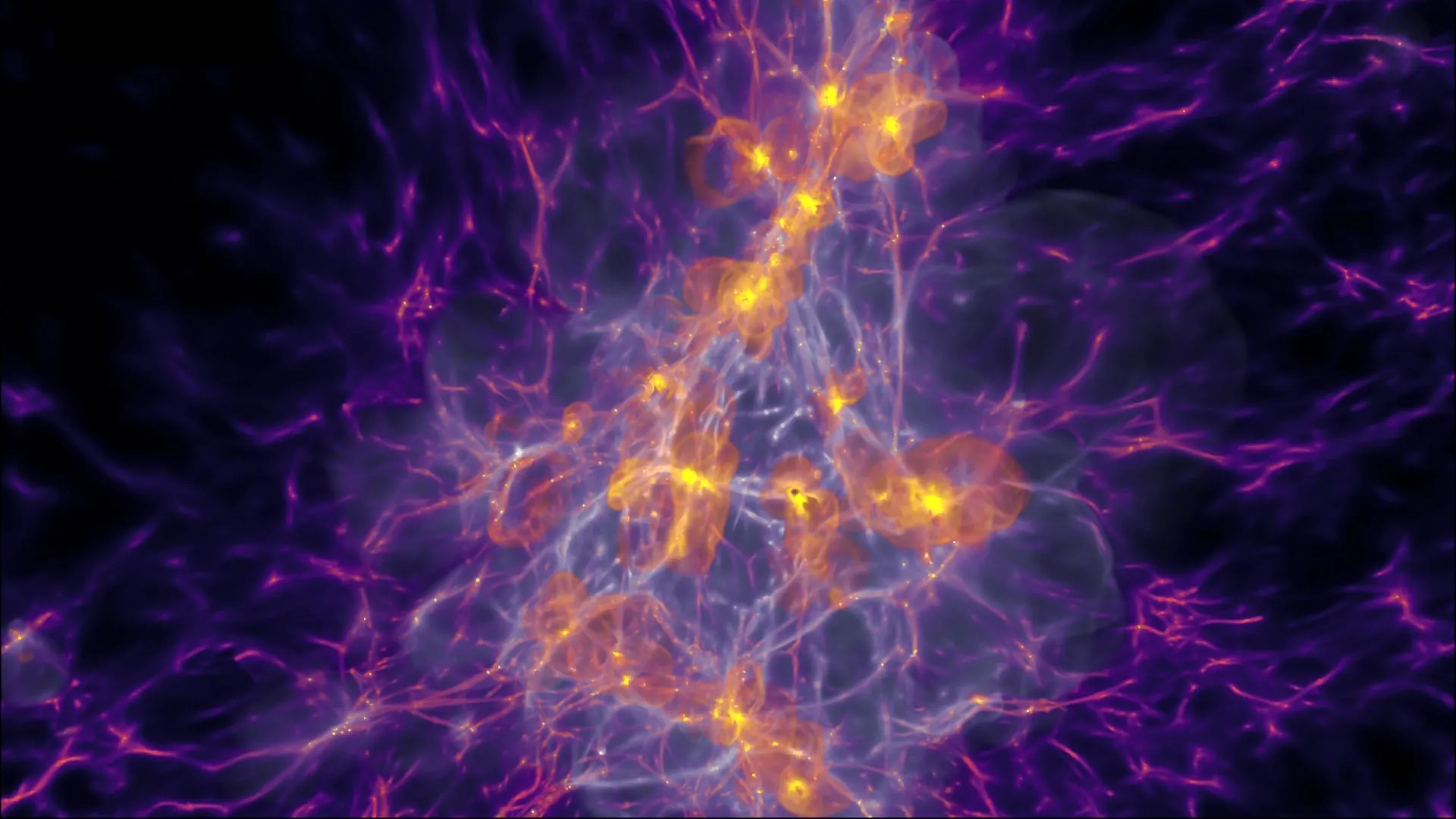
An international collaboration known as MEGATRON, led by researchers at the University of Bath with partners at the University of Chicago and the Institut d’Astrophysique de Paris, has published four studies examining how the earliest stars and galaxies illuminated the previously dark universe. The project combines advanced cosmological simulations with detailed models of radiation, chemistry, and galaxy formation to understand how these early stellar systems created and dispersed the chemical elements that would later become essential for planetary formation and life.
The research aims to bridge two different sources of evidence about the early universe. One comes from observations of distant young galaxies captured by the James Webb Space Telescope, while the other derives from chemical signatures found in some of the oldest stars within and around the Milky Way. By examining the chemical fingerprints in these ancient stars, scientists can infer characteristics of the first stars and how they began enriching the cosmos with its earliest chemical elements. The MEGATRON simulations track the evolution of a young galaxy toward a system comparable in mass to the Milky Way, simultaneously monitoring how gas moves, how starlight travels through space, and how chemical element concentrations change over billions of years.
The findings suggest that simpler modeling approaches may underestimate how strongly stellar radiation and chemical processes affect the gas surrounding galaxies. By running simulations at exceptionally high resolution, the researchers captured gas structures that less detailed models miss. According to Dr. Martin Rey from the University of Bath, MEGATRON provides a physical bridge between observations from the James Webb Space Telescope and stellar archaeology, helping answer fundamental questions about where the elements comprising the modern universe originated.
The MEGATRON project, which began in 2023 and is scheduled through 2030, has received 40 million processor hours on UK national supercomputers. The team is developing next-generation simulations with greater resolution and more comprehensive physical models, allowing for increasingly direct comparisons between theoretical predictions and astronomical observations of the early universe.
Article Attribution | Read More at Article Source
Article summary produced by Claude AI