

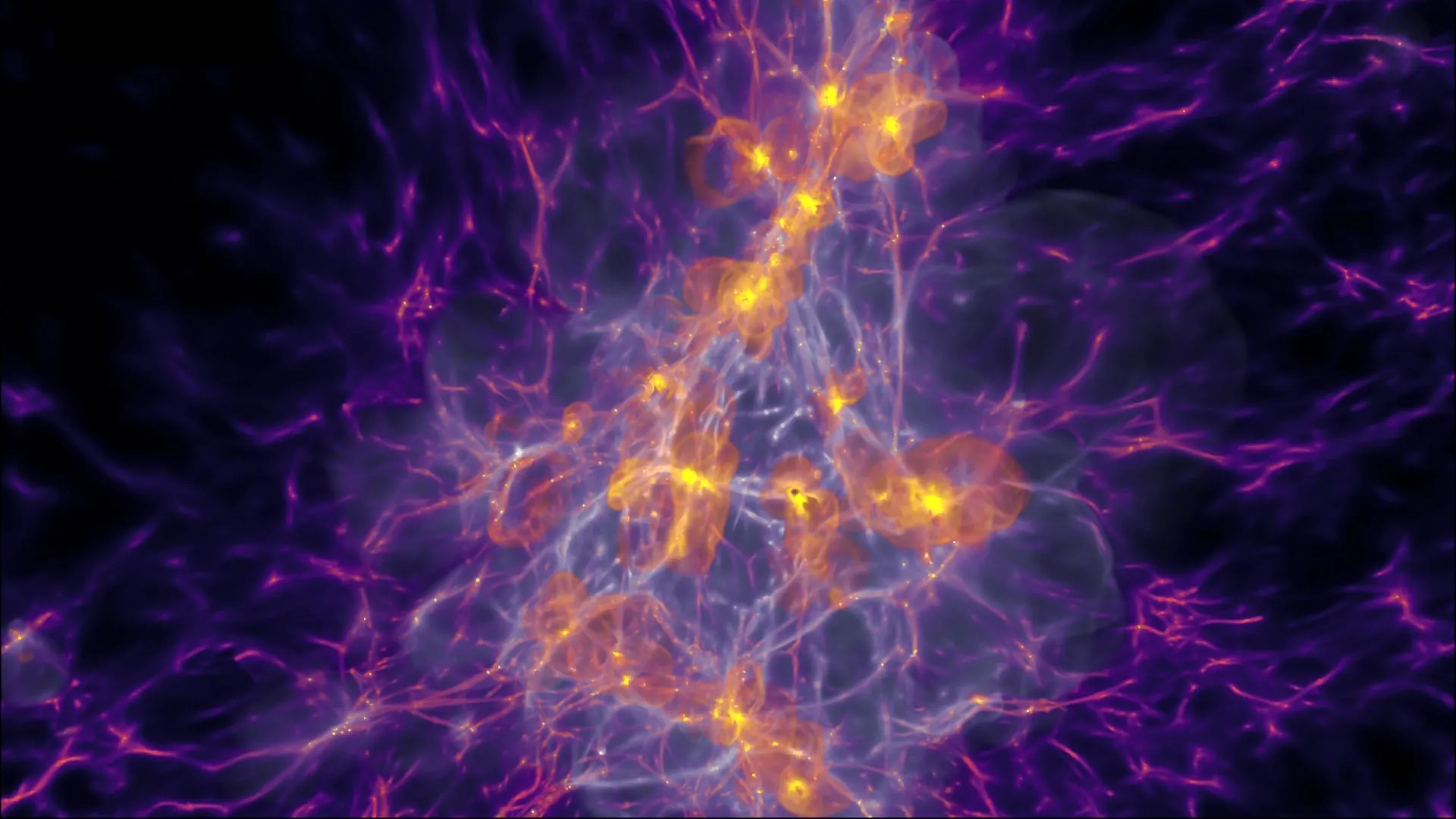
A collaborative research initiative called MEGATRON is employing sophisticated computational simulations to examine the epoch when the universe’s first stars and galaxies formed. The project, led by the University of Bath in partnership with institutions in the United States and France, aims to understand how these early stellar systems illuminated the previously dark cosmos and began creating the chemical elements that would eventually form planets and enable life.
Four studies published in the Open Journal of Astrophysics represent the project’s initial major findings. These studies combine advanced cosmological simulations with detailed models accounting for radiation, chemistry, and galaxy formation. The research demonstrates that accurate modeling of interactions between starlight, gas, and newly synthesized elements is essential for connecting two distinct types of evidence about the early universe: direct observations of distant galaxies captured by the James Webb Space Telescope and chemical signatures preserved within some of the oldest known stars in the Milky Way region.
The MEGATRON simulations track the evolution of young galaxies over billions of years, monitoring how gas moves, how starlight propagates, and how chemical element concentrations change. These high-resolution models reveal fine structures in gas that simpler approaches fail to capture, suggesting that less detailed models may significantly underestimate the effects of stellar radiation and chemical processes on galactic surroundings.
The simulations begin with pristine gas devoid of heavy elements, recreating conditions shortly after the Big Bang, then follow the formation of first-generation stars, their radiation output, supernova explosions, and the dispersal of newly created elements to subsequent stellar generations. This computational framework provides what researchers describe as a physical bridge between James Webb observations of infant galaxies and stellar archaeology conducted within the local galactic neighborhood.
The project, which began in 2023 and continues through 2030, has been allocated 40 million processor hours on national supercomputers. Future work will employ even greater computational resolution to strengthen connections between theoretical models and astronomical observations, potentially offering clearer understanding of cosmic element origins.
Article Attribution | Read More at Article Source
Article summary produced by Claude AI