

Scientists have long recognized quantum entanglement as a fundamental resource for developing advanced quantum technologies, including secure communication systems, quantum computers, and methods for transferring quantum information. Entanglement occurs when particles become so deeply connected that their individual properties cannot be described separately from the system as a whole. However, harnessing entanglement for practical applications requires researchers to efficiently identify and characterize the specific types of entangled states they produce.
Traditional approaches to this challenge rely on quantum tomography, a technique that reconstructs quantum states through numerous measurements. The limitation of this method becomes evident when working with multiple photons—the quantity of data required grows exponentially with each additional photon added to the system. This computational burden makes it increasingly impractical for larger entangled systems. Researchers have explored an alternative approach known as entangled measurement, which can identify certain quantum states using a single measurement rather than requiring extensive data collection and reconstruction.
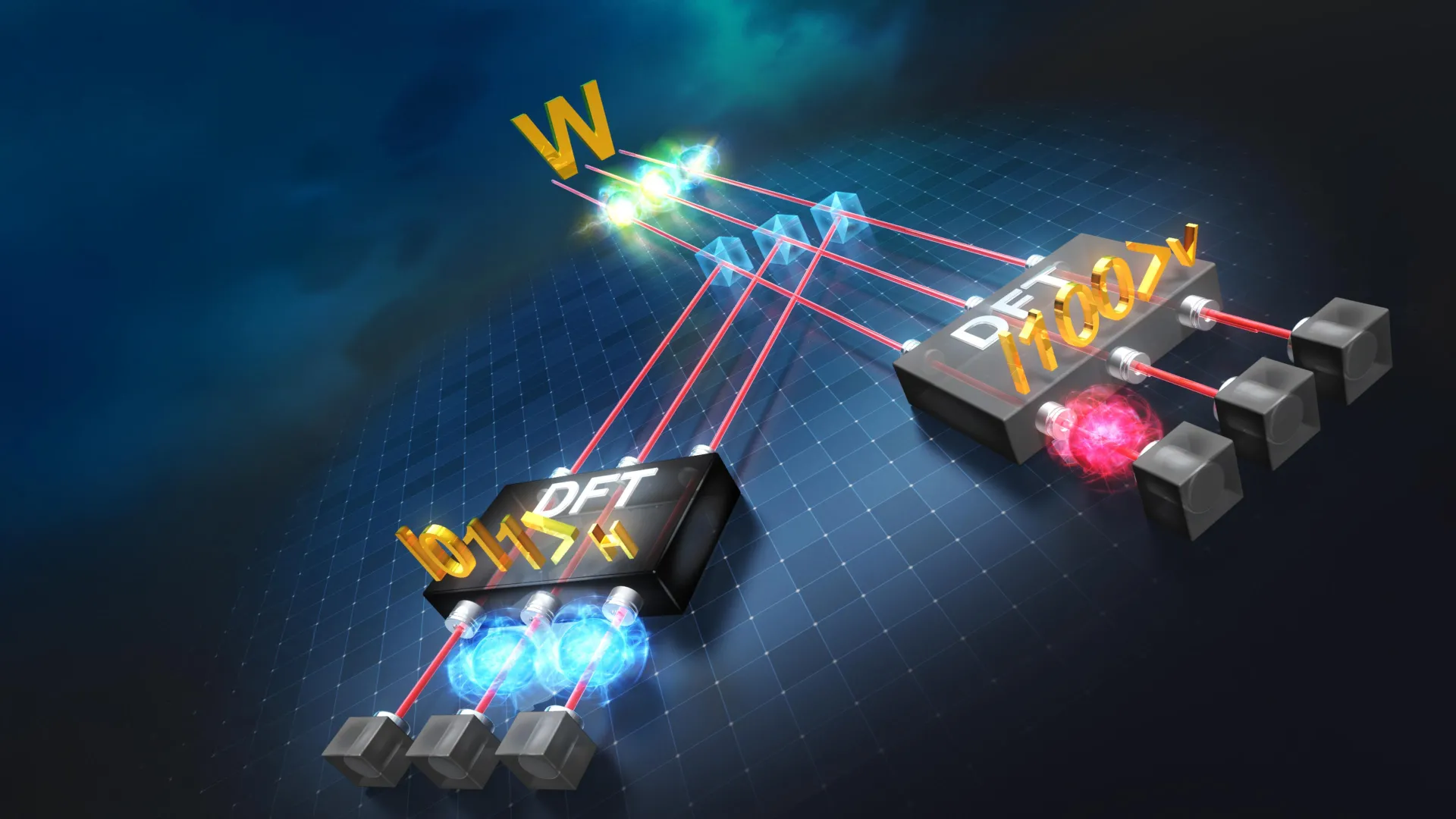
While scientists had previously demonstrated entangled measurement techniques for the Greenberger-Horne-Zeilinger state, no comparable method had been successfully developed for the W state, another crucial form of multi-photon entanglement. Teams at Kyoto University and Hiroshima University undertook a project to fill this gap by developing a new entangled measurement approach based on mathematical properties of the W state. Their method employs a quantum Fourier transformation within a photonic quantum circuit, leveraging the cyclic shift symmetry inherent to W states to reveal quantum correlations that would otherwise be difficult to detect.
The researchers demonstrated their technique experimentally using three-photon systems, creating optical devices capable of distinguishing between different types of W-state configurations. Their measurements showed that the system could reliably identify these states with high fidelity. The team has indicated plans to extend the method to larger multi-photon systems and to develop compact on-chip implementations, potentially enabling broader integration into future quantum technology platforms. Applications for this advancement include quantum teleportation, new quantum communication protocols, and measurement-based quantum computing approaches.
Article Attribution | Read More at Article Source
Article summary produced by Claude AI