

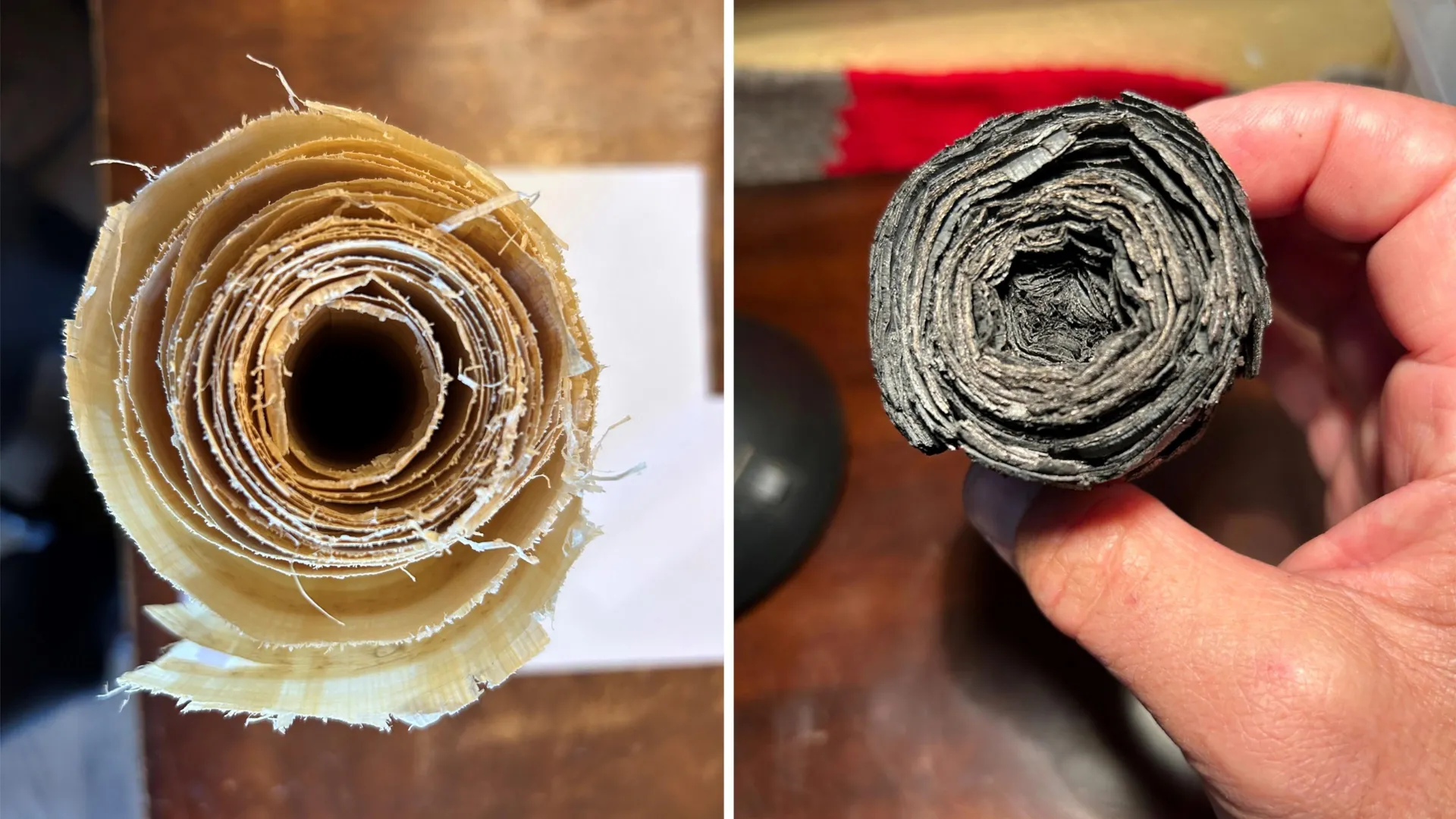
Researchers at UC Berkeley conducted an experiment to test whether ancient charred papyrus scrolls could be read without physical unrolling, which risks destroying fragile materials. Affiliate Douglas Seiler obtained authentic papyrus, reed pens, and traditional ink, then had high school students write sample texts before carbonizing the documents in a furnace to simulate conditions from the Mount Vesuvius eruption of 79 C.E.
The team discovered that inks containing lead produced strong contrasts when scanned with X-ray tomography, absorbing up to 25 times more X rays than the surrounding burned papyrus. This differential absorption allowed the writing to become detectable and readable through virtual reconstruction. The findings, published on Sept. 16 in PLOS ONE, suggest that researchers could identify and read lead-based inks without handling the brittle originals. Additionally, handheld X-ray fluorescence scanners proved effective for screening scrolls to determine which ones contain lead ink and would be suitable candidates for detailed imaging.
The implications extend to the Villa of the Papyri in Herculaneum, which contains approximately 1,800 scrolls and fragments housed in collections across Italy, France, and England. This represents the only known intact library surviving from antiquity. Previous attempts to physically unroll these carbonized documents frequently resulted in destruction, though the scrolls that were successfully opened revealed previously unknown ancient texts, including works by philosopher Philodemus. Many of these documents represent original writings from Roman intellectual circles rather than later copies, making them invaluable primary sources.
Experts emphasize the unprecedented significance of accessing this collection. Papyrologists note that most ancient literature has been lost entirely, surviving only through later manuscript copies or in dry climates like Egypt. The Herculaneum scrolls offer direct connection to ancient authors’ actual writing, potentially recovering lost works of Greek and Roman philosophy, literature, and science. The research suggests a systematic search for lead-based inks across the collection could substantially advance scholarship on the ancient world.
Article Attribution | Read More at Article Source
Article summary produced by Claude AI