

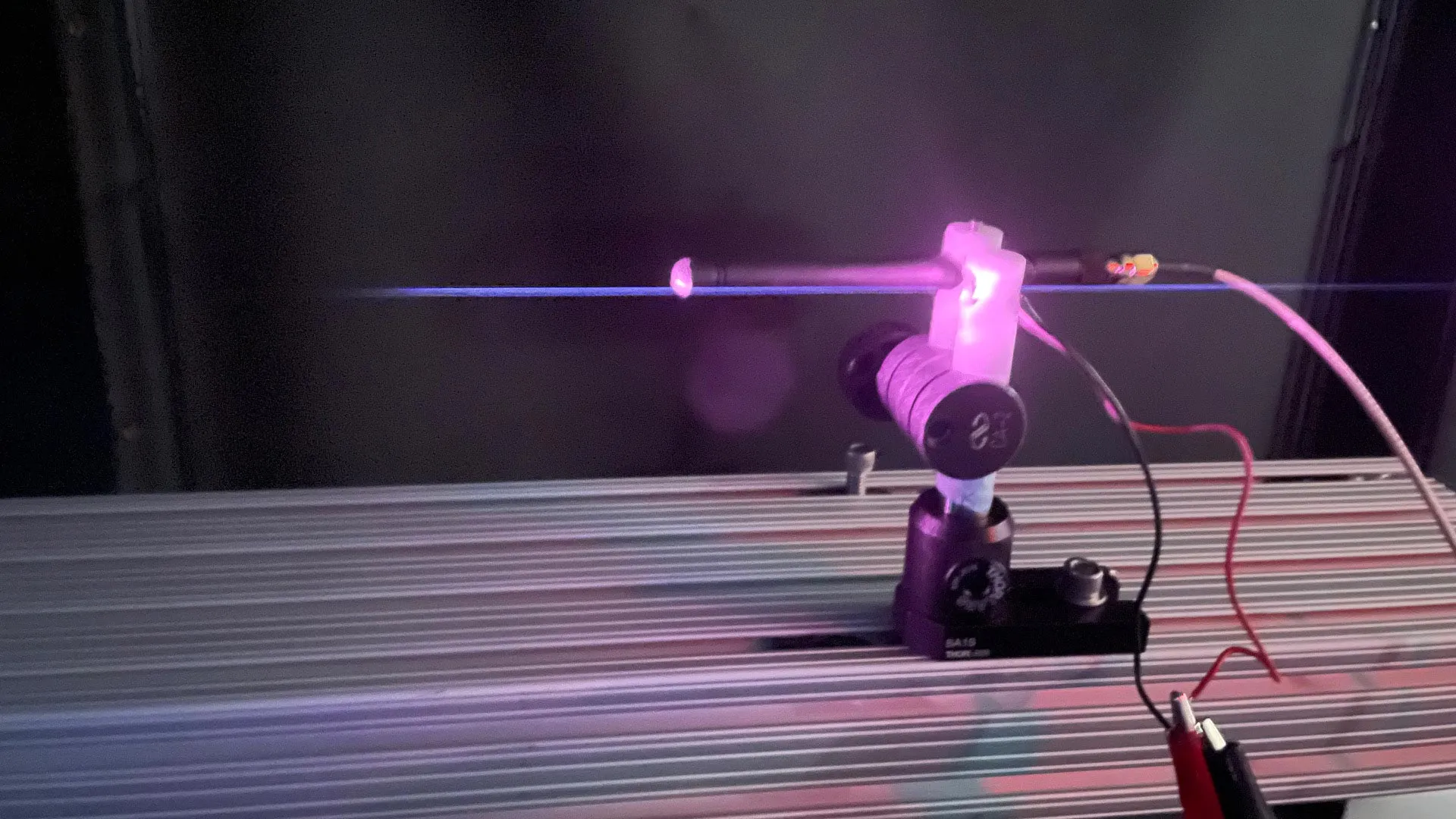
Researchers at North Carolina State University have unveiled a novel antenna design that utilizes a laser to generate a beam of plasma capable of transmitting radio waves. The device, which visually resembles a lightsaber, represents a departure from conventional metal antenna structures and could enable reconfigurable antenna systems that adapt to various frequencies and transmission needs.
Traditional antennas are constrained by fixed physical dimensions that determine their operating frequencies, requiring mechanical adjustments to change wavelengths. This limitation poses particular challenges for applications such as space exploration, where equipment must remain compact, lightweight, and reliable. The NC State team explored whether laser-generated plasma could provide an alternative approach by creating adjustable antennas directly in air rather than relying on physical metal structures.
The technology operates by directing a laser through the air with carefully controlled power and beam diameter to ionize a narrow region, stripping electrons from atoms and molecules to produce plasma. This concentrated plasma channel, called a plasma filament, forms the antenna’s foundation. To transmit radio waves, the researchers developed a contactless antenna feed using a metal ring that functions as a capacitor, allowing energy transfer to the plasma without physical contact. When a radio frequency generator sends a signal through the capacitor, the resulting electromagnetic field interacts with the plasma filament to transmit radio waves. The team successfully demonstrated transmission at 30 megahertz within the very high frequency radio band.
A significant advantage of the plasma antenna is its adjustability. By modifying laser parameters, researchers can control the filament’s length to accommodate different frequencies. Additionally, laser beam steering could allow directional control of the antenna without mechanical components, potentially enabling radar targeting or signal optimization. Conventional antennas typically require moving parts to achieve such adjustments.
While transmission capabilities have been demonstrated, reception testing and broad frequency range operation remain areas for further investigation. The researchers envision potential applications in satellites and spacecraft, where the technology could reduce mechanical complexity and weight constraints associated with traditional deployable antenna systems.
Article Attribution | Read More at Article Source
Article summary produced by Claude AI