

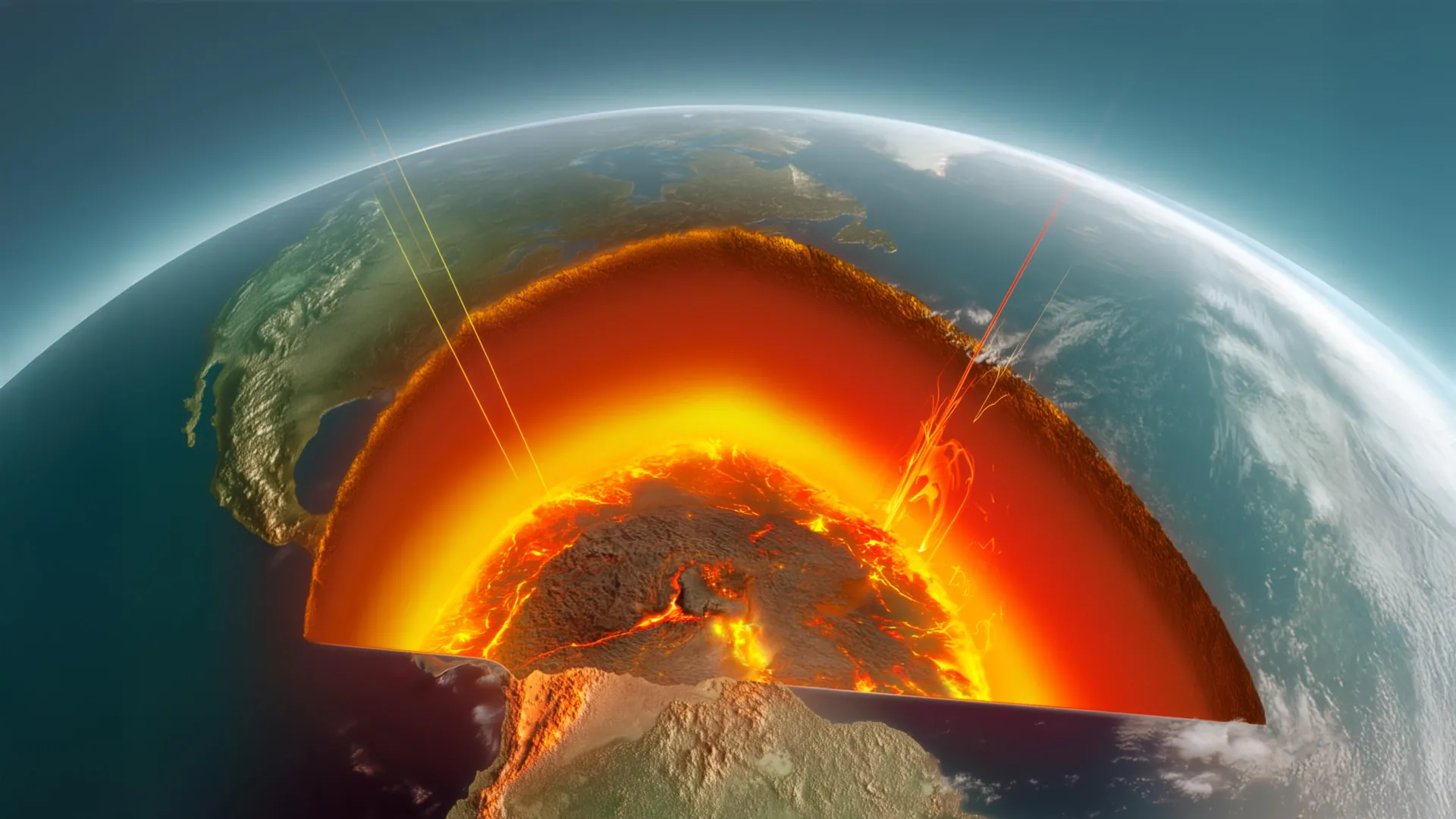
Researchers have found that magma can retain significantly more oxygen than traditionally assumed, challenging long-standing geological models. The discovery was made by an international team led by Dr. Yanhao Lin and Dr. Ho-kwang Mao of the Center for High Pressure Science and Technology Advanced Research, along with collaborators from Northwestern Polytechnical University and Vrije Universiteit Amsterdam. Their results were published in National Science Review.
The research employed high-pressure laboratory experiments and advanced computer simulations to investigate oxygen storage in molten silicate rock. Scientists recreated conditions found deep within Earth using specialized equipment capable of generating pressures up to 7 gigapascals—approximately 69,000 times atmospheric pressure—and temperatures between 1200 and 1800 degrees Celsius. Using synthetic mid-ocean ridge basalt samples, they discovered that at extreme pressures, molten rock can contain excess oxygen accounting for more than 5% of sample weight, compared to virtually none at atmospheric pressure.
Analysis using Raman spectroscopy confirmed that the additional oxygen became integrated into the glass structure rather than existing as trapped gas bubbles. Computer simulations employing deep neural network models demonstrated that oxygen dissolves into molten material until reaching equilibrium, with solubility increasing as pressure rises. This pattern mirrors the behavior of volatile components such as water and carbon dioxide, suggesting oxygen should be recognized as an independent component of silicate melts rather than considered solely in relation to other chemical elements.
The findings propose a previously unrecognized connection between Earth’s deep interior and the development of the planet’s atmosphere. The researchers suggest that magma generated in oxidized regions of Earth’s mantle could have absorbed substantial quantities of excess oxygen under immense subsurface pressures, potentially transporting oxygen from the interior to the surface through volcanic activity billions of years ago, thereby contributing to atmospheric oxygenation.
Article Attribution | Read More at Article Source
Article summary produced by Claude AI