

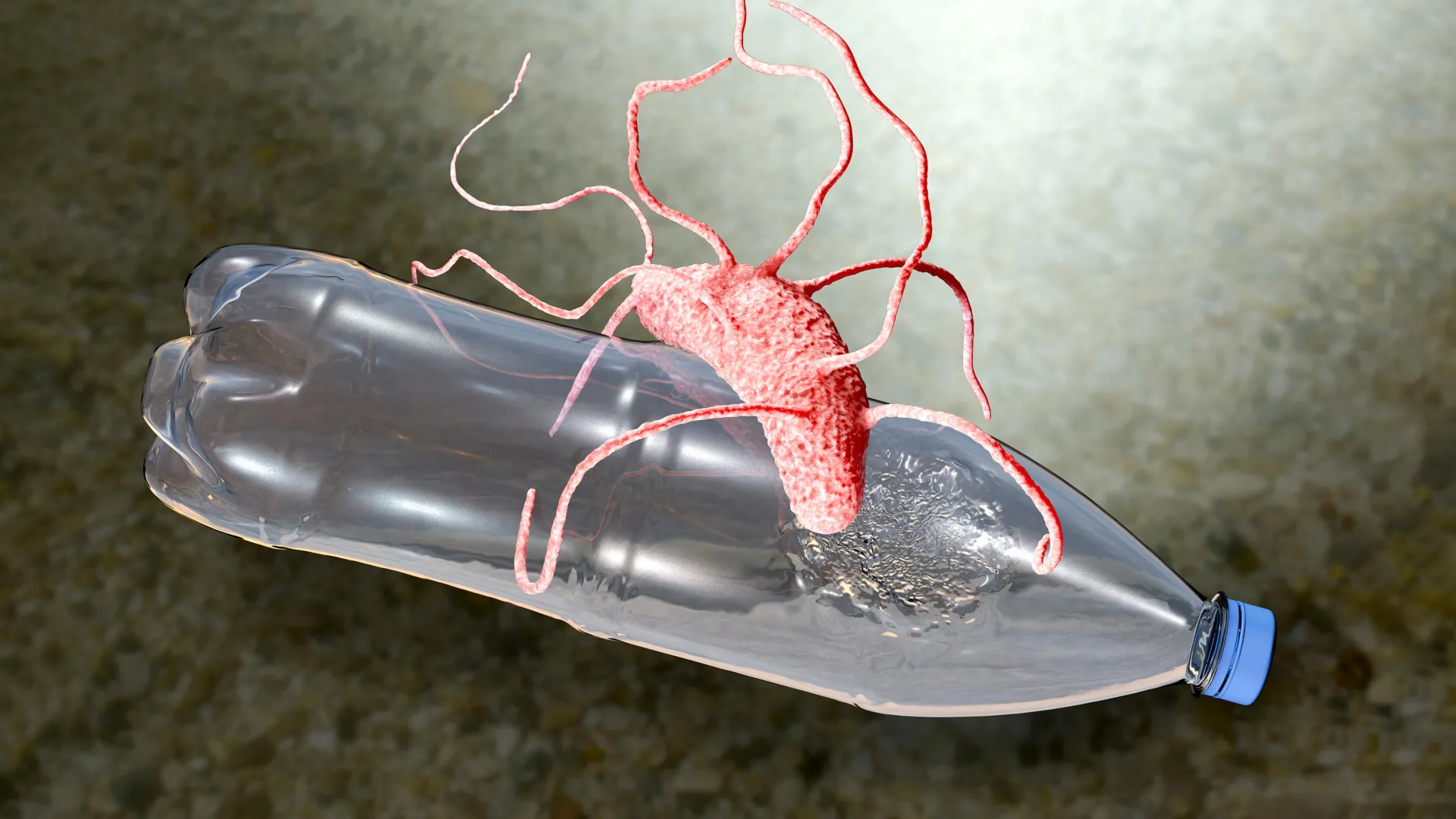
Researchers at the University of Konstanz have identified an unusual enzyme capable of digesting certain types of biodegradable plastics and polyesters. The enzyme has been colloquially named the “Pac-Man enzyme” due to its distinctive molecular structure, which features a notably wide opening where chemical reactions occur. The discovery indicates that some bacteria may be evolving the ability to break down specific plastic materials more rapidly than scientists had previously understood. However, the research also revealed an unexpected characteristic: the enzyme can additionally break down penicillin, suggesting a potential relationship to antibiotic resistance mechanisms in bacteria.
To investigate how microorganisms decompose biodegradable plastics, biologists Harry Lerner and David Schleheck from the University of Konstanz conducted comprehensive studies examining the entire microbial decomposition process. Their work focused on long-chain aliphatic polyesters, a class of biodegradable materials that contain chemical bonds susceptible to microbial breakdown. The team analyzed microbial community composition and genetic information to identify enzymes capable of breaking apart plastic polymers. In a field experiment, they buried samples in forest soil at the university’s botanical garden, selecting this environment because its microorganisms already possess biological mechanisms for breaking down complex natural materials.
Laboratory tests using soil from the same forest revealed significant results. The researchers mixed powdered bioplastics into soil samples and monitored microbial activity over an entire year, tracking carbon dioxide production as an indicator of microbial metabolism. All biodegradable plastic materials tested were completely degraded within approximately 250 to 330 days, while conventional high-density polyethylene showed virtually no decomposition. This stark contrast underscores the importance of polymer chemistry in determining degradation rates.
Examination of plastic films retrieved from the forest revealed unexpected microscopic structures. Using electron microscopy, scientists observed numerous tiny holes matching the dimensions of individual bacterial cells. This pattern suggested bacteria were not merely adhering to the plastic surface but rather penetrating the material itself. The researchers hypothesized that bacteria possess plastic-depolymerizing enzymes anchored to their cell surfaces, enabling them to digest into the material directly. This mechanism would allow microorganisms to break down plastic while remaining embedded within the film. The findings were published in The ISME Journal.
Article Attribution | Read More at Article Source
Article summary produced by Claude AI