

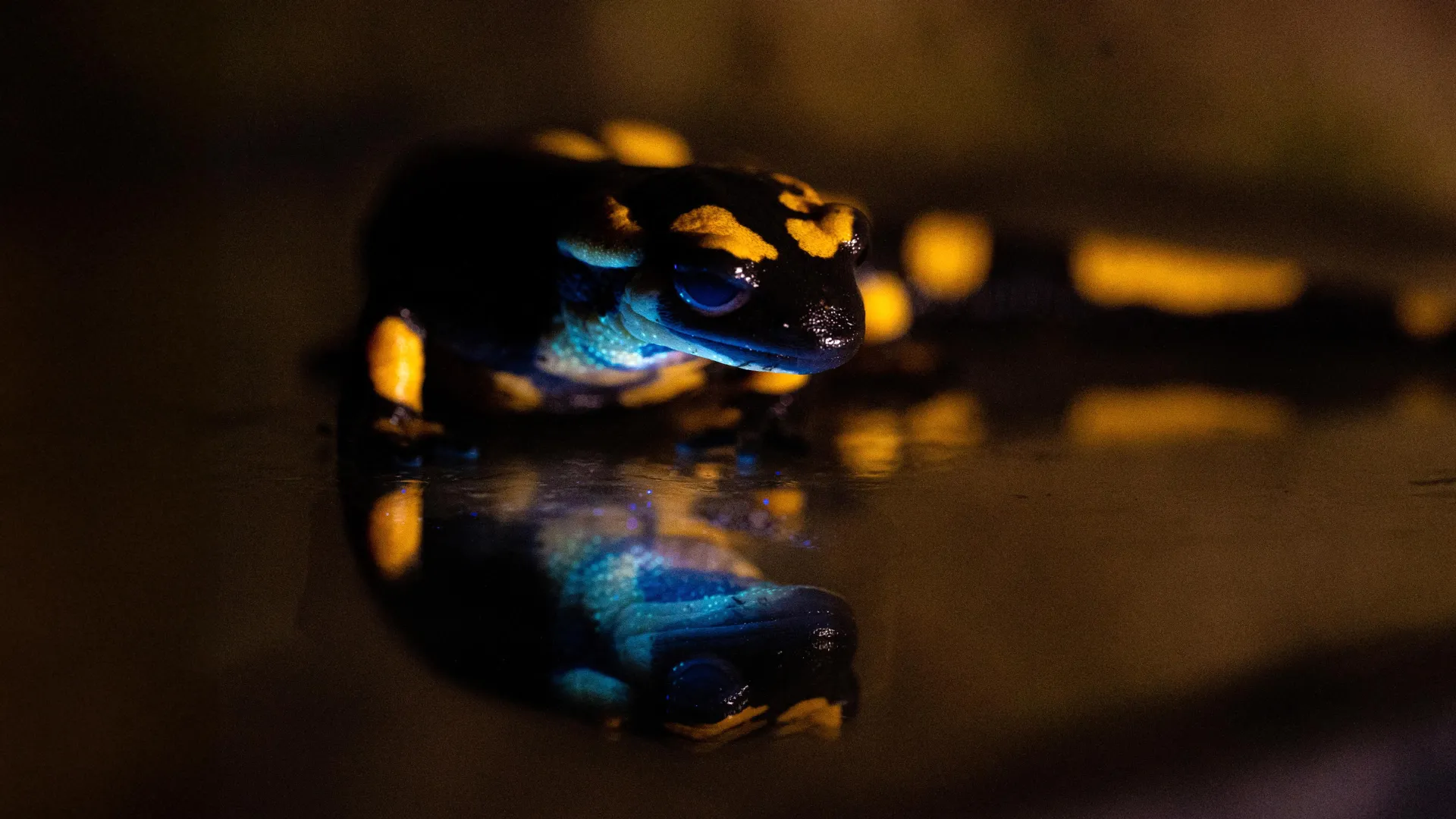
Researchers studying fire salamanders, a well-known European amphibian species classified as vulnerable by conservation authorities, have identified a previously undocumented ability. The animals exhibit fluorescence when exposed to ultraviolet light, producing visible green and cyan glows primarily on their yellow undersides and along their flanks. The fluorescent property originates from glands in the salamanders’ skin and their secretions, which can maintain their luminescent characteristics for more than 24 hours after leaving the animal’s body.
The fluorescence occurs through a process known as biofluorescence, in which compounds in the salamander’s skin absorb ultraviolet radiation and reemit that energy as visible light. This mechanism differs from bioluminescence, where organisms generate their own light through chemical reactions. Historically, scientists believed biofluorescence was primarily a marine phenomenon, but recent investigations have expanded understanding of this trait across various terrestrial species including reptiles, birds, and amphibians.
While researchers have confirmed the presence of fluorescence in fire salamanders, the biological function of this ability remains unestablished. Scientists propose several possibilities, including that the glow facilitates communication between individuals or helps potential mates identify one another. An alternative theory suggests the fluorescence enhances the salamanders’ warning coloration, making them more conspicuous to predators. The nocturnal forest environments where fire salamanders inhabit receive moonlight containing higher proportions of ultraviolet wavelengths than daylight, potentially allowing other salamanders to detect faint green and cyan highlights against yellow markings.
A significant remaining mystery involves the chemical compound responsible for the fluorescence. Despite decades of chemical study of salamander skin secretions, researchers have not previously identified this substance and believe it may represent a molecule previously unknown in the species. The research team, including scientists from multiple institutions, is now working to identify and characterize the responsible compound. Determining the chemical basis of the fluorescence could provide insights into its origin and whether it plays a functional role in salamander behavior or survival, information that may also contribute to ongoing amphibian conservation efforts.
Article Attribution | Read More at Article Source
Article summary produced by Claude AI