

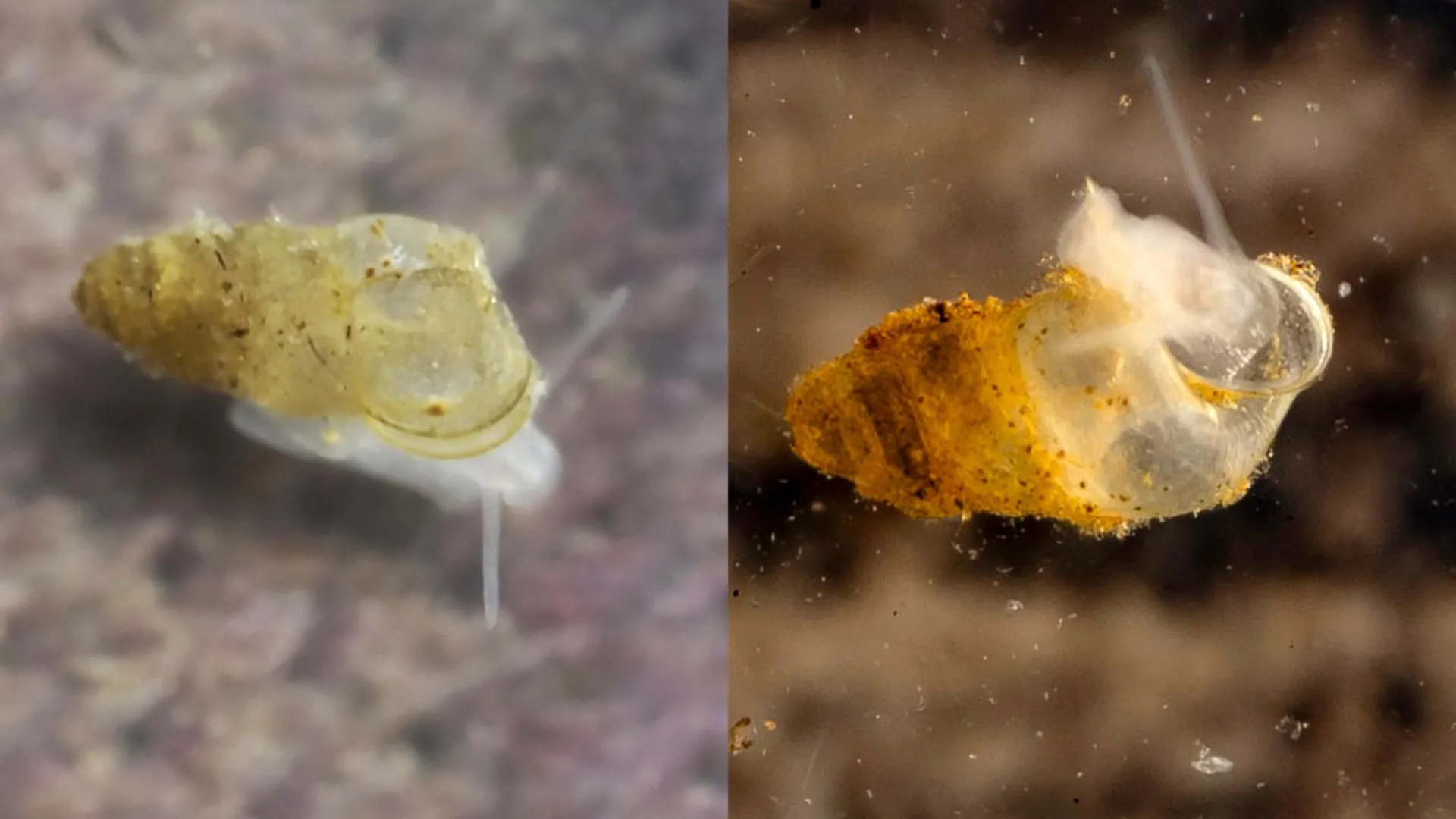
Researchers have documented Erhaia dijiang, a previously unknown freshwater cave snail species discovered in China and published in the journal Subterranean Biology. The discovery marks the first documented freshwater cave snail in China, addressing a significant gap in scientific understanding of the country’s subterranean freshwater mollusk fauna.
The species exhibits distinctive adaptations to subterranean life. The creature possesses no functional eyes, with vision structures having completely degenerated over evolutionary time. Its morphology includes a cone-shaped, nearly transparent shell, a depigmented body, and elongated slender tentacles. Researchers named the species after “Di Jiang,” a faceless deity from the ancient Chinese text Classic of Mountains and Seas, due to the snail’s extreme light sensitivity—laboratory studies showed specimens consistently retreating to dark areas when exposed to illumination.
The specimen was recovered at 2,062 meters elevation, establishing a new altitude record for cave snails within the Erhaiidae family and demonstrating that such species can inhabit limestone cave systems above 2,000 meters. Within its natural habitat, the snail inhabits submerged gravel and rocky substrates in water approximately one meter deep, where temperatures remain relatively stable near 20°C. Feeding observations indicate the species consumes diatoms and other microalgae from rock surfaces.
Conservation prospects appear concerning. During a field investigation in August 2025, researchers located only three living adult specimens and one empty shell within the confined cave environment, with no juveniles observed. The extremely limited population size and lack of reproduction evidence suggest vulnerability to environmental changes. Scientists emphasize the necessity for expanded systematic surveys of Chinese cave ecosystems to identify additional species and establish protective measures for these specialized organisms inhabiting highly restricted environments.
Article Attribution | Read More at Article Source
Article summary produced by Claude AI