

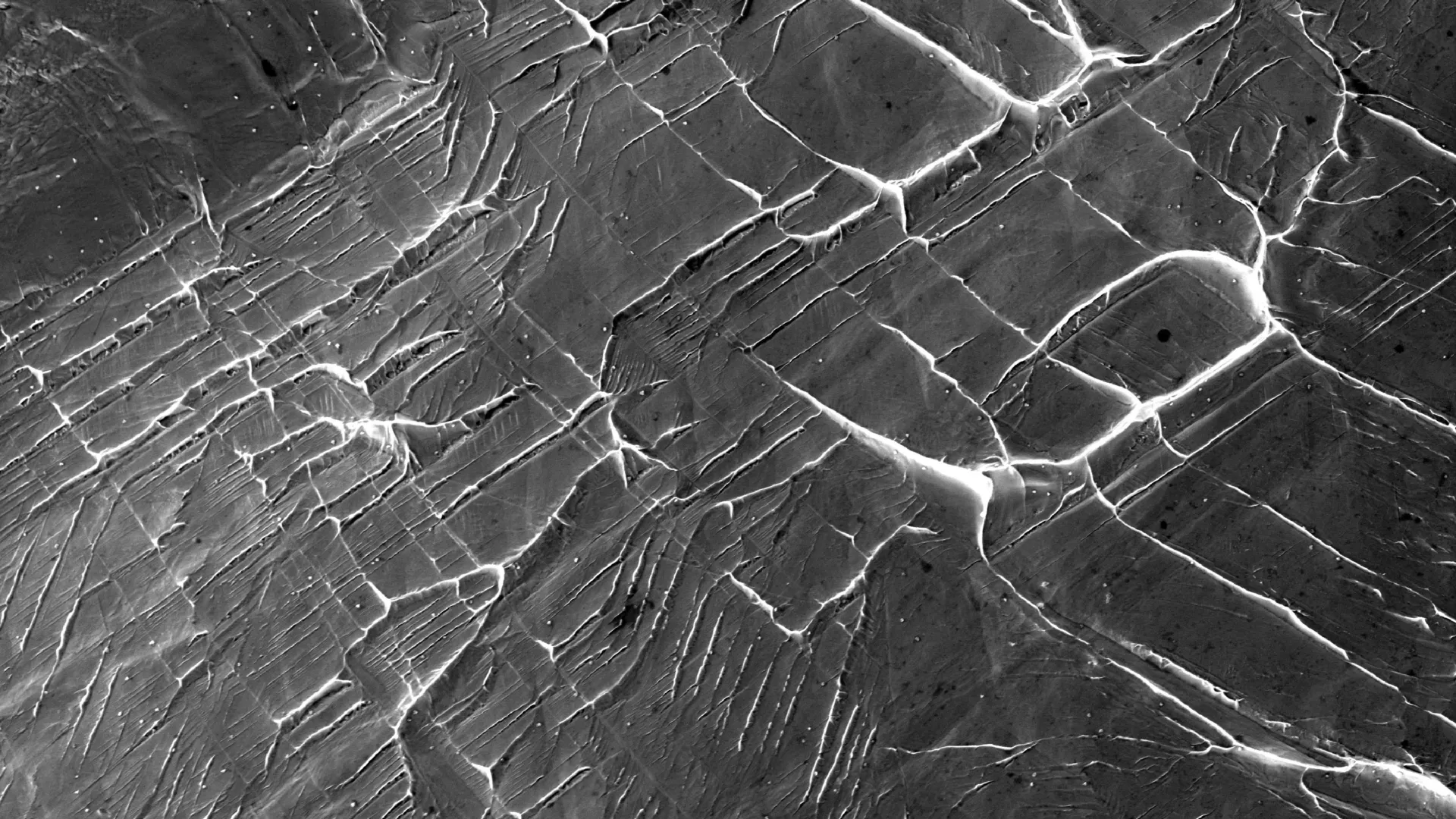
An international research team has identified a previously unknown microscopic mechanism that allows two experimental metal alloys to resist brittle failure at extraordinarily low temperatures. The findings, published October 14 in Nature, demonstrate that niobium and titanium-based alloys maintain remarkable damage tolerance when cooled to 20 kelvin, or -253°C. The discovery was made by researchers from the University of California, Berkeley, Lawrence Berkeley National Laboratory, and the University of Oxford.
Conventional understanding holds that many metals, particularly body-centered cubic metals such as iron, tungsten, and chromium, become increasingly brittle as temperatures approach absolute zero. Their atomic arrangement makes them vulnerable to crack propagation in extreme cold, as the usual mechanisms that allow metals to deform and absorb stress become less effective. However, the newly studied alloys behave differently, maintaining the ability to withstand damage even at the lowest temperatures tested.
The researchers identified the mechanism responsible for this unusual resilience through detailed microscopic analysis. Rather than relying solely on traditional dislocation movement, the alloys activate a process called nanoscale twinning, in which sections of crystal structure rearrange into mirror-image patterns alongside localized structural changes. When these newly formed regions meet crystal boundaries, they generate concentrated stress areas that produce additional defects, creating alternative pathways for the material to deform rather than fracture.
To conduct their investigation, the team used the Engin-X instrument at the ISIS Neutron and Muon Source in Oxfordshire, cooling samples with helium gas while stretching them and measuring their mechanical properties through neutron beam analysis. Subsequent examination with electron microscopes and atom-probe analysis revealed the microscopic structural changes responsible for the alloys’ exceptional performance.
The findings suggest a new design approach for structural metals intended for use in extreme cryogenic environments, with potential applications in energy systems, aerospace, and transportation. The research indicates that generating new defects at material interfaces may be as important as dislocation mobility in determining whether metals undergo brittle failure at low temperatures.
Article Attribution | Read More at Article Source
Article summary produced by Claude AI