

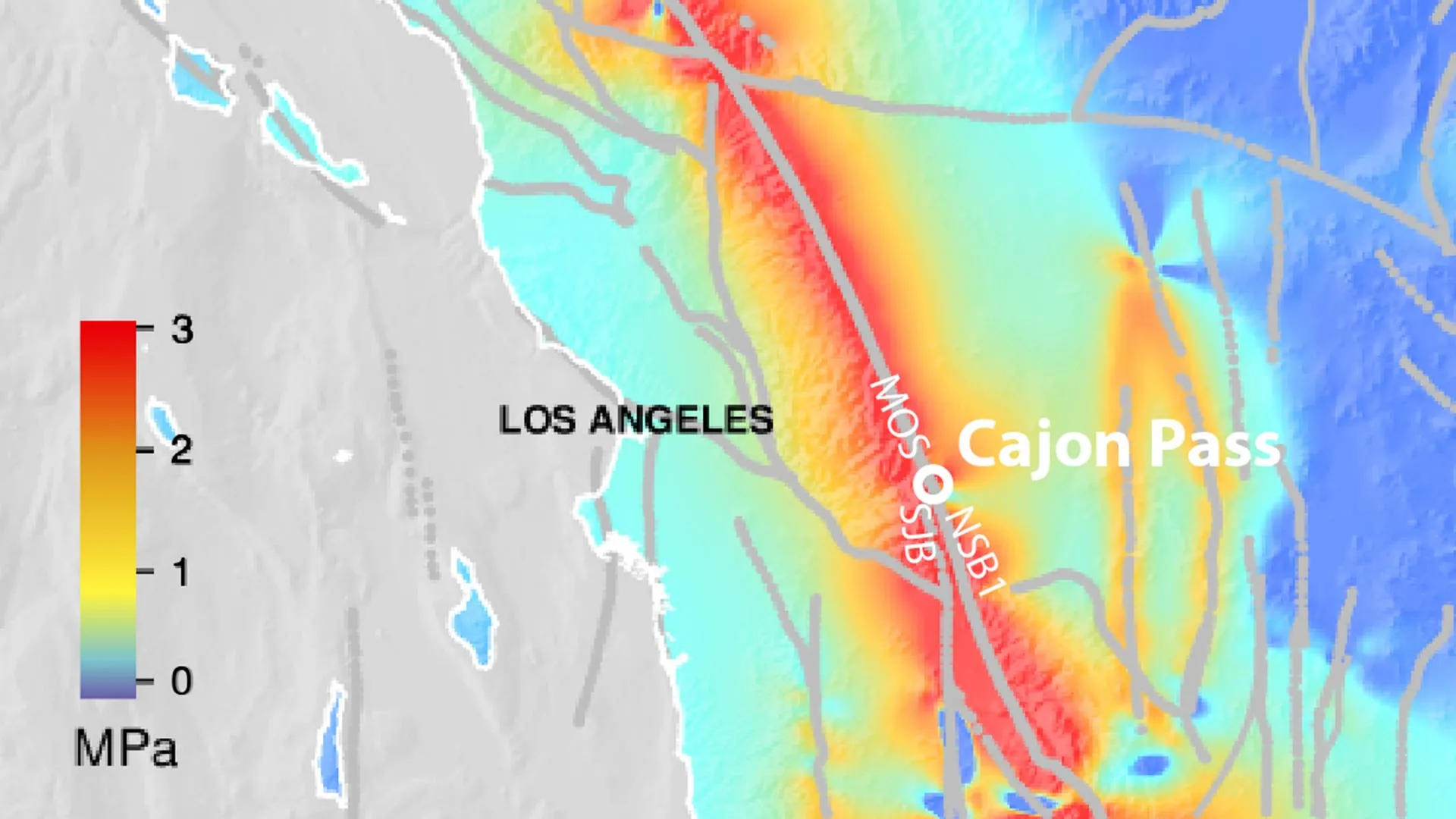
A new study led by researchers from the University of Bern and an international team has examined stress patterns along two major fault systems in Southern California over a 1,000-year timeframe. The San Andreas and San Jacinto faults, which together accommodate much of the tectonic motion in the region, come into close proximity at Cajon Pass, a geological junction located northeast of Los Angeles. The research, published in Journal of Geophysical Research: Solid Earth, involved scientists from the University of Hawaiʻi at Mānoa, the U.S. Geological Survey Earthquake Science Center in Pasadena, and the Scripps Institution of Oceanography at UC San Diego.
The investigators developed a physics-based four-dimensional model that simulated earthquake activity across three spatial dimensions while tracking changes through time. The team incorporated a 1,000-year record of past earthquakes derived from radiocarbon dating, tree ring analysis, and historical accounts of ground ruptures. The model tracked how individual earthquakes altered stress on neighboring fault segments, stress accumulation during quiet intervals, and deep crustal relaxation following large events. Results indicate that tectonic stresses in parts of the system have reached and in some locations exceeded the highest values observed anywhere in the 1,000-year simulation.
A central finding concerns the behavior of Cajon Pass, which the researchers characterize as an “earthquake gate.” This junction does not function as a simple barrier but rather responds to stress conditions that change over centuries. Historical evidence demonstrates both possibilities: the 1857 Fort Tejon earthquake stopped at Cajon Pass without continuing to the San Jacinto Fault, while the 1812 Wrightwood earthquake passed through the junction and ruptured both systems simultaneously.
Current modeling places stress on the San Jacinto-Bernardino section at 3.6 megapascals, higher than any value reached elsewhere during the simulation. The nearby Mojave South section of the San Andreas fault carries modeled stress of 2.8 megapascals. Both segments are experiencing unusually high and relatively similar stress levels, a configuration that resembles conditions preceding ruptures that crossed both fault systems in the historical record. A joint rupture could affect densely populated areas including greater Los Angeles, San Bernardino, Riverside, and the Coachella Valley, as well as the major transportation and infrastructure corridor at Cajon Pass itself.
Article Attribution | Read More at Article Source
Article summary produced by Claude AI