

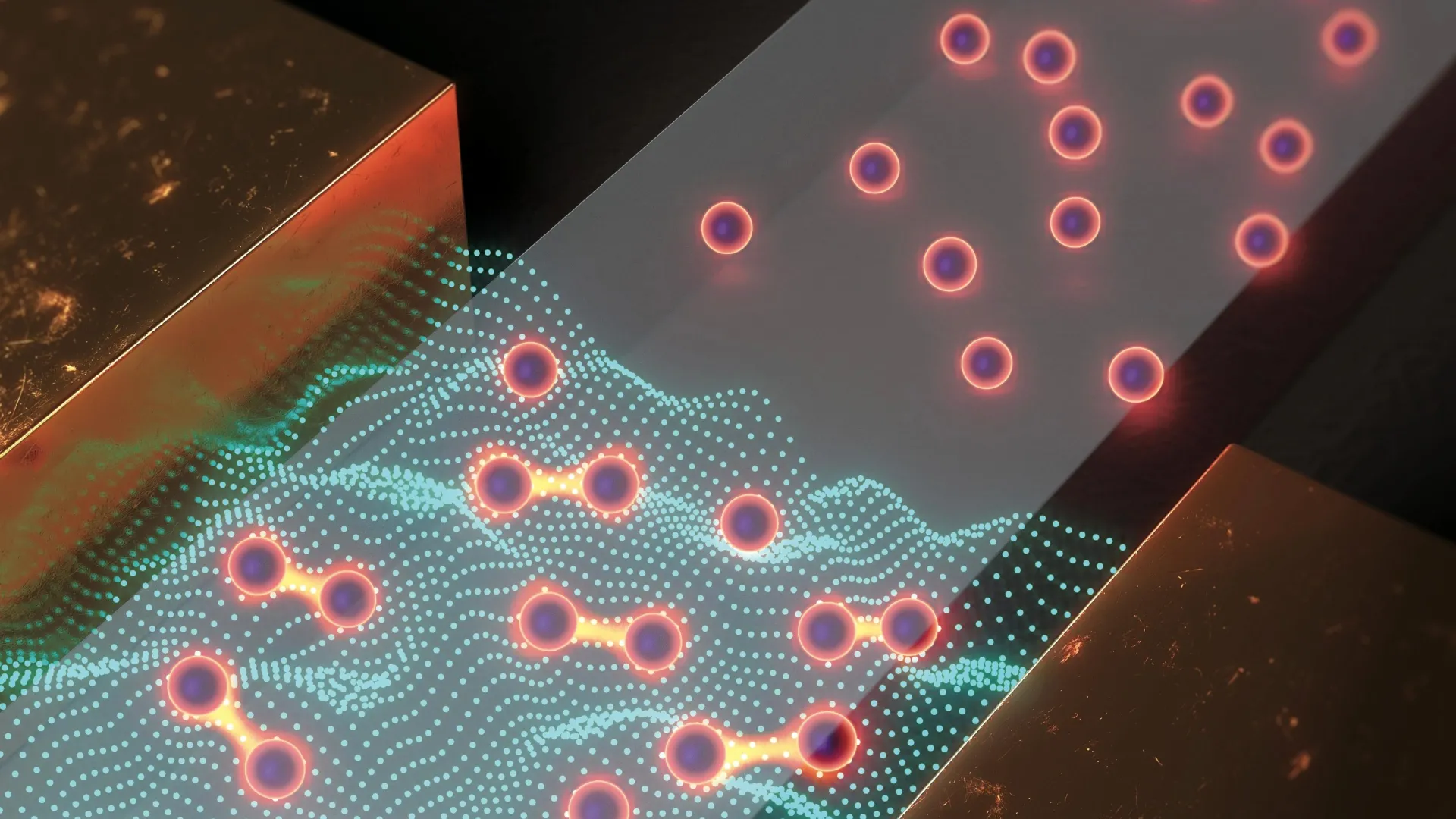
An international research team has shown experimentally that quantum fluctuations in a vacuum can enhance superconductivity, according to findings published in Nature. The collaboration involved researchers from the University of Science and Technology of China, Shanghai Jiao Tong University, and MIT, including Prof. Frank Wilczek.
Quantum physics reveals that what appears to be empty space is actually far more complex. According to quantum electrodynamics and the Heisenberg uncertainty principle, the lowest energy state continuously fluctuates as virtual particles appear and disappear. These quantum vacuum fluctuations are not merely theoretical constructs; their effects have been documented through phenomena such as the Lamb shift, spontaneous emission, and the Casimir effect.
The experimental approach involved placing the superconductor NbSe2 inside a terahertz dark cavity, which is designed to reshape the electromagnetic environment and amplify vacuum fluctuations. When the researchers compared the material’s superconducting properties inside and outside the cavity, they found that placement within the cavity increased the material’s critical temperature—the threshold below which it becomes superconducting—by up to 5.4% in a six-layer device. The critical current and critical magnetic field also showed significant enhancement near the superconducting transition.
To verify that conventional explanations accounted for the observed effects, the team conducted extensive control experiments by varying cavity geometry, frequency, material thickness, and other parameters. The results ruled out alternative mechanisms including material strain, degradation, and metallic screening. Notably, the superconductivity enhancement displayed a resonance-like peak at a particular cavity frequency, providing strong evidence that the effect resulted from coupling between the superconducting state and the cavity’s electromagnetic modes.
Theoreticians proposed that virtual photons exchanged between the superconducting state and the dark cavity lower the energy of the superconducting state, making superconductivity more stable. This work reframes the role of the quantum vacuum from a passive background to an active mechanism that can be engineered to influence matter’s behavior, potentially opening new pathways for controlling quantum materials without direct external energy input.
Article Attribution | Read More at Article Source
Article summary produced by Claude AI