

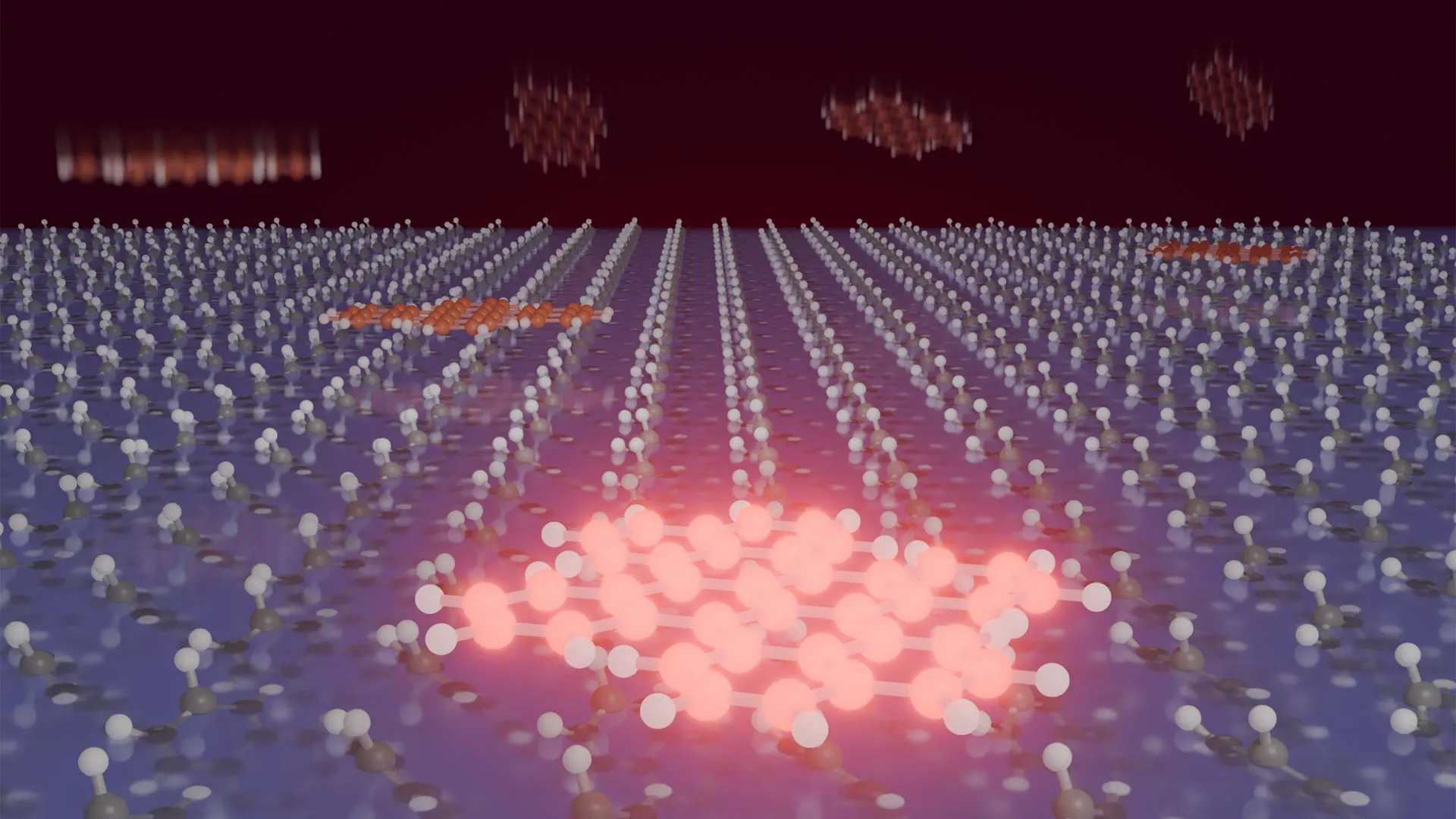
Researchers at the Max Planck Institute for the Science of Light have achieved a significant advancement in quantum physics by enabling individual molecules attached to a surface to reach the ultimate quantum limit of optical coherence. The findings, published in Science, represent the first time this fundamental limit has been demonstrated with molecules on a surface, potentially enabling new applications in quantum computing and secure communication.
Quantum emitters—individual atoms and molecules that interact with light—form the basis of emerging quantum technologies. These systems can produce single photons, store quantum information, and establish quantum connections between distant systems. Traditionally, researchers have maintained quantum emitters in vacuums or embedded them in solid materials to keep them stable. Placing quantum emitters directly on surfaces offers advantages, particularly the ability to manipulate individual molecules using atomic-scale probes like scanning tunneling microscopy and atomic force microscopy. However, surfaces typically accumulate environmental contaminants that disrupt the delicate quantum behavior of nearby molecules, preventing researchers from preserving the quantum optical properties of emitters on surfaces.
Scientists in the institute’s Nano-Optics Division, led by Prof. Vahid Sandoghdar, developed an innovative cleaning technique exploiting the natural sublimation of organic crystals. Researchers placed a crystal in a vacuum chamber cooled to extremely low temperatures, allowing the uppermost layers to evaporate gradually and carry away contaminants. After cooling the crystal to just a few degrees above absolute zero to halt further sublimation, they used a specially designed oven to deposit molecules onto the pristine surface.
The team evaluated whether molecules retained their quantum properties by measuring coherence times, which indicate how long quantum systems maintain their quantumness. They discovered that molecules on the exceptionally clean crystal surface consistently reached the Fourier limit—the theoretical maximum coherence duration determined by the time required for quantum emitters to release energy. This represents a fundamental threshold that surfaces normally cause coherence to exceed by hundreds or thousands of times in noisy environments.
Additional experiments revealed that crystal surfaces influence molecules by altering their alignment, energy levels, and potentially their shapes and vibration patterns. The researchers plan to integrate their ultra-clean surface method with advanced microscopy techniques to achieve nanometer-scale control over individual quantum emitters, potentially unlocking new details about molecular-surface interactions and enabling development of novel quantum technologies.
Article Attribution | Read More at Article Source
Article summary produced by Claude AI