

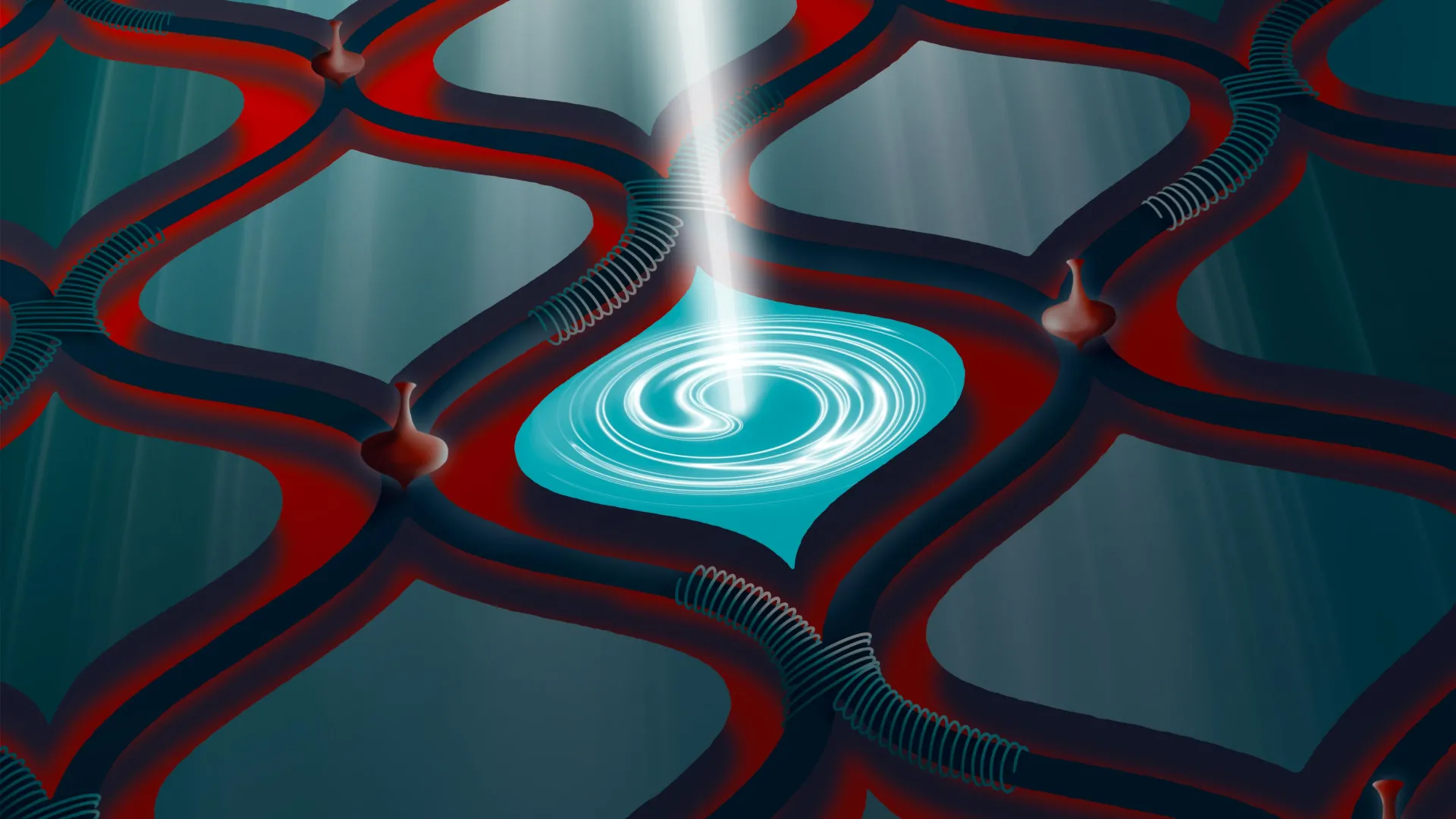
Scientists at the University of Oxford have successfully reproduced a counterintuitive quantum phenomenon using a hybrid quantum computing system. The experiment, detailed in Nature Physics, involved simulating how an invisible magnetic influence can completely stop a particle’s motion, even when the particle never passes through the magnetic field itself. This effect, known as the Aharonov-Bohm effect, was theoretically predicted in 1959 but has now been demonstrated in a more complex system than previous experiments.
The Aharonov-Bohm effect challenges everyday intuitions about how particles interact with fields. In classical physics, a charged particle only responds to forces it directly encounters. Quantum mechanics, however, reveals that particles can be influenced by fields in subtler ways. According to the 1959 prediction, a particle can experience changes in its quantum phase—an aspect of its wave behavior—based on magnetic flux nearby, even if the particle never enters the region containing that flux. While the phase change itself is invisible, its effects produce measurable consequences.
The Oxford team, led by Dr. Sebastian Saner and Dr. Oana Bazavan in collaboration with Dr. Alejandro Bermudez from Madrid, created their simulation using a hybrid quantum system combining two components: qubits encoded in trapped ions and quantum oscillators created by vibrations of those same ions. The researchers initially planned to introduce magnetic flux as a fixed background condition but discovered that encoding it as a dynamic component of the system provided both a practical advantage and the opportunity to explore a richer version of the phenomenon.
In their experiment, the researchers observed how a simulated particle could move between locations through quantum tunneling. Without magnetic flux, the particle tunneled freely. When flux was introduced, it altered the quantum phases of the two possible paths around a loop, causing them to interfere destructively and completely suppressing the particle’s motion. This demonstration confirmed the Aharonov-Bohm effect within a lattice gauge theory framework with a dynamical field, suggesting that hybrid quantum computers could help scientists investigate complex interactions that are difficult to simulate using conventional computing methods.
Article Attribution | Read More at Article Source
Article summary produced by Claude AI