

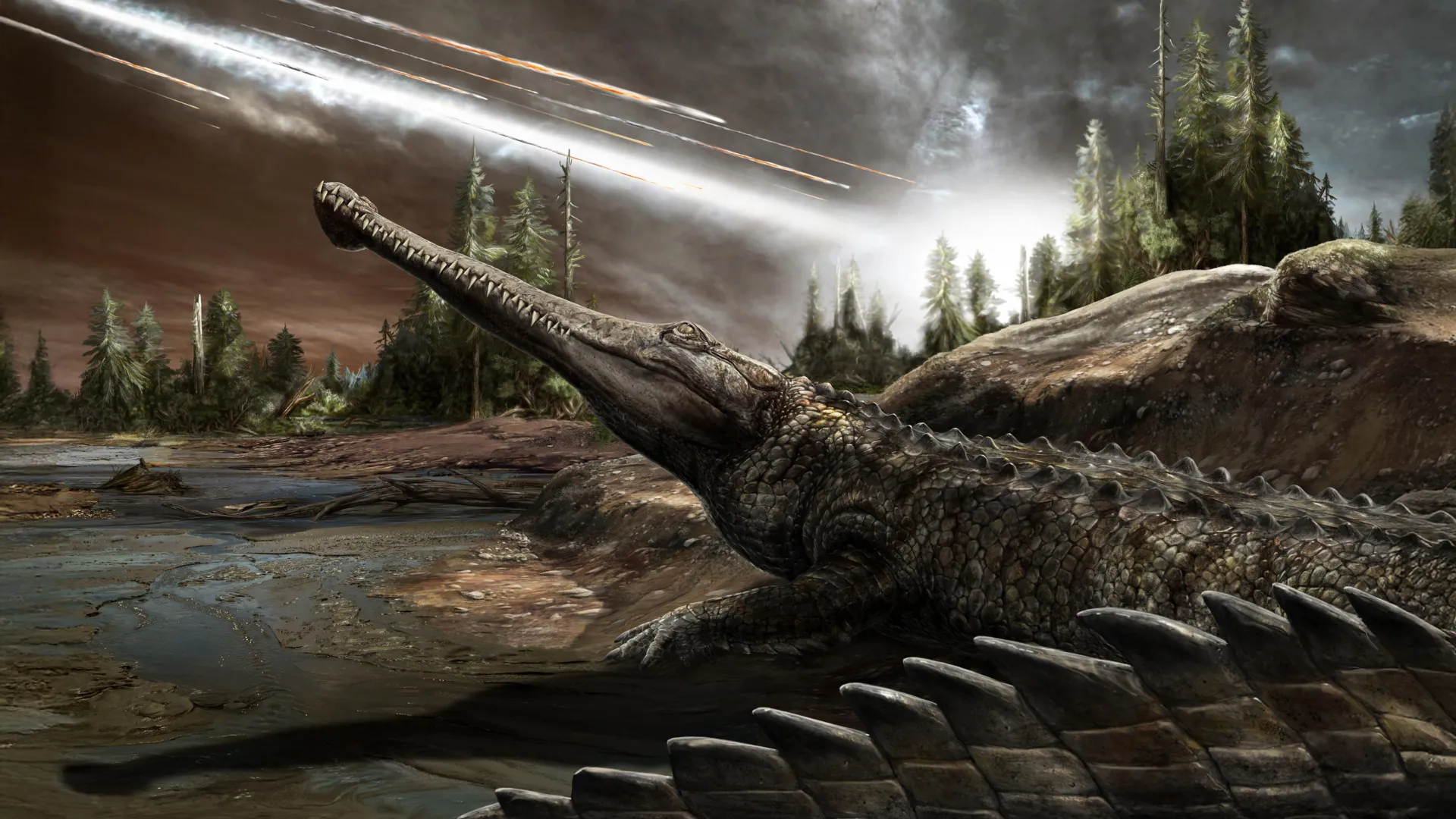
Scientists from University College London published findings in Science Advances examining why crocodiles survived the asteroid impact that eliminated most dinosaurs 66 million years ago. The research analyzed more than 7,000 fossils and records from over 400 living and extinct species, combined with computer climate models spanning 245 million years of Earth’s history.
The study reveals that crocodile ancestors consistently followed warm climates throughout their evolutionary history, expanding into new regions during warm periods and retreating toward tropical areas as temperatures cooled. When the asteroid struck, climate simulations indicated that tropical and subtropical regions near the equator remained warm enough to support crocodile populations, providing critical refuges as environments suitable for non-avian dinosaurs contracted severely. Lead researcher Dr. Alfio Alessandro Chiarenza noted that the asteroid did not make the entire planet equally hostile to all animal groups, and crocodiles’ long-standing preference for warm environments placed survivors exactly where suitable climates persisted best.
The broader crocodile lineage, known as pseudosuchians, displayed far greater diversity than modern crocodiles suggest. Ancient relatives included heavily armored herbivores, land-dwelling predators, and enormous animals such as Sarcosuchus, a “super croc” reaching 12 meters in length. Despite this extensive variation in body shapes, sizes, and lifestyles, what remained surprisingly consistent was the lineage’s relationship with climate preferences.
Researchers identified two notable exceptions to the warm-climate preference pattern. During the Cretaceous Thermal Maximum approximately 94 million years ago, one crocodile branch evolved tolerance for extremely high temperatures. Around 34 million years ago in Australia, an extinct crocodile group adapted to increasingly arid, desert-like conditions as the continent dried out. These adaptations demonstrate that while most crocodile relatives maintained their preference for warm conditions, some could evolve to handle different climates.
The researchers noted that favorable temperatures likely represented only one survival factor among several advantages. Other characteristics probably enhanced crocodile survival prospects, including relatively small body sizes, capacity to live partly in water, dietary flexibility, and modest energy requirements compared to larger dinosaurs.
Article Attribution | Read More at Article Source
Article summary produced by Claude AI